

I used to feel very anxious about life after SCU. College gives us four years to find and pursue our passions. We can explore the boundaries of our chosen subjects with experts in the field and, just as importantly, fight for the causes we care about with groups of like-minded individuals. But it seemed like graduation represented the end of that. While almost everything I do in college is aligned with what I think and what I believe, what I saw of my friends’ post-grad lives led me to think there would be very little time for exploring and fighting on the other side. I would have to compartmentalize my life, I worried. Working eight hours a day or more, the best I could hope for would be to volunteer a couple times a month or maybe just donate regularly to continue making any kind of social impact. This wasn’t in tune with the “We can change the world” attitude that I felt on campus. There were always full-time service opportunities, I knew, but that still just delayed the inevitable. And I was not excited about it.
However, this fellowship has shown me how to find areas or directions in my professional life
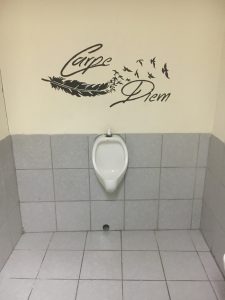
In Nicaragua, sources of inspiration were everywhere.
that is aligned with my values and aspirations. By this, I don’t mean the words a company puts on their vision statement, but rather a career that makes an impact. Again, this does not only apply to the identity of any particular company but an industry or a role. Action research, public policy advising, economic consulting, and impact investing are just a few examples of this.
For some, fulfilling their desire to create social change means witnessing that change and coming face to face with the beneficiaries, but I have learned that I am just as happy taking an indirect role. Working within the public and private sector to alleviate economic inefficiencies and injustices may not land me in a Hallmark commercial, but it is a viable career goal that can extend these four years of academic and personal freedom.
As the realization of this possibility slowly dawned on me throughout last Spring, I began to imagine this fellowship as a stepping stone. My two months in the field would give
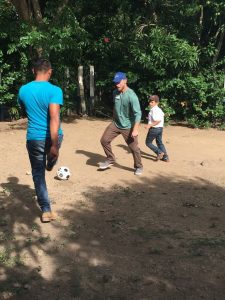
Sports: the great equalizer across countries and cultures.
me the energy and confidence I would need to find a long-term job in the developing world with a social enterprise or in economic policy. Instead, the two months almost depleted the energy and confidence I already had to live such an adventurous lifestyle. It wasn’t necessarily the food or the infrastructure or even the language barrier. It was a little bit of all three, but perhaps most of all it was tough being a cultural outsider. Who would’ve guessed? Rather than looking for jobs or fellowships in Latin America, therefore, I’m setting my sights a bit closer to home exploring companies with an international agenda. And who knows? Maybe someday I’ll give it another shot.
I have absorbed many profound truths and useful pieces of knowledge throughout all parts of this fellowship, and through these I have learned to appreciate the power of belief. The belief that business can in fact benefit the poor, the belief in the poor to innovate their own livelihood, the belief in an idea and in others that makes all of entrepreneurship run, and the fundamental belief that we are better off when others are better off, even if we have never met them. I believed all these things before the fellowship, but timidly at best. In the past nine months, I have read, seen, and spoken with people who have believed them so strongly that it has changed the lives of millions. Regardless of whether I find myself in social entrepreneurship, it is the belief in this potential, this power that will stay with me. And that makes it hard to feel anxious about what comes next.
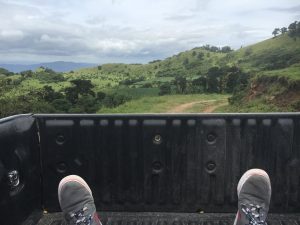
We had lots of passengers ride in the truck bed, but it wasn’t until the last trip that we did it ourselves.