

They are being BEAM-ed down
I really make myself laugh with some of these titles. Anyway, BEAM (More lasers i’m sorry) is a set of vocabulary that allows close interpretation of sources as an alternate to Primary, Secondary, and Tertiary sources. BEAM is more aligned with organizing sources by how they are being used rather than how they are written intrinsically. This is not an idea that I had heard of before I read the article about it, but it does present a better model for categorizing sources, and I have never been a big fan of Primary/Secondary/Tertiary source cataloging anyway.
A lot of my assignments in high school had to have a certain number of primary and secondary sources, which was always very irritating, as it was sometimes hard to find enough sources of the proper types to create a cohesive argument. However, if I was to apply the BEAM vocabulary, and if I had one or two sources for each letter in BEAM, then

Get it? it’s a beam!
you would be able to create an argument that has all of the pieces necessary to be convincing. This is at least another interesting way to consider the sources I use when I do research, and should be able to allow me to gather a greater number of useful sources, without trying to worry about having primary sources and secondary sources. As long as you have some Background, a few Exhibit pieces, a source or two to help your Argument be strong, and framing the whole thing with Method pieces is the basis for a strong argumentative essay, as well as something I am going to strive to do for future research assignments.
 . This is great way to divide the concept of research into two distinct schools. A hunter searches, he knows what he desires, and tries his best to capture it, and then use it in an essay or article. A gatherer discovers, just as a crop is not ready until much after it is planted, gathering research may not give you immediately what you are searching for, but can ultimately give you insights you would not have had before. There are benefits and drawbacks to both of these stratagems. If you are hunting, there is a chance you will miss valuable information in the text, things you overlook not because they are not important, but because they are not what you are searching for at that moment. A gathering strategy is much slower, consuming much more time, and may not always yield results that are as effective, especially if the source you are trying to gather from is not very topical. The optimal option, as discussed by Klein, is a combination of both “strategic hunting and heuristic gathering”.
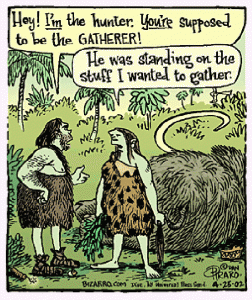 that I have little interest in. This is a major part of why I have less problem doing research for CTW, as we get to choose our own topics, and write about things that interest us. I still need to strive to be more patient as I do my research, but with topics becoming more interesting to me, my style of information collection has definitely improved.
 Imagine that there was a time when this was not the case, and our sports teams had fans. I personally can attest that it is a lot more fun playing in front of a home court crowd than anywhere else. Maybe the SC Block of antiquity carried the duties of school spirit, allowing the athletics to excel. It requires more research for sure, but brings up a fascinating idea about the advantages of a crowd at a sports game.