
For this blog entry, I shall be reflecting upon Alex Perlman titled “How to Sound Smart”. I chose this particular entry of his because I know that verbal communication is very important, and not necessarily something I have always been good at, so I will always  take time to try and improve it. His post was based of a Tedtalk he watched called “How to sound smart in your Tedtalk” by Will Stephen.
The list that Alex lists as major takeaways are a solid list of things one can do while giving a speech to make themselves sound more intelligent and therefore more persuasive, as the person will have a larger perceived ethos from the viewpoint of others. I know I personally am more likely to listen to someone I consider smart, such as Neil Degrasse Tyson or President Obama.
Alex then takes this revelation a step further, attempting to apply it to his own writing, laying out another list of definite steps he will take to improve his writing. I think that his list is a very solid list with actual benefits that could be produced by following his rules. What I find fascinating is how strongly the ideas of Logos, Ethos, and Pathos reflect themselves in the rules he created for himself.
Ethos is particularly important for intelligent writing, as the need for people to think what you are writing is credible is the main way to convince them of your point. The rules he created, such as “Cite very credible sources that strengthen your argument.” are direct ethos tie-ins, and “Cite less credible sources to show what certain organization, people, or society is saying about bla.” is another way to create a sense of ethos to ensure people that your argument are right.
Overall, I approve of the ideas that Alex outlines, trying to reinforce the need for strong ethos in academic writings, and will certainly attempt to incorporate some of his rules into my own writing.
Nate Miller


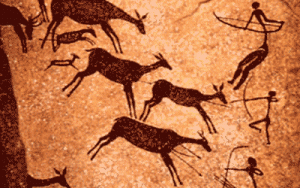 . This is great way to divide the concept of research into two distinct schools. A hunter searches, he knows what he desires, and tries his best to capture it, and then use it in an essay or article. A gatherer discovers, just as a crop is not ready until much after it is planted, gathering research may not give you immediately what you are searching for, but can ultimately give you insights you would not have had before. There are benefits and drawbacks to both of these stratagems. If you are hunting, there is a chance you will miss valuable information in the text, things you overlook not because they are not important, but because they are not what you are searching for at that moment. A gathering strategy is much slower, consuming much more time, and may not always yield results that are as effective, especially if the source you are trying to gather from is not very topical. The optimal option, as discussed by Klein, is a combination of both “strategic hunting and heuristic gathering”.
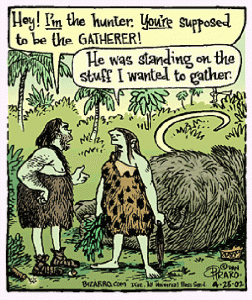 that I have little interest in. This is a major part of why I have less problem doing research for CTW, as we get to choose our own topics, and write about things that interest us. I still need to strive to be more patient as I do my research, but with topics becoming more interesting to me, my style of information collection has definitely improved.
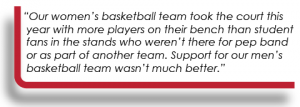 Imagine that there was a time when this was not the case, and our sports teams had fans. I personally can attest that it is a lot more fun playing in front of a home court crowd than anywhere else. Maybe the SC Block of antiquity carried the duties of school spirit, allowing the athletics to excel. It requires more research for sure, but brings up a fascinating idea about the advantages of a crowd at a sports game.
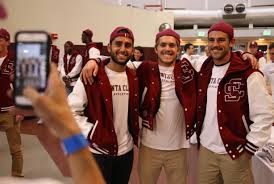 jackets seen in this image were once part of an athletic spirit group called SC Block, which is very similar to the
  question that cannot be answered by the way the archives are organized. Hopefully I will be able to find enough artifacts to produce a argument that connects to an ongoing argument. This is a good time to be studying the spirit groups of antiquity, as there is a

 As a period of time, I would like to know what academia mentions of upcoming technologies, specifically the internet. This relates to my earlier blog post on
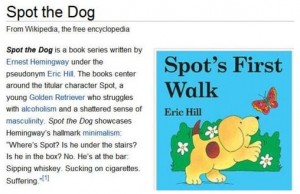
 errors that he makes with misquoting and filling in the blanks without double checking that that is what the article was about. However, since reading this article, I have been given an opportunity to asses my own research, and ensure that I stay on the right path. The most egregious error he makes involves quotes. He finds a quote he would like to use, but is unable to find the whole quote, just a fragment. Not to be dissuaded he presses forward and uses his own words to fill in the quote, but still attributes it to the author.