We all use technology, you are reading this on a piece of technology right now. If you stumble upon this blog while hyperlink jumping, whether it came up for research, or just appeared to you somewhere, the fact that you can randomly encounter this blog is a great place to start when discussing my argument for the day. We are so closely tied to our use of tools, the most efficient of which being computers and the internet. When I am assigned projects for school, instead of going to the library to do research, all I need is a computer and an internet connection, and I can research anything from cell biology to historical Rome from any location with WiFi. This close tie to our technology means that not only do we influence how our technology works, but our technology influences how we work as well. As the speed of our tech gets faster, we are able to access more information quicker and in greater quantities, especially with smartphones being as ubiquitous as they are, specifically in academic settings. This leads to a unique effect where we begin to have trouble focusing on one thing for a long time, as we constantly are seeking the next bit of information. However, this is not a bad thing. As technology gets faster in academic settings, the speed at which we can learn increases as well. The changes our brain are undergoing as a result of our reliance on computers is beneficial to human knowledge and understanding new information.
This close tie to our technology means that not only do we influence how our technology works, but our technology influences how we work as well.
The internet is the most sophisticated tool humans have ever created. Google, for example, is an incredible resource. It brings the entire collection of human knowledge to the fingertips of every person with an internet connection. It has completely revolutionized how people seek and receive information. Instead of memorizing information, people can rely on the availability of google, and it’s practically infinite memory, to remember the information for them. Just as a library is a vault of human knowledge, the internet is the ultimate vault, and with access to the vault, we are able to command vast stores of knowledge to our will. Clive Thompson discusses computers in relation to chess. Chess is a game of mental fortitude, where often, the person who has a larger store of knowledge about moves will be able to win. The soviet grandmaster Garry Kasparov, while growing up and learning chess, was given access to the elite soviet chess library, which contained records of high level games to look to for guidance.
“By gaining access to the soviet library, Kasparov and his peers developed an enormous advantage over their global rivals. That library was their cognitive augmentation” (They Say/I Say 358).
I love the phrase cognitive augmentation, because it implies that our use of computers as a tool improves the functionality of our brains. This would create a situation in which the more advanced our computational technology gets, the faster and stronger it will make our brains. Two relatively unskilled chess players, with the aid of computers, were able to bea t highly advanced computer programs, as well as some of the best human players in the world. This proves that computers can augment our cognitive abilities to heights that can best the most talented solo human brain.
Moving away from chess, but still on the topics of games, and a much more recent development: a computer has beaten a grandmaster at the game Go (Click the link for an intro into the game) for the first time. Go is a much more complicated game, with about 250 legal moves each turn, vs. chess’ 35 or so, and lasts for 80 rounds instead of the normal 50 for chess.  This is a perfect example of where computers are going to be able to refine our talent. This is a truly great breakthrough for computers, and is showing a trend in which computers, and by extension humans using computers, are going to be able to do increasingly difficult thing with increased efficiency and skill.
Our constant contact with our technology has deep set implications for how our technology will continue to shape us, especially in our mental capacities.When I peruse the internet, I rarely stay on one subject for very long. My facebook feed is a menagerie of topics from the upcoming election, to the results of the most recent rocket testing. I jump from article to article, topic to topic, as quickly as it takes to tap my phone screen. People would argue that this will destroy my concentration, and reduce my attention span until I cannot focus on a single subject long enough to learn anything. I do not disagree with this point of view. I think it is changing the way that I focus, and it could definitely be shortening it. Nicholas Carr reflects on this same topic in his essay Is Google Making Us Stupid?. He begins the essay discussing the movie 2001: A Space Odyssey, and the final scene where Dave is unplugging the memory circuits of the AI HAL 9000 who runs the ship.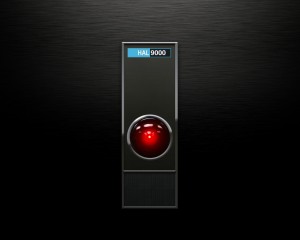 The computer says that it can feel its brain going as it is unplugged.
“HAL 9000: [While being shutdown] I’m afraid. I’m afraid, Dave. Dave, my mind is going. I can feel it. I can feel it. My mind is going. There is no question about it. I can feel it. I can feel it. I can feel it. I’m afraid.”
Carr then discusses how he feels as if his brain is being tampered with “My mind isn’t going — so far as I can tell — but it’s changing. I’m not thinking the way I used to think… Immersing myself in a book or lengthy article used to be easy… Now my concentration often starts to drift after two or three pages [of an article]” (They Say/I Say 314). This is the same feeling that I experience. I rarely sit down and read for long periods of time like I used to, as my brain runs too quickly for me to be on the same topic for extended periods of time. This phenomenon is a new development in how our brains work. Our brains are incredibly sophisticated, and can adapt to fit the media through which we are receiving our information. Later in the article Carr references the work of Daniel Bell, a sociologist, who argues that
“[As we use] tools that extend our mental rather than physical capacities — we inevitably begin to take on the qualities of those technologies” ( They Say/I Say 319).
So as the technology we use becomes faster and more streamlined, moving more information longer distances quicker, our mental faculties speed up, sacrificing long term attention span for more immediate knowledge accessibility. However, this change is not negative, as we can see by examining our history. Each time a new major piece of technology comes out in the field of knowledge storage and interpretation, such as the written word or the printing press, our brains have adapted to use the resources as best as possible. In both scenarios there were naysayers, “Socrates bemoaned the development of writing. He feared that, as people came to rely on the written word as a substitute for knowledge they used to carry inside their heads, they would… ‘cease to exercise their memory and become forgetful’” (They Say/I Say 326). Another example comes with the invention of the printing press invented by Gutenberg in the 15th century. “The Italian humanist Hieronimo Squarciafico worried that the easy availability of books would lead to intellectual laziness, making men ‘less studious’ and weakening their minds” (They Say/I Say 326). Both of these naysayers were proven wrong by the march of progress, and the explosion of knowledge that both the written word and the printing press brought about. This devisively argues that the increase in use of computers and the most recent technologies, as well as whatever changes they might bring about for our brains, is ultimately good, and will forward the overall knowledge that the human race has in its capacity to understand.
In summation, the quick advance of technology is purely beneficial to the general intelligence of the human race. Technology brings about the most advanced computational abilities to allow us to examine evidence far more closely than ever before. Not only do  they allow us to glean new insights from large swaths of information, they also efficiently and accurately take and record the data as well, leaving us with more time in which to make our insights. We should embrace any and all changes our minds undergo to help acclimatise to our new high speed environments, as computers are the next step forward of the human race’s collective intelligence.

 , as well as to try and connect with the audience in a way that a normal paper does not have. I wrote the intro with a first person tone, so that I could appeal to the reader as a person, not just as an argument.
 I also changed the formatting of the essay, mostly by shortening the average paragraph length, to make it a more manageable piece of literature for a casual blog reader to not get bored by. In conclusion, in order to make my essay a work more suited to be a blog post, I made fairly major changes to the tone and style of the writing, but managed to leave most, if not all, of the arguments content undamaged.
 the forefront of scientific research. At any rate, that’s all for now, goodbye!