This is the video adaption of my argumentative paper on the necessity of computers in modern universities. I created it using photostory, and editing the photos in pixlr, a free photo editing software through google drives.
Nate Miller

This is the video adaption of my argumentative paper on the necessity of computers in modern universities. I created it using photostory, and editing the photos in pixlr, a free photo editing software through google drives.
Nate Miller
The final assignment has been begun, the CTW race is coming to a close soon, however, there is still a significant amount of work that needs to be done for me to finish out this course. 
My paper about the internet and computer use in higher education is coming along nicely, with a few small bumps in the road, but overall progressing in a positive direction. Recently my professor sent me a link to an article about links between technological literacy and poverty, which I am going to strongly incorporate into my final essay. This essay by Cynthia Selfe is the perfect connection that I need, as it allows me to better find my own niche for my argument, something we are striving to do with these essays . I found my niche to be how the internet is vital to being successful in school, so therefore any group of people unable to access the internet, such as a group with large amounts of poverty, are not going to be able to be successful academically which then sets them back as they attempt to enter into the modern workforce.
This trend draws itself very strongly upon racial lines, which makes this an issue beyond just poverty, which would be bad in of itself, but because of this revelation it becomes a part of a much larger problem of institutionalized racism, something that needs to be actively combated to get rid of. I then am going to offer the idea that if governments  provided some sort of base technological education or supplement to Americans who can not afford computers on their own, then millions of Americans would be able to live much more financially successful lives.
Nate Miller
As one of our assignments for this class, we have to create a survey to do in person research about our topics at Santa Clara. I think this is a truly interesting way to do research for a paper, as it gives a truly personal view into how the topic affects people at the same institution that we are all at together.
To create a survey, there are several thing to consider. 1) what do you want to know? 2) how do you want to ask your questions? and 3) how are you going to get people to respond to your survey? I have come up with conclusions to try and answer these questions in regards to my own survey.
First, I need to figure out what I want to know. My topic is how the internet affects student life at Santa Clara, so i need to create questions that accurately gauge the levels of internet use at the university. I also need to clarify whether that use is for education or entertainment, as those are two very distinct categories of internet use.
To achieve this goal I am going to create questions that ask for hourly counts of internet use in both categories, so I can compare them side by side for accurate results. The next thing to tackle is how important people think their internet use is in relation to their education, so I shall create questions that have the responder rate on a scale of 1-5, agree to disagree, things such as: The internet is important to education, The internet hinders my ability to learn in class, I would be able to be a successful student without the internet, and etc. I think that this will give me good insights into people’s opinions about the internet in higher education.
The final obstacle is getting people to fill out my survey. I hope that my teammates will fill out the survey, as well as peop le from my class, but I am also going to send out emails and facebook messages attempting to get people to fill out my survey, as the more responses I have the more accurate my conclusions will be able to be.
Nate Miller
In class today, we gave our presentations for our first research assignment. I did mine on the effect of the internet on higher education, but there were lots of other unique presentations too. One presentation that I thought was fascinating and important was James’ presentation on diversity on College campuses.

Within this presentation he brought up a lot of good points regarding the need for increased diversity on campuses everywhere, and the benefits brought about by having a diverse student body. As James laid out in his presentation, having a diverse student body not only allows for a more open minded community when it comes to civil issues, but also  produces better students and better leaders, both very important things that universities are striving to do. With racial issues being such a large influence on many large issues of today, any organization that strives to bring the most people into the most enlightened view about race is doing a good thing. This, combined with proven increases in academic
success on diverse campuses leaves very little room for doubt that having diverse campuses is beneficial to everyone involved.
I went to a fairly non-diverse high school, so Santa Clara has been a greater step into diversity for me. Other students may come from more diverse schools and by attending Santa Clara, are stepping into a less diverse community. Either way, we need to recognize the need for diversity and strive to create a community where everyone has equal opportunity in everything, and is not held back or looked down upon because of their ethnicity.
Nate Miller
For this blog entry, I shall be reflecting upon Alex Perlman titled “How to Sound Smart”. I chose this particular entry of his because I know that verbal communication is very important, and not necessarily something I have always been good at, so I will always  take time to try and improve it. His post was based of a Tedtalk he watched called “How to sound smart in your Tedtalk” by Will Stephen.
The list that Alex lists as major takeaways are a solid list of things one can do while giving a speech to make themselves sound more intelligent and therefore more persuasive, as the person will have a larger perceived ethos from the viewpoint of others. I know I personally am more likely to listen to someone I consider smart, such as Neil Degrasse Tyson or President Obama.
Alex then takes this revelation a step further, attempting to apply it to his own writing, laying out another list of definite steps he will take to improve his writing. I think that his list is a very solid list with actual benefits that could be produced by following his rules. What I find fascinating is how strongly the ideas of Logos, Ethos, and Pathos reflect themselves in the rules he created for himself.
Ethos is particularly important for intelligent writing, as the need for people to think what you are writing is credible is the main way to convince them of your point. The rules he created, such as “Cite very credible sources that strengthen your argument.” are direct ethos tie-ins, and “Cite less credible sources to show what certain organization, people, or society is saying about bla.” is another way to create a sense of ethos to ensure people that your argument are right.
Overall, I approve of the ideas that Alex outlines, trying to reinforce the need for strong ethos in academic writings, and will certainly attempt to incorporate some of his rules into my own writing.
Nate Miller
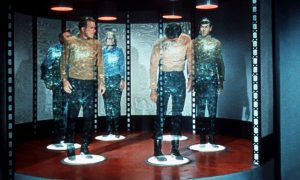
They are being BEAM-ed down
I really make myself laugh with some of these titles. Anyway, BEAM (More lasers i’m sorry) is a set of vocabulary that allows close interpretation of sources as an alternate to Primary, Secondary, and Tertiary sources. BEAM is more aligned with organizing sources by how they are being used rather than how they are written intrinsically. This is not an idea that I had heard of before I read the article about it, but it does present a better model for categorizing sources, and I have never been a big fan of Primary/Secondary/Tertiary source cataloging anyway.
A lot of my assignments in high school had to have a certain number of primary and secondary sources, which was always very irritating, as it was sometimes hard to find enough sources of the proper types to create a cohesive argument. However, if I was to apply the BEAM vocabulary, and if I had one or two sources for each letter in BEAM, then

Get it? it’s a beam!
you would be able to create an argument that has all of the pieces necessary to be convincing. This is at least another interesting way to consider the sources I use when I do research, and should be able to allow me to gather a greater number of useful sources, without trying to worry about having primary sources and secondary sources. As long as you have some Background, a few Exhibit pieces, a source or two to help your Argument be strong, and framing the whole thing with Method pieces is the basis for a strong argumentative essay, as well as something I am going to strive to do for future research assignments.
In Michael Klein’s article “What is it we do when we write articles like this one — and how can we get students to join us”, he discusses research as a hunter/gatherer dichotomy . This is great way to divide the concept of research into two distinct schools. A hunter searches, he knows what he desires, and tries his best to capture it, and then use it in an essay or article. A gatherer discovers, just as a crop is not ready until much after it is planted, gathering research may not give you immediately what you are searching for, but can ultimately give you insights you would not have had before. There are benefits and drawbacks to both of these stratagems. If you are hunting, there is a chance you will miss valuable information in the text, things you overlook not because they are not important, but because they are not what you are searching for at that moment. A gathering strategy is much slower, consuming much more time, and may not always yield results that are as effective, especially if the source you are trying to gather from is not very topical. The optimal option, as discussed by Klein, is a combination of both “strategic hunting and heuristic gathering”.
I am guilty of not taking the time to gather properly the majority of the time I do research. The difference between me and the people that Klein discusses in his article is that they are all doing research about something that interests them. They have no problem spending hours doing gathering style research on whatever topic they are interested in, as whatever they find will be truly enlightening for them. I find it very difficult to properly gather information when I am researching a topic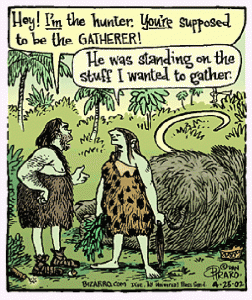 that I have little interest in. This is a major part of why I have less problem doing research for CTW, as we get to choose our own topics, and write about things that interest us. I still need to strive to be more patient as I do my research, but with topics becoming more interesting to me, my style of information collection has definitely improved.
The artifact that I ended up choosing is the constitution of the Block SC Society of Santa Clara University. While I was scouring the internet for any reference of them, as well as trying to glean more information about spirit groups at SCU, I found an application for the Job of Manager of Athletic Game Day Promotions. I found this to be an interesting find, not only because I was not aware that such a position existed, nor that there is a fairly extensive list of requirements for the job, but because I wonder if this position would have been fulfilled by SC Block back when they existed. It makes me wonder why there is a recent application for a position that I would have hoped would already be filled. However, the overwhelming lack of support for the athletics department from the student body points to the idea that we really do need someone or something to come in and make a change.
This ties nicely into an article I found on The Santa Clara, The undergraduate newspaper’s, website titled Santa Clara Has No School Spirit. This article discusses the lack of people who attend sports games, blaming largely the student body for our sports team’s mediocrity. I would like to 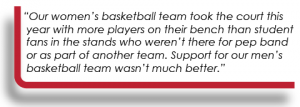 Imagine that there was a time when this was not the case, and our sports teams had fans. I personally can attest that it is a lot more fun playing in front of a home court crowd than anywhere else. Maybe the SC Block of antiquity carried the duties of school spirit, allowing the athletics to excel. It requires more research for sure, but brings up a fascinating idea about the advantages of a crowd at a sports game.
I am excited to look more into this idea, especially as if I was able to make a solid claim, and even more farfetched if I can make some noise, then more people will come to our sports games, which are very fun to go to.
Well, upon returning to the archives for the second day, I have determined that I am going to need to go a third time. In exchange for my original idea, which was much better, I am going to examine the history of the athletic spirit groups on campus, which appear to have started with the group SC Block. The 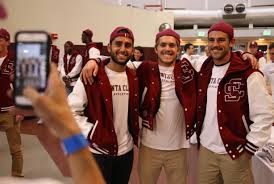 jackets seen in this image were once part of an athletic spirit group called SC Block, which is very similar to the Bronco Bench Foundation and the Ruff Riders combined. I think this will be a truly interesting organization to study, especially as I am an athlete at Santa Clara, so it will be pertinent to my everyday life.
This could also be a fascinating inquiry into how the archives actually work, and will allow me to practice finding information that I know exists for sure, rather than seeking out a  question that cannot be answered by the way the archives are organized. Hopefully I will be able to find enough artifacts to produce a argument that connects to an ongoing argument. This is a good time to be studying the spirit groups of antiquity, as there is a new athletic director at Santa Clara, so there are ongoing changes in the athletic department as we speak. I will look into whether the changes that are currently happening are driving the athletic department and spirit groups in a way that aligns with the way it used to be, or if it will take the department in an entirely new direction.
I am very glad that I found a new topic in time for the essay to be completed, even if I do need to return to the archives for a third day. As it was actually impossible to find the sources i needed the first two times I went, I should be able to glean enough information from the third trip to create a solid essay.

Well, that’s that. In regards to my last post about my archive trip, the idea will have to be scrapped. The digital archives did not seem to have any works, student or otherwise, about any subject relating to computers or the internet.

time to try and come up with a new idea.