College has been nothing like what I once expected, and surprisingly after three and a half years, I am more eager to enter “the real world” and less melodramatic about finishing up senior year than I thought I would be. That is not to say that I’m not already nostalgic— I think everyone misses college now and then— but I’m not panicky about entering the work force anymore. By studying in India for 5 months and working for a summer in Nepal through the Global Social Benefit Fellowship, I have experienced unanticipated personal and professional growth, and most importantly, I have become aware of that growth.
The GSB fellowship incorporated a lot of self-reflection into the 9-month journey, and as a Psych major, I recognized its importance pretty quickly. In the past, I have kept a multitude of diaries, some of which had secure and decorated locks and keys, others of which were intended as “dream diaries,” but all of which I now read and cringe at. And it is this particular flinching that makes me realize just how much I’ve changed and just how valuable it is to document and revisit this growth. Thus, I take delight in the opportunity to share some of the most defining experiences I had in Nepal (even though I realize I may one day look upon this vocational reflection… and wince.)
Uncategorizing Myself
Through the fellowship, I worked to help Equal Access (an organization that creates and delivers critical radio content) develop unrestricted funds, but I never expected my business contributions to include so much interdisciplinary understanding. Being categorized as a Psychology major and International Business minor often throughout college, I perceived myself as just that, but while developing business strategies in Nepal, there was so much more to take into account. Understanding the technological patterns of Nepal’s population was critical to analyzing business opportunities, yet contributing to a field like engineering in which I had next to no experience was quite difficult at first. While sitting in meetings with the computer engineers, the technical jargon often flew over my head, and it took several dumb questions and secret reGoogle-ing sessions of those same questions to finally understand how the technical opportunities could be leveraged as business ones.
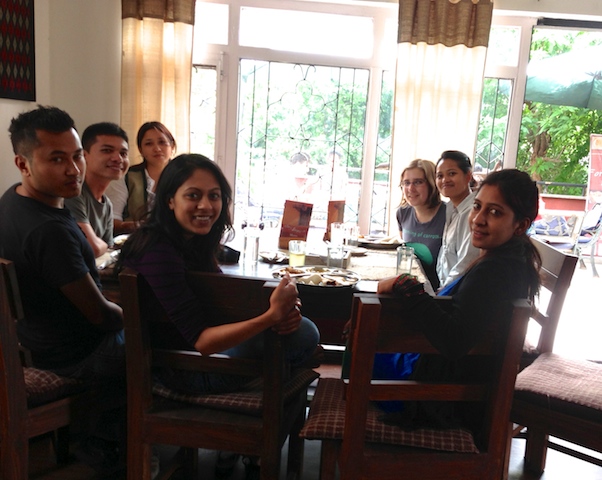
An interdisciplinary lunch
What inspired me was that people at the social enterprise were always learning, within and outside of their specific fields, which helped implement effective solutions to the real world problems that were actually quite interdisciplinary. I began to realize that while becoming an expert and specializing were important, being able to generalize and apply expert topics to a multitude of disciplines were highly valuable skills. The most promising solutions, I found, took several aspects into consideration.
After coming to such a realization in Nepal, a part of me resists sitting next to only Psychology majors at graduation. A few subjects may define me more than others, but the term that describes me most appropriately in most environments is still “student,” someone who is always learning. I will graduate in just a few months, but no matter what organization I work with in the upcoming years, I still plan on being a student.
Readapting Myself

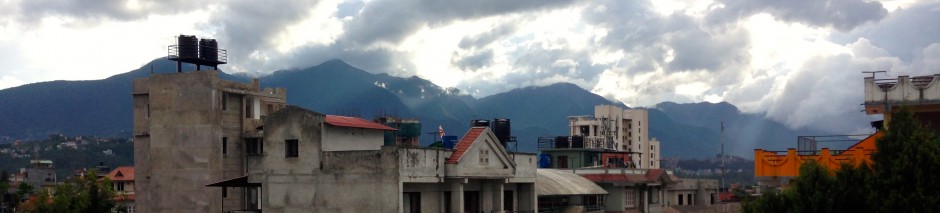
A stylish way to adapt to the weather
The other most critical takeaway from working in Nepal was the importance of having an agreeable attitude. In Nepal, a lot of things never went as planned, be it because of spontaneous weather, the general tendency for people to plan last-minute, or lack of infrastructure. It became ordinary for electricity to stop working multiple times a day. That our taxi broke down was more comical than worrisome, and knowing our flight itinerary just 11 hours before our departure was apparently plenty planning.
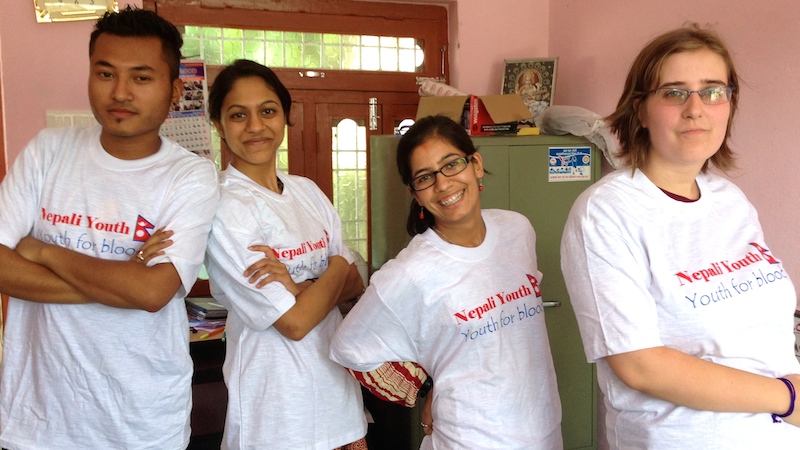
Modeling our “Youth for Blood” t-shirts in Biratnagar
It often wasn’t possible to control the events that took place in Nepal, but the people of Nepal seemed prepared because they were constantly and spontaneously readjusting to the situation. This skill to adapt was impressive in and of itself, but the most inspiring part was that certain employees made even the most undesirable situations enjoyable with their agreeable attitude. Humor put events into perspective, and the trips that could have been stressful and unwelcome actually became some of the most memorable journeys. In other words, an agreeable attitude made adapting to the situation graceful and even a bit entertaining. It was while we wittily complained about our hotel’s broken air conditioning and sarcastically commented on each others’ flawed tendencies that I fully understood the significance of a quotation that my father had typed and pasted on my bedroom door during my irritable adolescent years: “It is attitude, not aptitude, that determines your altitude,” and in a developing country like Nepal, there was a lot of altitude to climb.
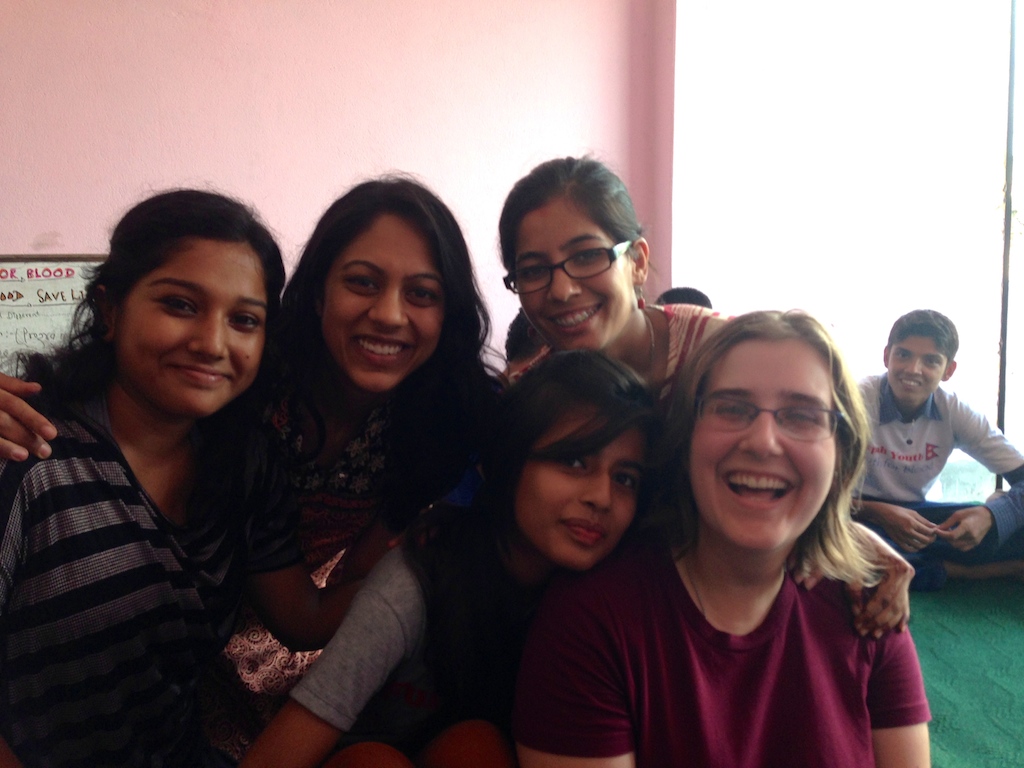
Enjoying the company of urban youth in Biratnagar
Looking forward, I am excited to implement what I have learned through the fellowship in the real working world. People remind me that college is possibly the last time I’ll be a “student,” but I’m not sad about discarding the technical term, because I believe I’ll be a student for the rest of my life. Most importantly though, as I continue to embrace learning, I plan to document my experiences so that I may go back, cringe, and witness the peaks of growth, and then use that knowledge to better apply my greatest gifts to the world’s greatest needs.
Thank you. Please feel free to contact Niki at n4agrawal@scu.edu.
Posted November 2013