
Monthly Archives: February 2012

Reality really is broken

In Jane McConigal’s book, Reality is Broken she exlores a recently exploding phenomenon of online gaming anlooks at its various social impacts and implications toward the future. When many of us think of online gaming, we tend to think of some overly obsessed child sitting in their room, ignoring reality, entirely fixated on a flashing computer screen. Popular media has given us this image through shows like Southpark, and MTV Real Life stories. These programs however present a rather warped view of the online gamer in my opinion. Having been an online gamer myself, i can almost assure anyone that this is not the case for a majority of Americans.  As McConigal states in her except posted on the market place (http://www.marketplace.org/topics/life/big-book/excerpt-reality-broken ) generally Americans tend to be on the lesser end of extreme gamers, with the average game player playing around 1- 2 hours a day. Although i admit that in my prime game playing era, i played for much longer periods of time than an hour or two.

In her book, McConigal makes a lot of really interesting comparisons between reality and virtual gaming environments. She starts by first making the observation that reality was not tailored for each human being, and that reality does not set up each person to succeed, nor does it care if you enjoy it. However, the difference that exists between reality and gaming is that games have been created by human beings for human beings. In games people can feel a sense of adventure, immersion and even in some instances escape. While to some escape sounds like a bad things, because it alludes to the idea of running away from reality, McConigal sees it in a different way. McConigal sees gaming environments as allowing people to exist in a world that makes them feel accomplished, providing structured activities, and allowing for new experiences that could never be experienced in the world.

Though McConigals ideas may seem to be a little bit strange to those fo us who have not looked at virtual worlds as a means for entertainment. I believe that her ideas hold some truth but only to those with willing and open minds. Some people are able to find comfort through online gaming,s some find competition, and some find achievement, who is to say whether or not virtual reality and reality are so very different.

Heres a picture of a guild found in wow, a guild is a collection of players(sometimes who do not even know each other in real life) who adventure and explore the world together .
There and Here Again

Like my reference to the epic fantas tale The Lord of The Rings? I felt that it was rather appropriate because todays topic is dealing with fantasy MMORPGs. In specific i will be talking about the social MMO that is changing the world, Second Life . I know , i know whenever soemone mentions Second Life its easy to hear a thousand moans and the cries of sad children everywhere but why? Second Life is different. When one typically thinks about MMORPG’s they often think about stuff like the before mentioned Lord of The Ring series.  They typically detail events dealing with orcs swords and magic, but Second Life takes an entirely different approach.

The goal of Second Life is to create a Virtual world much like our own. In Second Life one is able to do nearly everything that they can do in the real world. In Second Life you can buy property, you can chat with friends, you can fly, you can swim, you can even have children. Thats right! in the world of Second Life it is possible to engage in reproductive activties with other players. Although that may be a very interesting topic we should probably spend some time talking about the use of Second Life as it pertains to this class. Earlier this morningi signed up for Second Life selected a green dragon-like character and entered the world. Connection to the game was very quick as the only files necessary to play the game totaled only 624kb, a very small amount.  After entering the game i walked around for a little bit, and tried to converse with others but many of them simply ignored me.  I played with the controls for a bit and found it quite easy to move and operate the games camera. The tutorial island did a very good job of explaining the game. Later today i plan to venture back into Second Life with my classmates.

Audio In the Age of the Internet

In article posted on CNET titled “10 music-tech trends that will shape the next decade” CNet blogger Matt Rosoff details tend trends he thinks will change how we interact with audio in the future. Here i will discuss a few of these that i think are the most interesting and substantial changes that he lists.

The first of the changes that Rosoff details in his article that i though was interesting was the switch from downloads to streaming software. In the last couple of years, starting around 2005 and the founding of YouTube which effectively reinvented the home movie many Internet users began to see the switch from downloading to streaming. For many, the substantiality of this change does not seem so innovative but for those of us interested in teh inner working of technology. we understand that years of development needed to take place before our internet connection would be able to handle streaming content. A more recent explanation for this switch could probably draw a link between recent government initiatives to stop piracy.

Another interesting initiative that Rosoff believes will take place within the next ten years and has already started to become present within society is the idea of “fidelity rather than file size”.  While in the past we generally tended to upload files in their most transferable form, forgoing any concerns or aspirations for quality, in today’s technological age we are able to produce and transfer higher quality content. An example of this can be seen with YouTube yet again. One  of the trademark achievments ofthe innovators at YouTube was becoming one of the first streaming sites to allow the uploading of high quality video. Although we tend not to think of these advancements as monumental, they truly are, years of though went to creating networks strong enough to handle the high quality content we produce and want to share with others.

Rosoff also believes that where all of this high quality video and audio content is coming from is also changing.Much like the  ideas expressed by Lawrence Lessig, Rosoff believes that society is on a monumental shift in which large corporations and artists with substantial financial backing are not the only ones being able to create content anymore. He believes that a new generation of artists from the unheard masses of  consumers has emerged and is already beginning to fundamentally change the way we see music and video content. Below are some examples.

Source: CNET- 10 music-tech trands that will shape the next decade

Youtube: Battlefield 3 EPIC Real Life Battle

Madeon: Pop culture live mashup

Preservation Through Technology

Having been a California native, and being a Santa Clara University student i am often not amazed by my surroundings as much as i should be.  As i walk around campus i see the faces of other students of different cultures and backgrounds, i see lush green vegetation all around me and on certain days i feel the cool air. California, like many of the great states in the United States, has a rich and diverse history filled with information, some of which has been lost and some that is in the process of being preserved.

With the creation of its California Legacy Project, Santa Clara University is seeking to broaden the amount of information that is preserved about California’s past, and in doing so seeks to educate those who are uninformed of California rich cultural heritage. A link to the website for the California Legacy Project can be found here, and contains a few key publications from California’s native authors. The publications that are being created by the CLP mainly tend to focus on California’s unique historical events, its environment and key experiences in the lives of its inhabitants. The CLP website also contains podcasts and excerpts from its publication on its website.

One of such podcasts by Susie Chapney Clark speaks about the Mammoth Dome also known as the Lick Observatory, located near San Jose atop Mt. Hamilton. Clark describes the telescope as monolithic and says that it was the first telescope open to the public to ever be founded in California in 1888.  For more information on the Lick Observatory follow this link here

What is interesting to me about the California mission project is the idea that it uses technology to preserve human culture as opposed to the traditional forms of writing and oral cultures that we have used throughout the past. Do you think that the use of technology will preserve culture better? or do you think that we are taking a step in the wrong direction?


TheTwitter Effect

For many of us the idea of social media is nothing new. Those of us born into the digital age of the computer and the internet are now being referred to as digital natives. Our generation knows little of what it is like to live in a society that is not always in constant connection with each other.  With the influx of new technologies being developed that encourage us to participate in sharing information and ideas with each other through social networking many times we forget to question whether or not these technologies are effect us in a positive or negative way. In the case of sites like Facebook and Twitter we have seen a trend in people feeling antagonized by the pressure to remain updated on the lives of their friends. They are bombarded with useless information that they really had no business knowing in the first place and tend to waste their time on these sites when they could be engaging in more intellectually stimulative activities. However a recent study by Gilad Lotan an avid fan of blogs and new forms of media is providing a new outlook on how social media can be used as a tool for social mobilization.

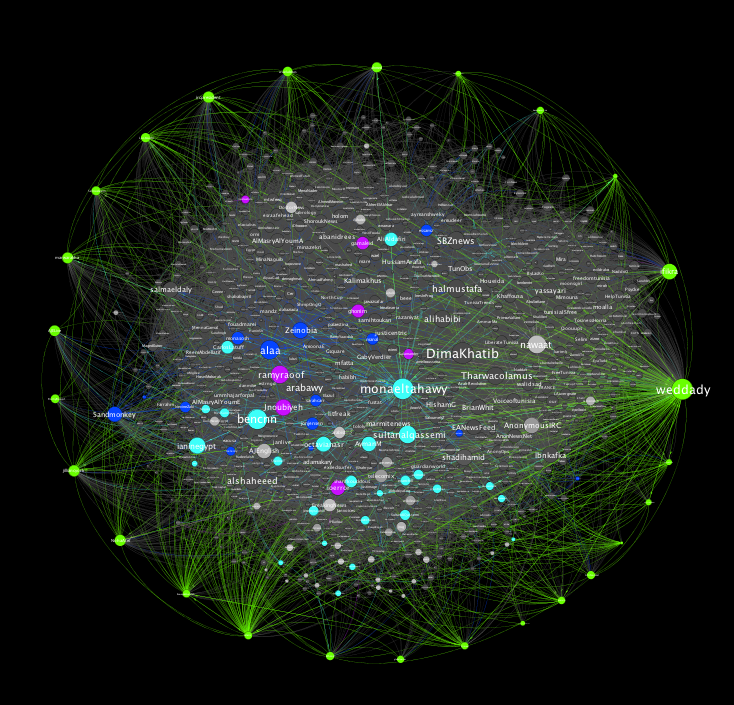
http://globalvoicesonline.org/wp-content/uploads/2011/12/Screen-shot-2011-12-12-at-2.45.48-AM.png

In Gilad Lotans’ study The Revolutions Were Tweeted, he looks to indentify the effect that ordinary citizens had on mobilizing other against the injustices being face in their countries.  Lotan does this by analyzing groups of tweets by hashtags (e.g #sibouzid) and identifying 12 key groups of media that would be present during the revolution.  These groups ranged from forms of traditional media to bloggers, to pirating and advertising bots. results of Lotans study showed a great increase the amount of newer forms of media such as bloggers, activists and journalists were the most active on twitter in spreading news about the revolution. This is ground breaking because now there is legitimate evidence that the internet can be a tool that elicits social change or at least spreads information and allows ordinary citizen a chance to participate in the exchange of information. While in the past people were confined by their inability to afford writing technologies or a lack of education, Twitter has now given them everything that they need to being a discussion. An interesting picture that I found on Gilad Lotans’ site shows the effects of individuals in spreading the word about injustices being face in Egypt and Tunisia.