In the spring of my senior year of high school, I had a tough decision to make. Like many of my classmates who had the opportunity to continue their education, I was faced with choosing which university I would be attending in the upcoming fall. There were many factors to consider: distance from family, financial costs, extracurricular opportunities, and of course, academic options. Of all the schools I had visited and applied to, Santa Clara was the one that really stood out to me because of its focus on the holistic education of its students. As someone not sure of what I wanted to study or where I wanted to go in life, I felt this was the most important factor for selecting a school, because I wanted to be able to learn and grow as much as possible in the four years I would be in college.
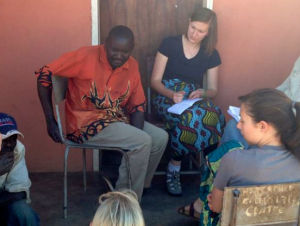
Getting the chance to talk with the mentors of the radio school gave us a glimpse into the benefits and challenges of radio education.
My experience as a Global Social Benefit Fellow has been a perfect example of that holistic education model. This summer, as part of the fellowship, I spent seven weeks in Zambia learning about the educational opportunities available to students through interactive radio instruction schools, as well as how a social enterprise could help provide more students with access to education. Leading up to this summer, the other GSB fellows and I spent ten weeks learning about social enterprises, business models, and various attempts that have been made to address the world’s greatest needs in unconventional ways. While this information was interesting and important to learn, I feel that this experience has been so much more than learning about social enterprises. In some respects, I might even go so far as to say it wasn’t about that at all.
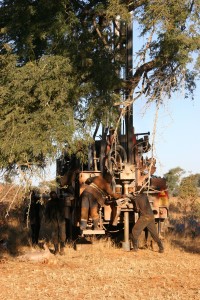
We anxiously awaited the moment they would hit water while drilling this borehole. Unfortunately, the moment never came, and we were able to see one example of the inaccessibility to water.
Each moment that I was in Zambia presented me with a new learning opportunity that gave me a chance to think critically about what I was experiencing. Whether it be learning about access (or lack of access) to water when we watched a borehole be drilled in one rural community, or listening to mentors tell us why they continued to teach in the radio schools despite the challenges they faced, I was getting to see a part of life I had never thought about before. In his 2010 address in Mexico City on the “Challenges to Jesuit Higher Education Today,” Adolfo Nicolás, S.J. said, “Shallow, self-absorbed perceptions of reality make it almost impossible to feel compassion for the suffering of others; and a contentment with the satisfaction of immediate desires or the laziness to engage competing claims on one’s deepest loyalty results in the inability to commit one’s life to what is truly worthwhile.” That’s exactly why learning about the world around me is so important to me. It makes me aware of the world around me and its everyday realities, which reminds me that I am part of a larger, global community.
Another part of this idea of holistic education for me has been learning more about who I am and what I value most. I grew up in a small farming community where community really did mean everything. People, and the relationships we have with one another, are so vitally important to me. The old adage of, “it takes a village to raise a child,” may be true, but I don’t think it captures the full importance and value of a community. If there is one thing that I have really witnessed in the past year of my life, it is that it takes a village—the whole village—to sustain and develop that village, not just a child. The radio education system in Chikuni Parish wouldn’t be nearly as successful as it is without the support and dedication of the mentors and other community members working to provide a better education for their children.
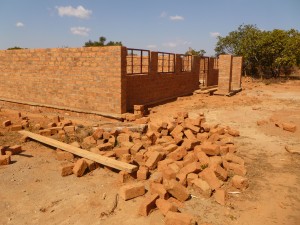
The new radio school building one community is coming together to build.
In these past nine months, I have been able to see things and do things and learn things that I would never have imagined possible. But isn’t that the point of education? To stretch us and challenge us and force us to examine the world in ways we had never considered? That’s something I hope to carry with me as I continue discerning what I am called to do in this life.
The poet Mary Oliver poses a question that I want to now pose to you. She asks, “Tell me, what is it you plan to do with your one wild and precious life?” I don’t know everything I want to accomplish in this life, but this experience has given me somethings to strive for.
Explore. Dream. Learn. Experience. Discover. Listen. Breathe. Grow. Love. Be. Live.