Blogging is difficult.
This has been my first blog post after being in Capetown for about five weeks, I find a tug between different things I should write about. I’ll start with a poem I recently found in the District Six Museum. District Six is the former name of an area in eastern Capetown where tens of thousands of its inhabitants were forcibly removed under apartheid. The museum is made up of historical facts, newspaper clippings, photos, and other mementos that previous residents have brought to the museum in order to keep the memory of this area alive.
—
“Lydia In the Wind” by Lueen Conning-Ndlovu
The wind is a wounded witness
She will not be still
Not until we are listening
Are we listening
Will we recognise her
Circling the crevice
Between two worlds
Our reality and hers
Howling around this empty plot
This hole in our history
Can we hear beyond our fears
The wind is a haunted woman
She is wild with rememberings
Singing the truth and the tragedy
Of our buried heritage
Our slavery
If we do not know we are free
She is held captive once again
This tie by a broken chain of events
Our degrees of amnesia
The root of her dis-ease
Her feet are bleeding
From this haunting dance of grief
She will only know relief
When all our ghosts are put to rest
When their stories are collected
Returned to their place of honour
Recorded in our history
Embedded in our memory
Bring in the light of consciousness
Who was she
Who are they
Who are we
And with this unveiling we see
The awesome dimensions
To this family
We are uncovering the path
Of recovery
And in the questioning
Comes the who am I
Out of the listening
Comes through you am I
Through you am I
—
Overview
Winter School
Our time here started out packed with activities. Jake and I did a few tourist things here and there, as he studied abroad here and knows his way around. He showed me lots of places and great hikes, and I tried to soak it all in. It was overwhelming at first. Then, we were able to meet staff members of IkamvaYouth including Zoe, our supervisor. We now know the main office in Capetown, which is small, humble, and pleasant.
Over the next few weeks, Winter School started, which is a period of two weeks during South African students’ three-week winter break where Ikamvanites, or participants of IkamvaYouth, are required to attend rigorous tutoring at a local school or university. We were able to attend tutor training for Winter School, which was our first real introduction to any youth or students associated with IkamvaYouth. The first day was held at Masiphumelele branch; it was a small gathering, but it was fun and informative. This was a good chance for us to introduce ourselves, get to know people and hang out, and also to start getting survey results. The following two days were similar: the trainings for the Nyanga and Makhaza branches.
From here, things sped up; for the first week of Winter School, Jake and I were in the Eastern Cape at the Joza branch, in Grahamstown. We got to see how IkamvaYouth really functions. Granted, this was the first Winter School ever held by the one Eastern Cape branch, and it was hectic; Jake and I helped out here and there, and got to know the branch coordinator, Buli, and her assistant, Nkosinathi. We started interviewing the tutors, which was lots of fun and very tiring. Jake and I started to notice patterns in our work style and in our talents for working together, and we developed a good way to conduct interviews together. This first week was fun, hectic, and an immense learning experience for me, and for Jake as well.
I noticed how the Eastern Cape was also much more rural compared to the Western Cape. The Joza branch Winter School was held in the local high school, Nombulelo High School, in the Joza township, and it overlooked rolling hills, sweeping fields, and open sky. Cows and donkeys walked through the campus at their leisure, and goats picked around in the trash. The atmosphere was slow, steady, and open. I once pointed to a donkey and laughed about how it was swinging its head and making such loud noises, and one of the tutors laughed about how funny it was that it was so normal for them, and so odd for us.
At the end of a long week of work and recording interviews, we headed back to the Western Cape. For the second week of Winter School, Jake and I switched between the Masiphumelele WS, which was held at False Bay College in Fish Hoek in a few classrooms donated to them, and the combined Makhaza/Nyanga WS, held at University of Western Cape in a few small school buildings. Jake and I got very used to setting up camp in new places, whipping out my notebook whenever needed, and conducting interviews upon interviews in the little time we had.
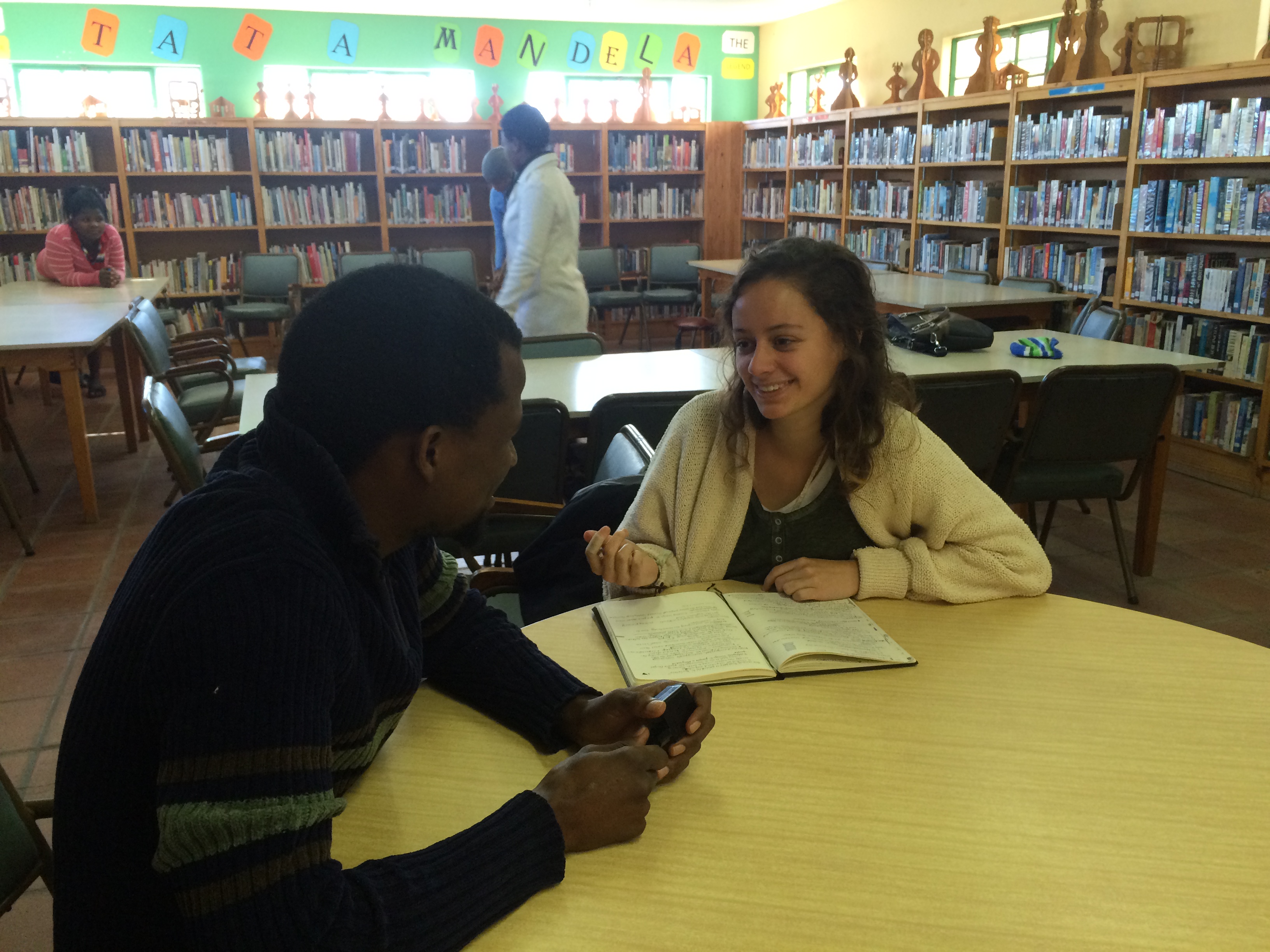
Winter School was exhausting, as anyone at IkamvaYouth can attest to. Some of the staff members say it’s the most stressful time of year! I learned so much about the tutors, the kids, and the IY culture. Our days were made up of quick interviews, some group discussions, and packing as many qualitative times with people into those two weeks as we possibly could, and our nights were made up of deciding how we felt about our interviews that day, what we noticed, what we needed to change about the next day. These two weeks also revealed the real relationship that develops between the tutors and the learners. It was spectacular hearing about how much each tutor deeply cared about the learner they were tutoring and that real incentive to be there. The ex-learners said this as well; they expressed how they really longed to give back to Ikamva after Ikamva had given them so much. We also got to see the talent show at the end of Winter School, which was a testament to the real spirit of Ikamva and the environment that Ikamva is able to provide for everyone who’s part of it.
Matric Week
This one week followed Winter School for IkamvaYouth; this was the week specifically for Grade 12 learners preparing to matriculate. We used this time to interview staff members about tutor recruitment, orientation, and retention. It was great to see the “other side of the story,” which was really valuable for our research. This week consisted of traveling between the three branches themselves throughout the week, and proved to be another busy week of quick visits and interviews.
Now, with matric week over and one week that Ikamva has completely off of work, it’s time to breathe and take in what has happened for the past month.
—
Working with Ikamva has been interesting, to say the absolute least. At the most, it’s been challenging, fun, informative, and a privilege. We have a few weeks to go, but looking back on this past month gives me the opportunity to process what it’s like being part of this larger organization.
Before I started this fellowship, I knew it would be a different experience than my other times of travel. Our primary objective here is to do something that will really help the organization, even in a small way. If I can try to iterate a big point from these past few weeks, it’s learning what it means to do something small in the context of something much bigger. We are delivering something to Ikamva that will help them develop their tutor recruitment, orientation, and retention. Learning that this small deed is something that’s part of a larger Ikamva is one thing; learning that this small deed is part of a much larger South Africa is another.
I have seen poverty, I know what it looks like. Visiting townships was not a culture shock for me. But, poverty is something one can never really “get used to,” and frankly, something one never should “get used to.” Driving out of the Capetown International Airport for the first time, we passed the Nyanga township; I’ve seen that kind of poverty before. The metal walls and ceilings, two-room houses stacked so close to each other it’s hard to tell where they separate, dotting the hill that separated Nyanga and the airport. I didn’t know much about Nyanga the first time I saw it, and I felt a distance from it. My mind went into us-and-them mentality. It tempted me and I fell into it, and that became easier and easier with every mile we drove closer into the Gardens neighborhood of Capetown, where our apartment would be. I was away, I was separate. I am us, they are
Working with the tutors and the learners helped that wall begin to dismantle. In Gardens, I became more aware of a divide I saw. White folks walk the streets and go into the restaurants, and more often than not, Black folks work those shops. Something was subtle, and the divide became easier to be a part of. It’s hard to explain, and I found myself weaving myself into the complication of race in South Africa. I also found over time that South Africans are extremely open to talking about race, which is something very different than I’ve experienced in the U.S.
Visiting the District Six museum the other day for the first time gave me the context in which to look at my time here. Apartheid is technically gone, but that was not very long ago at all. Something that devestating and in such violation of human dignity cannot simply be thrown out the window and left to solve itself. I feel myself constantly trying to figure out South Africa, and even Capetown, which is a wonderful and also fascinating place in and of itself. District Six is only an example of many similar tragedies scattered across South Africa.
I can’t expect myself to “figure out” South Africa; we’re in such a small part of it, and for so little time. If there’s something I do know, we are a small, contributing part of something much, much, much bigger than just Ikamva, and as I said, if I’m being honest, I’m still piecing together where we fit in. Education is so important, education is so important. Self-empowerment is so important, and creating a space to realize these things is so important. These kids are passionate about that, and I can see that.
Peculiarly, above the confusions I have and the challenges we face every day here, becoming acquainted with the history of South Africa and the pain that has happened and happens here, I find more of myself and of God, over and over again. The hope that this country has shows a history; I am a mere spectator, and now, a participant. Peculiar.
—
Jake and I, this coming week, are going to take another trip to the Eastern cape, but this time on a break, to go on a 5-day guided walk/hike along the “Wild Coast” of South Africa. We will be staying in Xhosa villages and learning some history, hopefully. Capetown has been wonderful to me, but hopefully this time will be a new adventure for a short time, and I can use this time to process more of this beautiful, crazy country I’m in.
—
And in the questioning
Comes the who am I
Out of the listening
Comes through you am I
Through you am I