
Working with BanaPads Limited in Uganda and Tanzania this summer opened my eyes to a whole other world. I learned so much about an area that has always been so foreign to me, I met so many people who have inspired me in different ways, and I learned a lot about myself throughout the whole experience. From the first day we got there in June until the day we left in August, I was tested every day.
Being the introvert that I am, it was difficult for me to talk to so many new people every day and be forward enough to get the necessary data, but to also be conscious of the cultural differences between myself and the people of the Ugandan community. This was very apparent when we would have meetings with Bbaale Richard, the founder of BanaPads, or with PeerLink, a partnering organization in western Uganda. There would be so much Ty, Caroline, and I would want to discuss at one time, but we had to learn to speak slowly and take it one step at a time. This was a struggle for me, since I am a person who is constantly doing five things at once. I really had to learn to be patient and to work with the people there instead of coming in as an outsider and taking control.
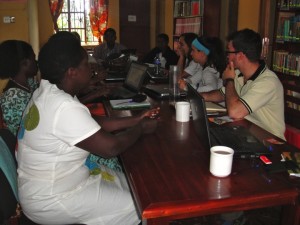
Typical Meeting with PeerLink
Throughout the two months in Uganda I had many experiences of seeing raw humanity and the strength of a human being under what Americans would consider “unlivable conditions.” Oftentimes when we were working, I would kind of forget how different everyone’s backgrounds were until we would hear stories. One of the stories that will always stick with me was when we were all at BanaPads headquarters in Mpigi and it was Bbaale, Jeremiah, Jared, and more BanaPads employees sitting at the main table. Soon they all started telling the stories of when they wore their first pair of shoes and when they wore their first pair of underwear. I could not believe it. Every single Ugandan at the table knew the exact moment for both. Most of them were in grade school or even older when they had their first pair of either. Then I was asked if I knew when I had my first pair of underwear or shoes. Embarrassed, I said I did not know because I always had both. At that time I realized how much the people sitting in front of me had struggled their whole lives to get to where they were today: to be in a position where they can now help others in their community not have to suffer as much as they did growing up.
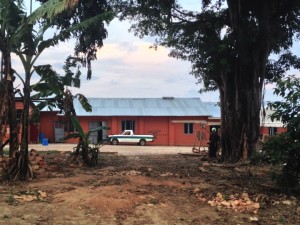
The front of BanaPads headquarters.
There are some things that I will never fully understand, like what it is like to grow up in rural Uganda, but I have met many who have overcome the difficulties associated with growing up in such a harsh environment and have seen their passion for making their community better. The people in Uganda want to help improve their community – businesses work together, households share goods and services, and people are just willing to give. This is a concept that is so foreign in America, where every business is trying to outdo all of the competition and people want to be portrayed as better than everyone else.
We were able to have conversations with many current Champions or Champions in training during our 7 weeks with BanaPads, and we were also present for some of the interviews the Champions in training gave to local households about menstruation. Oftentimes when we asked why the women wanted to become Champions, it was never really for the money (although that was a bonus), but it was to instill change in their communities and give the women a better life. They wanted to break the silence about menstruation, a topic that is never discussed in these areas. These women took full days away from their housework to be trained to become Champions. They were strong and passionate mothers, wanting a better life for the child that was on their backs.
Looking back, I wish I could have had more conversations with the Champions in training, but I was nervous due to the language barrier. These women, often not very educated, were so talented; Ugandans are so talented. They have learned how to live in conditions we do not understand without most of the technologies that we claim we could not live without. Most of these people have never seen a computer and would not see one unless they attended university. They endure hardships every day that we never have to consider, like lack of hygienic menstruation materials or malaria.
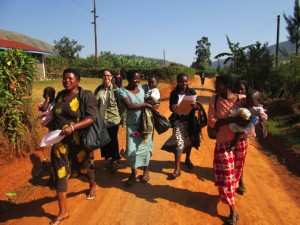
Walking with Champions in training before they conduct interviews.
My experience with BanaPads really taught me the benefits of going out of my comfort zone to talk to someone. I am usually one to just sit back and observe, but oftentimes I had to be the one to talk to a local fabricator or talk to a Champion or run a meeting. Each time, I was terrified, but I was so happy afterwards because I was able to understand the people more by talking to them instead of observing. This is something I hope to continue to do now that I am home, whether it is going out of my way to make a job connection or just to get to know someone better. This experience also taught me to enjoy life. I am one to stress about absolutely everything, but the things I stress about are not important in the long run. The people of Uganda are so dedicated to relationships and just enjoying people’s company, and I think they know exactly what is important in life: friends, family, and community. Before I left, I was so caught up in school, golf, work, and my future life that I was never in the moment when I was with people. Now I realize what is important, and I am striving to reset my priorities so I can enjoy life with the people who matter most.
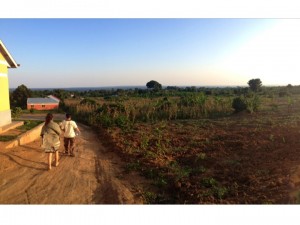
Ty and I walking back to headquarters.