
Wow. It was a very short 47 days. You might be wondering if you missed all of my in-field blog posts from those two months. The truth is, I had so many opportunities to update this blog but I just felt like I wasn’t quite ready to share my experiences yet. I have a bad habit of overanalyzing things and I’m learning that experiences can’t always be condensed down to cohesive blog posts. But I’ve been missing out on the opportunity to get my thoughts out of my head and hear what others think about them. And recent conversations with my parents, my project partner Kate, and many other amazing people have forced me to do just that. They forced me to stop analyzing for a minute and just tell my stories. So, here goes.

The vivid community-produced paintings on the walls of the Masiphumelele library, one of the IkamvaYouth branch locations in the Western Cape
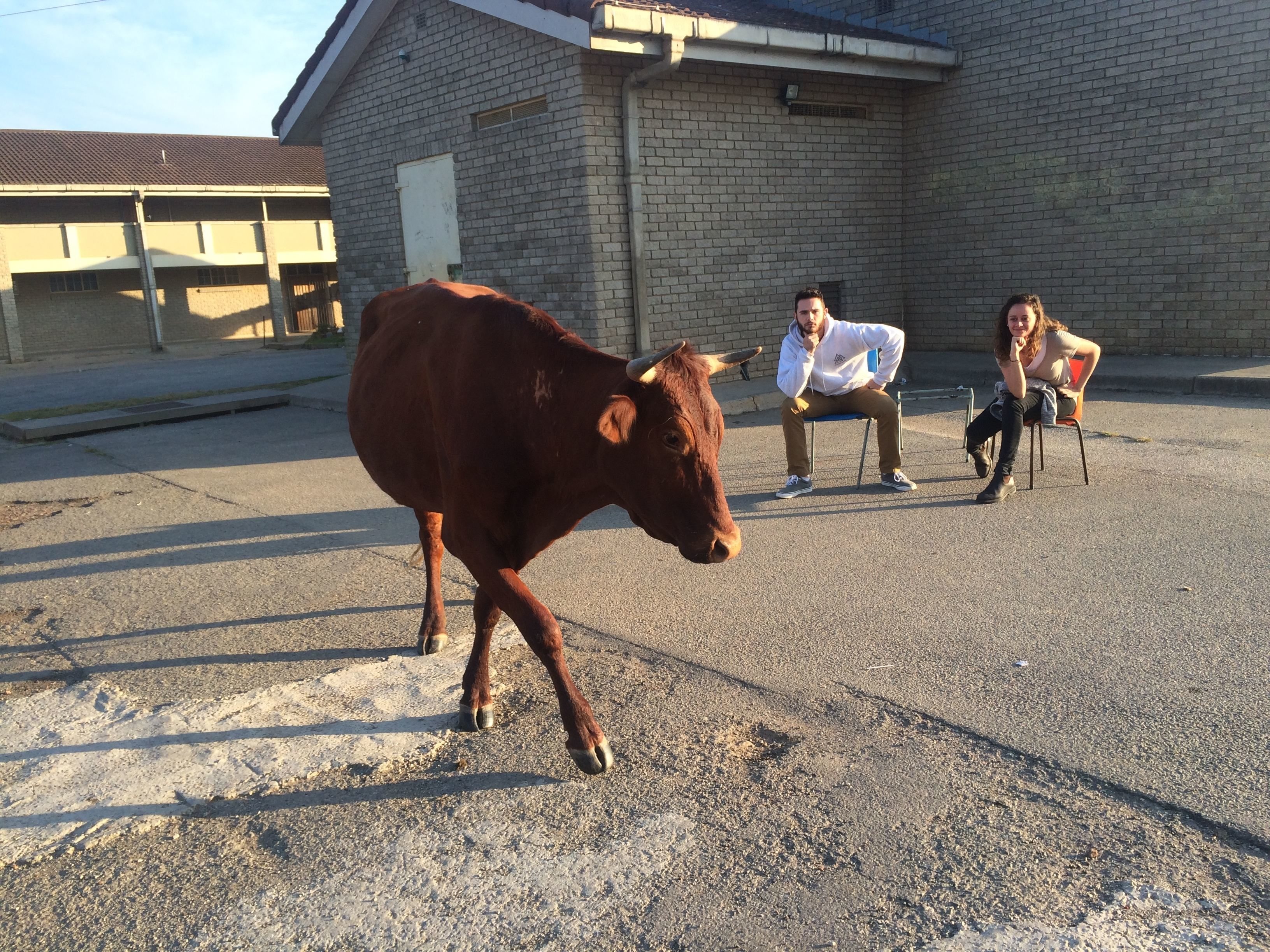
Life in Joza, a rural Eastern Cape town, is quite different than that in urban areas, evident by the livestock animals roaming freely through the open halls of the local high school
Those seven weeks were absurdly fun, in so many ways. I had the privilege to work in an astonishing range of environments, from the dense urban townships in Cape Town to the quiet villages of the rural Eastern Cape province. Each and every one of the specific experiences I got to be apart of had a unique way of contributing to my own “vocational discernment,” the junction of my passions, my talents, and the world’s needs. The concept of vocational discernment has been weighing heavy on my mind for the past… few years, it seems. I know that doesn’t necessarily make me unique. Every human being has surely grappled with the question of what he or she is “meant” to do.
Since vocational discernment is an abstract concept that I, among other things, tend to overanalyze, I sometimes get a bit anxious when I’m asked what I want to do after graduating college. And it’s my own fault, really. I get stressed because a phenomenon known to millennials as FOMO: Fear Of Missing Out. According to Urban Dictionary, FOMO is “an omnipresent anxiety brought on by our cognitive ability to recognize potential opportunities.” That, for me, is just an elegant way of saying that that the clock is ticking. Of course, uncertainty over the future should not control my decisions. I think I’ve come to accept a bit of FOMO in my life without letting any anxiety about the future detract from the beauty of life that surrounds me. But it’s hard to deny the fact that if I’m at a pivotal part of my life in which the ramifications of each and every decision will likely have a profound impact on my life’s trajectory. The closer I get to graduation, the more I become aware that things are starting to moving crazy fast.
________
If you had asked me to describe myself before leaving for Cape Town, I would probably have used the word efficient. To me, efficiency means cutting out waste, distractions, and obstacles to success. And I don’t limit that definition strictly to professional settings. I love finding ways, often through technology, to cut out wasted energy in everyday life. If there’s one saying I live by, it’s, “don’t work hard; work smart.” Perhaps it’s that same fear of missing out that drives me to be as efficient as possible so I can pursue a range of opportunities that might not otherwise be attainable. But, the truth of the matter is that, regardless of my enthusiasm, not every person in the world wants to hear me talk about optimizing email inboxes or streamlining their daily habits. It wasn’t until later in the field placement, during a five-day backpacking trip through coastal villages in South Africa’s rural Transkei region that I fully realized how out of touch my expectations were with the reality of life for many South Africans.
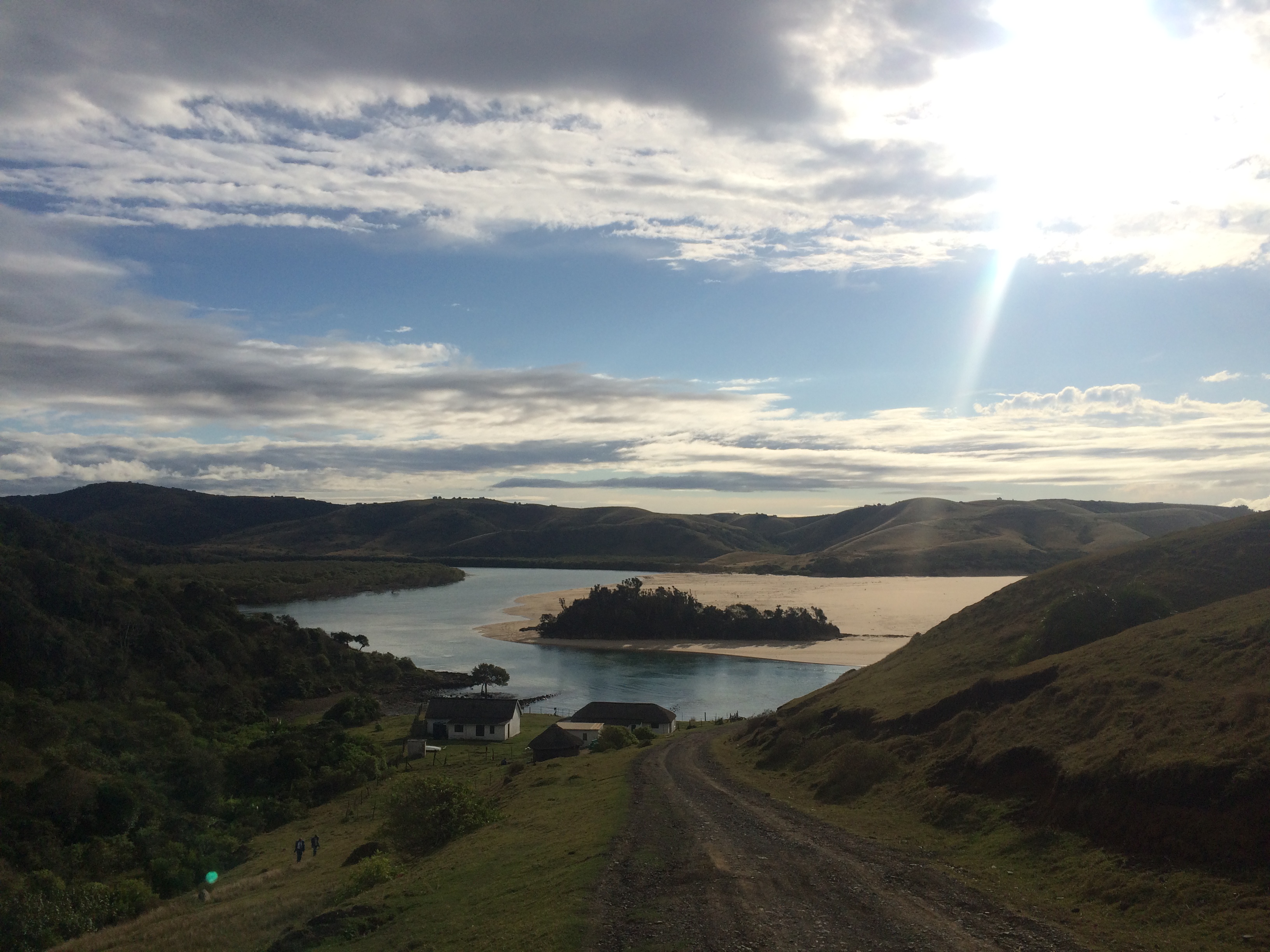
The Transkei region is one of the most beautifully rural areas in South Africa and was even at one time a distinct political republic set aside for ethnic Xhosa people
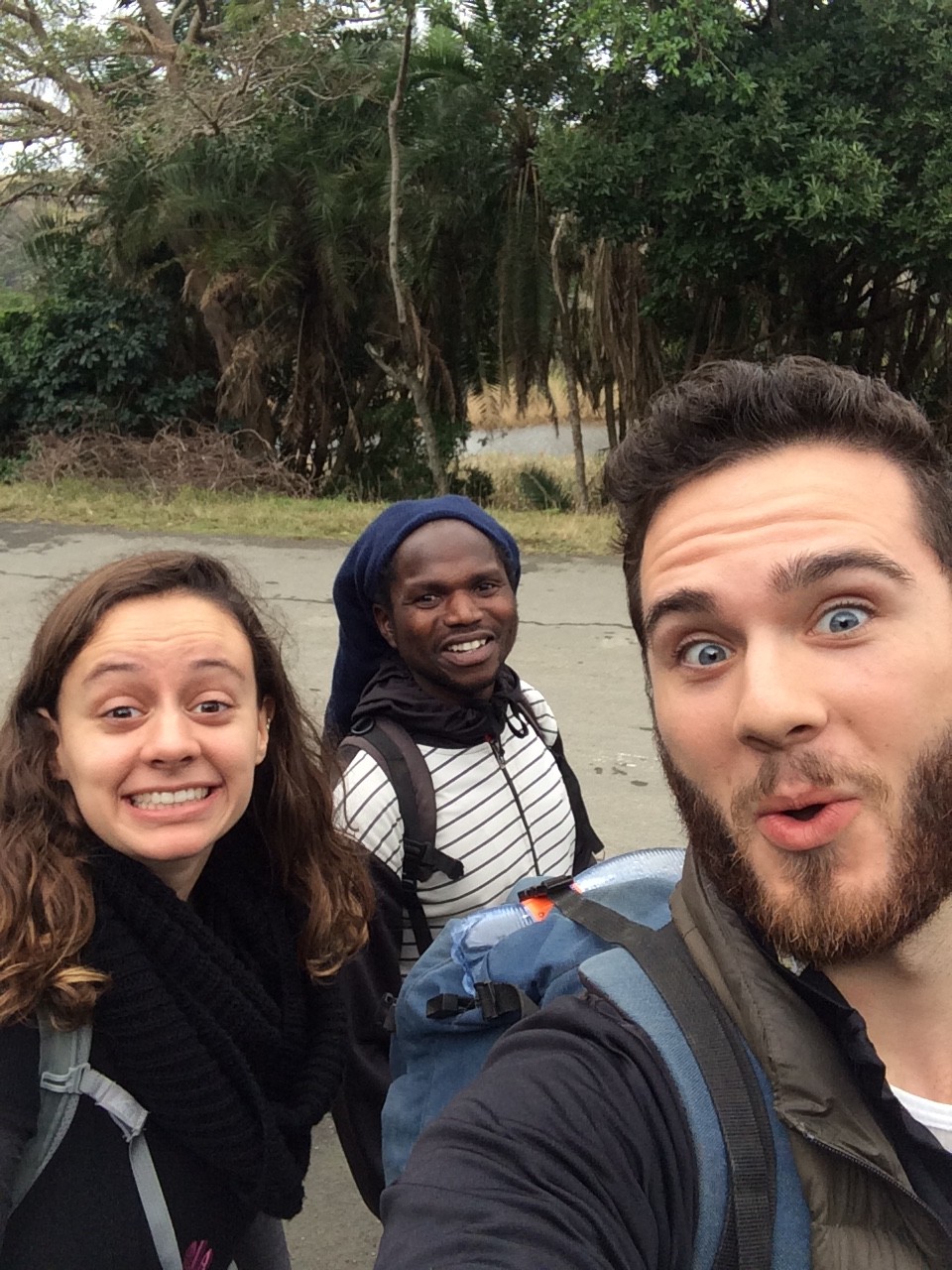
Kate, Sipho, and myself excited to leave the backpackers in Port St. Johns and begin the five-day backpacking journey through the “Wild Coast”
After an exhausting (and seemingly exclusively uphill) first day of hiking, we arrived at the final stretch of beach. Our guide Sipho, a native and resident of the area, seemed anxious when he noticed the clouds and rain in the distance. As we approached the storm (and vice versa), we hastily yanked our jackets and pack covers out of our bags as the rain began to soak our thermal layers. As we picked up the pace, Sipho pulled an inexpensive feature phone from his tiny bag. After holding it to his ear silently for a few seconds, he said, “We must hurry.” The tone of his voice and the fact that the temperature was dropping rapidly with the setting sun were great motivators. We hustled towards the village, visible in the distance, and passed a woman and a young boy in plain clothes doing the same. Sipho said something to her in Xhosa and she smiled shyly but stayed silent.
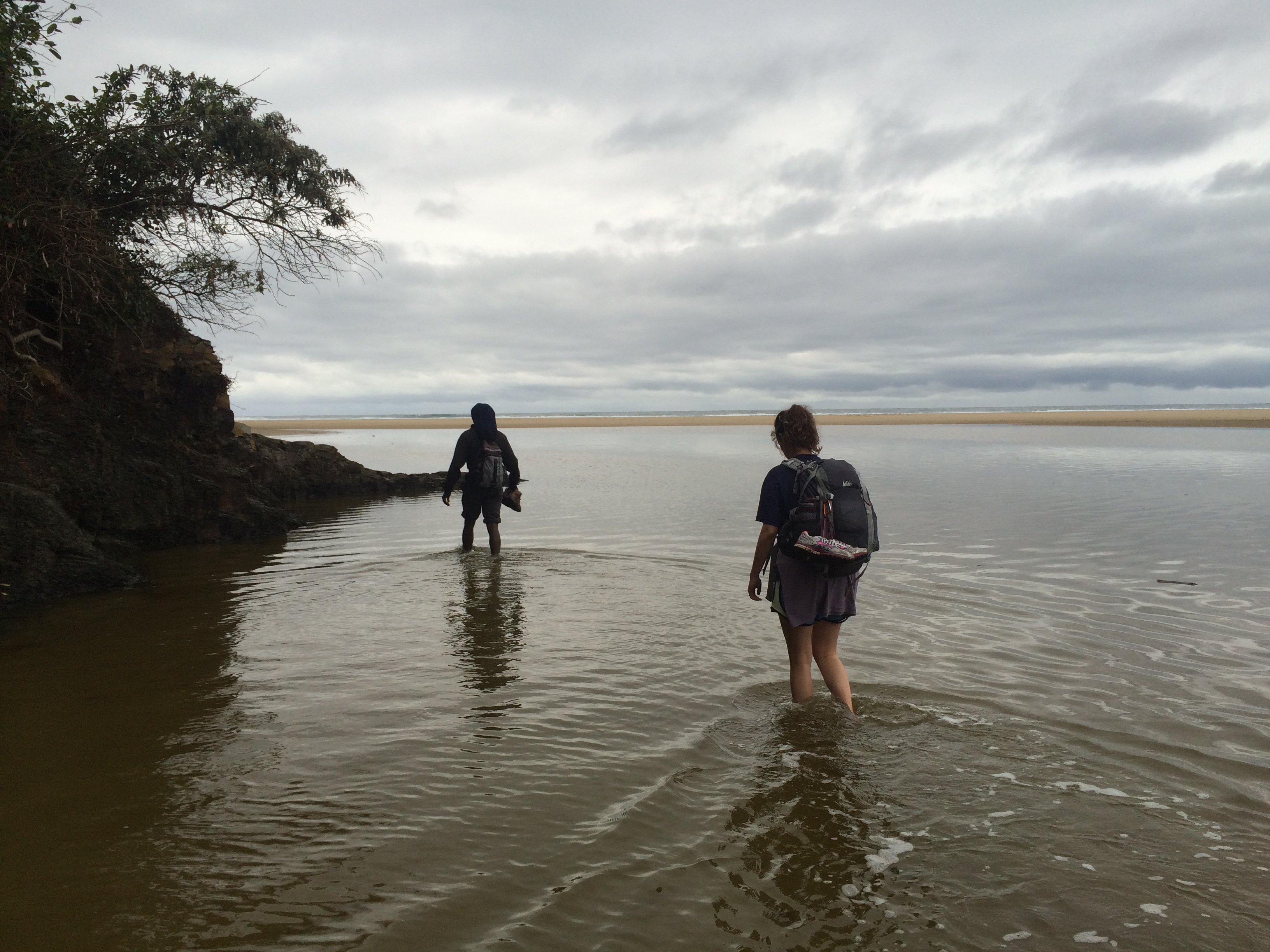
Sipho and Kate cross one of the many rivers that feed into the Indian Ocean
As we neared the village and entered the heart of the storm, Sipho pointed out the river crossing and explained that there was no way to cross the raging river water without the boatsman–and he was nowhere to be found and was not picking up his phone. After frantically making several more unanswered phone calls, Sipho explained that his phone was waterlogged and, although it was still powered up, some of the buttons had stopped working and he could not access his contacts in order to call the boat operator. “So how else can we get to the village?” I asked. “We can not. We would have to turn around.”
…We can not? Surely he’s joking, right? We just hiked up and down hills for five hours.
At this point the young woman and boy had caught up to us, the boy sobbing as the gusts of wind hurled sand and saltwater into his eyes. We crafted a makeshift rain cover out of a trash bag and took refuge in the forest near the river. As we all began to realize the severity of the situation, Kate, sternly but calmly, asked, “Sipho. We need to come up with an alternative plan now. How are we going to get out of here?”
I’ve ever heard more contained panic in one sentence then I did when Sipho replied, “I don’t know.” Then, just as quickly as the panic had entered his voice, it left as his phone started ringing. “It’s the boat operator.”
We crossed the river one at a time because the boat operator skillfully maneuvered the kayak through the raging waters, aggravated by the intense downpour of rain and vicious winds. It took almost an hour to cross the river and hike to our residence for the evening. We took turns carrying the boy who, although still crying, had lost the fear in his eyes.
That was one of the most physically and psychologically draining experience of my life. The reality of the situation hadn’t really sunk in until I awoke the next morning. What we experienced was not staged. It was not just a zany evening of shenanigans.
We got a very real glimpse into what it means to rely entirely on someone and what it can mean when that lifeline disappears.
We understood how dependent our lives are on technology.
And we realized that for many people, like that young woman and boy, sometimes there is no easy solution. Sipho later told us that if we hadn’t been there with a cell phone, she would have turned around and made the two-hour-long hike through the steep, muddy hills back to the village from which she had come.
That experience was truly transformative for me because, in one sentence, Sipho had perfectly communicated the reality of living in a place where the things that I take for granted are never a guarantee.
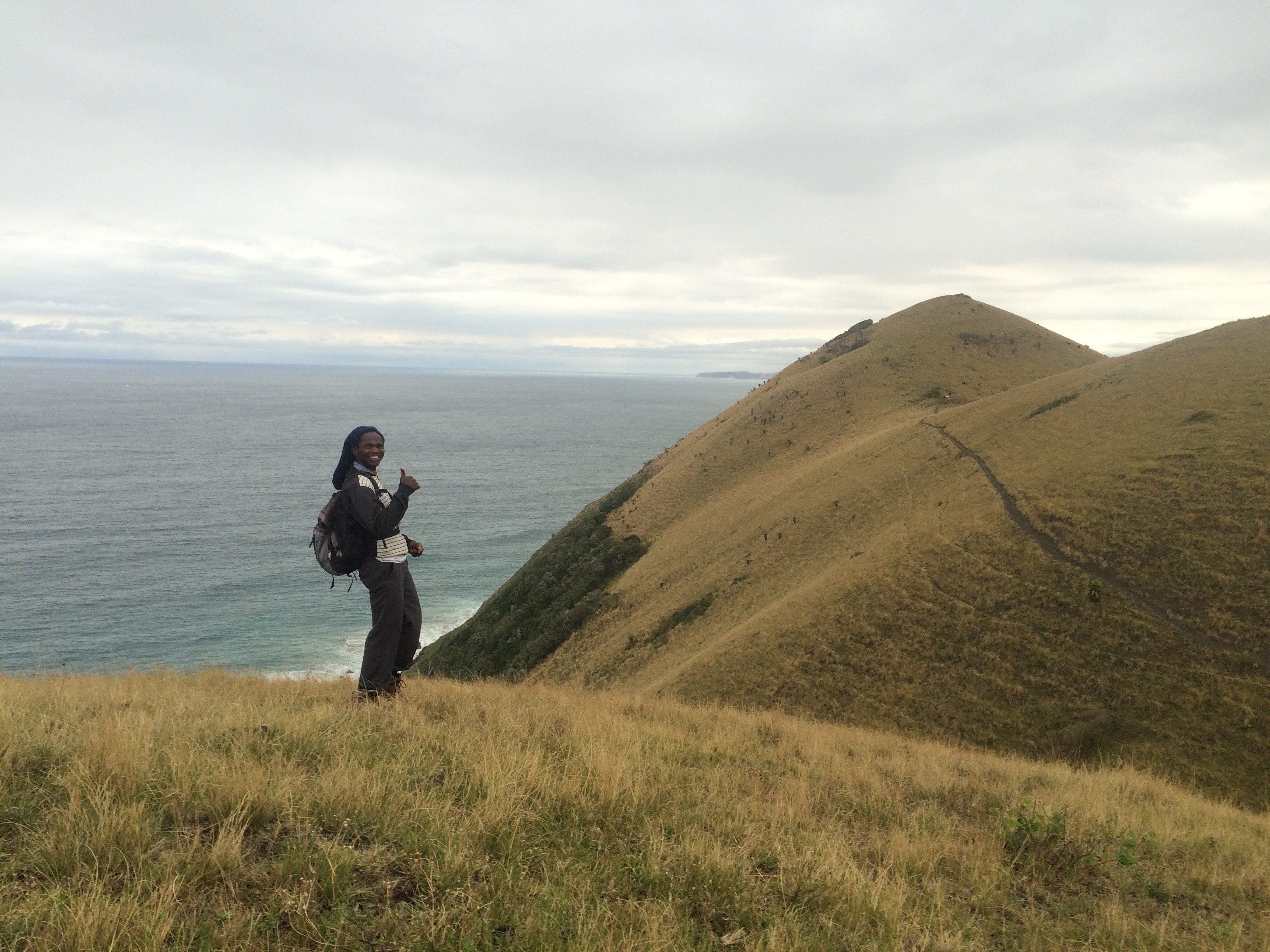
As you can see, there’s never been a happier person in the world than Sipho
I’m happy to say that the rest of the backpacking trip was relatively stress-free. But I am thankful that I got to experience such a journey and develop respect for the people and lifestyle of the Transkei and South Africa as a whole. My love of efficiency has not disappeared, but it is now accompanied by a healthy dose of understanding that the world I am accustomed to is far removed from the reality of most. For once, the world had not moved at my pace. I feel profoundly humbled to have been able to come to that realization without serious consequences.
This fellowship has helped me to put aside some of the stress of vocational discernment. I’m starting to get some clarity as things begin to line up and make sense. It’s taken some personal growth for me to realize that I don’t need to analyze anything right now. It’s taken that same growth for me to realize that writing a blog post doesn’t require anything except for me to tell a story.
Cheers