17% Done! But am I really?

Time Flies When You’re Having Fun

As I sit down to write this, I’m just about to finish my second day of Spring Quarter.  This means that as long as everything goes according to plan, as of two days ago I was 1/6th done with college!  But just because I’ve finished my second of twelve quarters, does that mean I’ve gathered 1/6th of all the knowledge I’ll learn while at college?

I certainly hope not.

It’s definitely exciting to be able to say that I’m well on my way to graduating, but when I think about what that really means it’s scary.  While I totally expect (and am hoping) to continue to learn a lot after graduation, I question whether I’ll know enough and have enough skills when I graduate to be successful in the “real world.”

Mastering my Craft

“Has it ever seemed to you that less competent people rate their competence higher than it actually is, while more competent people humbly rate theirs lower?”

This is a genuine cognitive bias called the Dunning-Kruger effect.  When I first heard about it, I had what I thought was an interesting thought relating it to my college education.  It’s general idea is that as people learn more about topics, they realize that the topic is a lot more advanced than they initially thought and as a result, they actually don’t know very much about it.  Many people look at this in a negative light, thinking that life gets more complex as you get to know about more things.  However, when I applied this phenomenon to my education I came upon an interesting conclusion.

It Only Gets Harder From Here

As I continue to learn about the complexities of the world, I’ll begin to learn things that I don’t even think about now.  Many of the classes I’ve taken so far have been intro level classes, meant simply to introduce topics.  For example, as I take the next series of economics I’ll be introduced to new complexities that stretch my thinking even further.  What I’m saying is that even though I’ve finished 1/6th of all my classes at school, as I learn more about each subject, more questions will arise which will in turn make me learn more in each class.  These classes, many of which will be upper division (read harder), will be difficult but ultimately will be where I learn the breadth of my college knowledge.

By taking these more in depth and challenging courses in the next three years, I’ll not only finish my remaining 10 quarters of college, but I’ll learn way more in the last 2 quarters of my senior year than I have in the first 2 of freshman year.  While this makes the rest of my college career look very challenging, it’s also comforting because I trust that by the time of graduation, I’ll have put myself in a great position to succeed.

Image Credit

http://memegenerator.net

http://theodysseyonline.com/northern-iowa/the-best-college-memes-ever/192312


Categories: Uncategorized | Leave a comment

How to Blog

challenge-accepted-gif

WHAT’S THE PURPOSE

Every good piece of writing has a purpose.  Whether you’re making an argument or just telling facts, there’s a reason why you’re spending your valuable time writing it.  A good purpose is the most important part of writing, especially blogs.  Then, once you figure out why you’re writing, you’ve got to figure out who’s going to read it: who’s your audience?  After you accomplish all of this, you can begin to blog.

HOOK THE READER IN

The first paragraph and title of any blog post should hook the readers in.  Your readers have no obligation to read your writing so unless you give them a reason to spend their time reading your opinion, they won’t.  It’s as simple as that.  When writing my first blog post, I figured having an interesting title was the quickest way I could draw people into my writing.  By titling it, “How to Fix English Class,” I’m immediately connecting to a topic that people find interesting.  Also, it implicitly takes a controversial position about english classes: that they need fixing.  My first paragraph itself continues to argue my position that typical english assignments are boring.  By doing so, I hope to hook anyone who agrees with me and everyone who disagrees with me.  Also, because it is a blog written in first person, my first sentence immediately begins to start a conversation with the reader.  It reads,

“Imagine this.  You’re sitting in your dorm room, listening to the newly released Kendrick Lamar album, talking to your roommate about how much you don’t want to do your latest english assignment.”

My goal with this sentence was to start a dialogue with my audience and make them feel as though they are part of my writing.  As long as your readers feel invested in what you’re saying, they’ll continue to read it.

DRAW ON PERSONAL EXPERIENCE 

Before I wrote my first blog post, I spent a lot of time reading blogs across the internet.  The blogs addressed numerous different topics, from sports blogs to politics blogs, but they all had one thing in common; each and every one was written with a personal touch.  I decided that I needed to find a way to draw on a personal experience of some sort in my first post.  As a result, I decided to focus on my friend’s english class and one of his boring assignments.  His courageous choice to think outside of the box was the perfect springboard into my bigger topic, that in order to have a meaningful education, technology must be used.

EDIT IT DOWN

If you’re anything like me, when you start writing about a topic that you find interesting, you’ll suddenly look at the page and realize how much you’ve written.  This is always going to be a challenge that you face when writing blog posts.  In my first post, I started off with a very long essay about how technology is extremely important in the world of education.  I decided to cut much of the essay out, leaving just a few of the most important paragraphs and substituting the less important ones with my personal stories that transformed it from an essay into a blog post.

MAKE SURE THEY LIKE IT

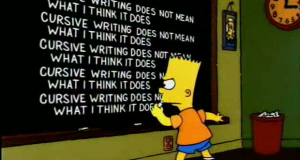
Lastly, an extremely important part of blogging is keeping your audience entertained.  This can be accomplished many ways, but one of the most common, and easiest, is through the use of imagery.  When writing about dense topics, like the necessary use of technology in education, funny pictures can be a great way to break up your writing.  They give the reader something pretty to look at for a moment, which gives them a refresher from your writing while also adding to your argument.  In my post, I used images after almost every subtitle.  Additionally, I used my first image, after my title, to hook my reader in.  By using a picture that many people would recognize, Bart Simpson in trouble in his elementary school, I not only get more people hooked into my post, but also demonstrate that it will be about education.


Image Credit

http://vocaladymagazine.com/2015/07/02/how-to-convince-your-parents-to-let-you-be-a-creative-writing-major/

http://www.ignitesocialmedia.com/community-management/community-manager-life/

Categories: Uncategorized | Leave a comment

How to Fix English Class

bart-simpson-writing-sentences-featured-image

ASSIGNMENT

Imagine this.  You’re sitting in your dorm room, listening to the newly released Kendrick Lamar album and talking to your roommate about how much you don’t want to do your latest english assignment.  You’re supposed to analyze the rhetoric and rhetorical styles that authors use to make their essays good.  It’s a typical english class essay: everyone ends up researching an old, famous, white author and writes essentially the same 5 page analysis as everyone else.  Isn’t there anything else people can write about?

Suddenly, your roommate has a brilliant idea, what if instead of choosing an author, you choose a poet, or even a rapper?!

SPOKEN WORD

720x405-R1231_FEA_Kendrick_Lamar_A

This is what happened to my friend Alex in his english class in his first quarter of college.  The class was told to write a biography of a Californian author who they thought the class should study next quarter.  While the rest of the class chose writers of the past, Alex chose to write about Compton-born rapper, Kendrick LamarHis argument was pretty straightforward:

“Too much of our curriculum is centered around literature written decades or centuries ago by white authors. Rather than learning about the recent history of California through authors of older generations, we should pick a modern, black poet like Kendrick. His music is a connection to the modern struggle of black Americans. Studying music allows you to still read the lyrics as well as experience the themes aurally.”

It was a great choice.  Not only do rappers use rhetoric in their songs, but because he’s a current artist, the issues his music responds to are the same issues we are trying to solve in society.  Isn’t that what education is all about?  Thinking outside of the box and bringing other cultures and thoughts together to reshape our opinions?  However, in order to study a current author, technology is needed.  In order to keep up with the issues that his music responds to, along with the music itself, those who study Kendrick rely on technology.

TECHNOLOGY SOLVES OUR PROBLEMS

Despite the ease in which technology made a boring assignment interesting and valuable, people still argue that technology is being overused in education.  They argue it’s making us dumber!  In reality, it’s just allowing us to use our brains for other things, like drawing connections between cultures.

My own view is that technological innovations are providing society with a method in which information is easily accessed and remembered, which allows education to be even more interesting and valuable.   To be clear though, there are still good and bad uses of technologyI concede that by making information easy to access, people have become lazy and are in a position where they can gather new information without really learning it.  However, I still maintain that the benefits that technology provide outweigh the negatives.

THE WORLD IS FLAT

For example, technology brings cultures together and allows people to study the cultural issues other people face.  From other cities in the United States, (Kendrick’s hometown of Compton) to cities all across the world, different cultures and societies offer unique perspectives to today’s life.  Thanks to technology, we are able to gather all these different perspectives and become fully educated to the world around us. Some people may respond by arguing that technology will never be able to replace the methods in which people learned before technology was so easily accessible.  I would reply by clarifying what I’m saying; technology will never and should never totally replace prior methods of learning.  Its best use is in conjunction with traditional learning methods such as going to the library.  This ease of communication and shared knowledge can be extremely beneficial if it’s used in the correct amount.

ANTICIPATION TO LEARN

Technology allows people to find topics that they have never heard of before and easily become interested in learning more about them.  In her article, “I Had a Nice Time with You Tonight. On the App,” Jenna Wortham, a writer for the New York Times, suggests that smartphone apps actually bring people closer saying,

“If anything the pervasiveness of technology in my life has heightened my desire for actual one on one meetings” (396).

In other words, it is understood that interaction through a phone screen will never produce the same results as seeing your significant other in person, and in no way will social media ever be able to replace that.  However, it creates anticipation for the moment when that in-person meeting actually does happen.  I think this is a perfect correlation to education.  The online interactions serve as getting hooked by an new topic on the internet, but the real deal, where the real educating occurs, comes from the face-to-face discussions, which can be considered the hands on research that goes on at a library, in a classroom or through reading a book.

Similarly, had it not been for a multitude of different technological advances, Alex wouldn’t have ever thought to write about Kendrick.  It would’ve been an extremely challenging assignment.  From listening to his songs over and over and writing down the lyrics by hand, to then analyze them and then write a whole new paper.  Instead, all he had to do was search for Kendrick’s lyrics.  Genius music pops right up and he’s taken to a place where he can read and analyze the lyrics.  Also, on the side of the page he’s given someone else’s opinion of what Kendrick’s lyrics mean, yet another example of the shared knowledge that technology provides.

WHAT DOES IT MEAN?

tumblr_inline_n17fltqhgh1rbihbq

When interviewed for Rolling Stone Magazine, Kendrick is vague about what the title of his third studio album, “To Pimp a Butterfly,” means.

“That will be taught in college courses someday…. “You take a black kid out of Compton and put him in the limelight, and you find answers about yourself you never knew you were searching for.”

Kendrick’s dream of being studied in college courses is one that Alex shares.  They agree that by studying his music, new ways to look at society will develop.  However, in order for classes to study Kendrick, technology must be used in the classroom.  It wouldn’t be possible to study any artist’s music without the aid of machines that give millions of people access to the same information.  As long as technology is used we’ll be able to do exactly what I feel education should be all about, learning from everyone’s perspective in order to look at the many questions and challenges in society.

Here’s a link to an NPR youtube video that encapsulates the idea of analyzing Kendrick’s music in a classroom environment.

Works Cited

Wortham, Jenna. “I Had a Nice Time with You Tonight. On the App.” They Say I Say With Readings. Ed. Gerald Graff. By Cathy Birkenstein and Russel Durst. New York: W.W. Norton, 2015. N. pag. Print.

Image Credit

http://www.avoiceformalestudents.com/wp-content/uploads/2014/10/

http://www.rollingstone.com/music/news/the-trials-of-kendrick-lamar-inside-the-new-issue-20150311

http://gifrific.com/ron-swanson-throws-out-computer/

http://theodysseyonline.com/unc/college-life-michael-scott-gif-edition/74750


Categories: Uncategorized | 1 Comment