Private vs. Public Colleges

Yesterday, in my english class, a colleague of mine presented about the benefits that private and public colleges offer.  His research was very interesting to me because it intertwined with my research, which is about diversity on college campuses.  His research broke the debate down into three different categories.

Cost and Size

Obviously private colleges cost more, on average, than public schools do.  This is because in-state tuition at public colleges is so low.  However, a very interesting point that was brought up was that private schools tend to have a better four-year graduation rate.  This makes the long-run cost of attending private schools less than it might seem initially.  Hopefully, in your first year out of college, or fifth year after starting school, you will be making money which will help pay for some of the cost of attending college.  Conversely, it may take you 5 years to graduate at a public school, which would mean that instead of making money in your fifth year, you are spending another year paying college tuition.  A reason why private schools tend to have better graduation rates may be the class sizes.

Private schools tend to have small classes which allows students to have more discussion based classes.  Additionally, you get to know your professors which is an invaluable asset to have when you inevitably get confused by the material that you are learning.

Diversity

The most interesting part of my colleague’s research was about diversity.  He was looking at the retention and graduation rates at colleges and how they related to diversity of campuses.  This is where my own topic helped fill in some gaps.  I found an article in my research that found a positive correlation between college diversity and first-year GPA as well as freshman to sophomore retention rates.  This seems to show that diversity is extremely important for colleges and raises the question: which type of school, private or public, has greater diversity?

Categories: Uncategorized | Leave a comment

Chicago’s Chance

“Help me with this; I’m lost.”

Thats how New York Post columnist Phil Mushnick begins his opinion piece challenging the decision by the Chicago White Sox, a professional baseball team, to make Chancelor Bennett, known better by his stage name, Chance the Rapper, the team’s ambassador.  Mushnick disagrees with the White Sox’s recent decision to make Chance their “team ambassador,” a position that combines the fans of hip-hop and those of baseball.

Mushnick says he “spun the Google wheel” and it “landed” on Chance’s song Smoke Again, which he claims to be “dehumanizing gangsta rap.” However, by “randomly” selecting a single song, Mushnick avoids fulfilling his obligation to fully understand who Chance is as an artist.  Not all of Chance’s beliefs are represented through one single song, and if they were, I guarantee Chance wouldn’t pick Smoke Again as the one that does. If Mushnick were to pick a couple more songs, he might land on Sunday Candy, Nostalgia or Wanna Be Coola song that advocates for individuality and uniqueness in a time where everyone is too focused on being the same and fitting in to be “cool.”   In fact, when googling “Chance the Rapper songs,” Smoke Again doesn’t come up in the first 10 articles.  This seems to argue that in order to make his insular opinion, Mushnick searched “Chance the Rapper Smoking Weed Song”- an activity that Chance no longer participates in.

It’s sad that Mushnick fails to recognize what thousands of people, including the White Sox organization, Chicago’s mayor Rahm Emanuel do: that Chance is striving to improve the lives of millions.  Sadly, readers of this opinion piece may come to an  unfortunate conclusion: that Chance is hurting Chicago when the truth is in fact the complete opposite.

Categories: Uncategorized | Leave a comment

How to B.S. a Presentation

pluto-the-new-bs-alert-from-nasa

Recently a classmate of mine responded to a TED talk that she saw about what it means to be smart.  In this talk, the performer told his audience that

 “he will make them feel as if they have learned something even though he himself had not conducted any research or have anything inspirational to say.”

Despite telling the audience that he was making random claims and that he had nothing to back them up with, he still managed to come across as compelling and informational.  This is how he sounded “smart”:

The Steps

  1. Use hand gestures
  2. Take long pauses,
  3. Adjust your glasses / wear glasses
  4. Ask a hypothetical question,
  5. Tell a personal and embarrassing anecdote

Just because a presenter does any one of these things, it doesn’t actually make them any more or less smart than they already are. However, because of the stereotypes and ideas we have associated with type of people who do these things, people are able to come across as smart if they do some of them.

Obviously, nothing makes you seem smarter than actually knowing the material you’re supposed to be presenting but if you use these steps in a presentation where you know the material, I guarantee people will realize how smart you are.


Categories: Uncategorized | Leave a comment

The Greatest Catch That Didn’t Count

Screen Shot 2016-04-21 at 12.44.50 PM

Sectionals

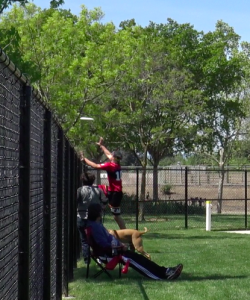
I play for the Santa Clara University frisbee team and this past weekend, we played in a big tournament called “Sectionals.”  It consisted of the best teams from Northern California and Southern Nevada.  The top seven teams from this tournament would go on to “Regionals” (which consists of the best teams from the SW United States) in two weeks.  While at the tournament, one of the seniors on our team made an unbelievable catch, on a pass that was out of bounds and about to fly over a fence.  He leaped up and caught the frisbee while climbing the fence, reminiscent of an outfielder in baseball robbing a home run.

Since the game was being recorded, the video of this unbelievable catch quickly made its way across the internet and just yesterday it was tweeted out by Brodie Smith, a very well known professional frisbee player and trick-shot YouTube sensation.  It was a great reminder of how powerful technology is in sharing stories.

Ease of Communication

Within just a couple days, the whole world was able to see a single highlight that happened in Livermore California over this past weekend.  Thanks to the exposure from Brodie Smith’s tweet, the play is currently at #1 on the frisbee thread of Reddit.

Twitter and Reddit aren’t common places where scholars would think to look for communication and interaction, however, this is a simple example of how easily people can be connected in today’s world.  This same concept can be applied to learning in a classroom environment.  People from across the country and world are able to share ideas through these technological developments.

SC Top Ten

Our team is currently trying to get the video to be played on ESPN’s staple sports show, sportscenter.  We are using twitter to raise the number of views of the play and hopefully as a result, more people will see it and potentially it will ultimately wind up on ESPN.  If it wasn’t for the ease of sharing and communication that the internet provides, the only people who could have witnessed the great catch would be those who saw the play live.

Categories: Uncategorized | Leave a comment

How To Use Twitter in Papers

In his article, “BEAM: A Rhetorical Vocabulary for Teaching Research-Based Writing,” Joseph Bizup, a professor at Columbia university introduces his research concept: BEAM.  As opposed to the traditional way of categorizing sources, primary, secondary and tertiary, Bizup chooses to organize them in categories based on how the way they are being used.  BEAM is made up of background, exhibits, arguments, and methods.

Of the four categories, the most interesting is exhibits.

Bizup states that the most common form of an exhibit source is giving an example of something.  However, Bizup distinguishes between “evidence” and “exhibit.” He stresses that the job of “exhibits [is to] lend support to claims …. [and] provide occasion for a claims.” In other words, exhibits are basically a way to restate the claim you are making through an example, rather than provide a “proof” for your statement.

Twitter

The reason why exhibits are the most interesting to me is that I believe it is the category in which many new technological sources would fall.  As a student, I would never consider using twitter or some other social network in my research paper.  However, Bizup’s method leads me to think that it’s possible, assuming I do it correctly.  A new feature that twitter offers is access to creating and participating in simple polls.  Someone can tweet out a question, and quickly gather responses from a huge group of people.  This data could then be used to share the opinion of many people in a research paper.  As long as it isn’t used to prove that the writer is correct in their complete argument, it would be extremely powerful as a form of evidence that shows what people are thinking.

Bizup’s strategy has given me hope that research papers, something I would never associate with the developing technological world, are becoming accepting of the ways the next generation thinks.


Categories: Uncategorized | Leave a comment

A New Research Process


Busy, Busy

Unsurprisingly, college is a busy time.  Between all the classes, various clubs, sports and socializing with friends, sometimes it seems a little crazy for professors to expect students to write research papers in just two weeks.  So it’s not extremely surprising that Michael Kleine is horrified to see college students just “copying” and not “analyzing, synthesizing, evaluating, selecting, rejecting…” different sources to create research papers.  In his article, “What is it We Do When We Write Articles Like This One – And How Can We Get Students to Join Us?” Kleine explains ways for students to get away from how they typically conduct research and also tests to see what these typical methods are.

Hunting and Gathering


Kleine breaks down the research process into eight different boxes, four categorized as “hunting” and four categorized as “gathering.”  Within each of these subsections there are four different categories, “collecting, rhetorical sifting, pattern seeking and translating.”  Each box corresponds with a different part of the research process.  This was a tool that I found extremely interesting.  Prior to the reading, I had never explicitly thought about the different subsections of research, I’ve always had one big category: do research.  However, I think by using this method, I will be able to make sure my research is more complete.

However, while I now have the ability to make sure I don’t skip any part of a good research process, that doesn’t mean it’s always going to be feasible for students to abide by this model.  As I previously mentioned, college life is busy and while schoolwork is always going to take precedent over other activities, It may not be necessary or practical to use them all.

Categories: Uncategorized | Leave a comment

“Why I Write Letters”

Social Media Takeover

As I was scrolling through Facebook last-night, a typical procrastination strategy that usually results in nothing but an hour or so going to waste, I came across an unusually interesting post from one of my high school friends.  It was a link to his first article, titled “Why I Write Letters,” for Odyssey, a “social content platform that discovers and shares a chorus of millennial voices, amplified organically through social media.”  I gave it a quick read, it was only about 500 words, and immediately realized how much it related to both my current english class and life outside of school.

I immediately connected with his article before I even began reading it.  For every birthday, Christmas, or Easter present I have ever gotten, my parents have always made me write a personal thank you letter by hand.  It’s always been a pain for me to do, however, it’s the type of thing that ends up being worth it.  People are really happy when they receive hand written letters and for the most part, they’re really easy to write anyway.  However, the vast majority of kids my age don’t write cards for any occasions, instead resorting to email or even more likely, a text, Snapchat or Instagram post.

His article discusses the issues that our generation is encountering with respect to our dependance on technology and how it impacts our daily lives.  He describes his perception of our generation’s need to always be on our phones and our lack of ability to hold a conversation for more than five minutes.  He goes on to ultimately share his concerns for the future,

“I fear for our diminishing sense of compassion. It is worrisome that social gatherings seldom involve social activity; it is worrisome that documenting an event for the purpose of posting it on social media outlets has become more important than experiencing said event.”

What’s ironic to me is that his message, which I agree with on the majority of levels, is being shared on a website that takes pride in its ability to reach a young audience through social media.  My friend is using technology and our generation’s constant need to check social media, to reach his audience.  This is the way in which I hope, and believe he hopes, technology can be used in the future to connect people from across the globe and share our ideas.

Categories: Uncategorized | Leave a comment

“A National Trend”

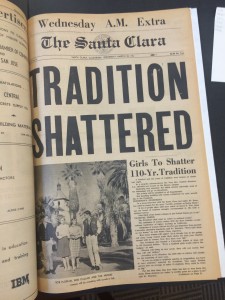
Tradition Shattered!

IMG_2759

In my last post I discussed my impending trip to the archives at Santa Clara University and some of the questions I am hoping to answer through my research.  I was planning on researching the way the university transitioned from an all boys school to a coeducational school.  There were numerous collections at the archives full of articles written by the students of Santa Clara.  Above is a picture of a very controversial article.  The title answers some of my questions itself.  It definitely gives off the feeling that the girls that were about to start coming to the school were unwelcome.  While is is definitely true that many of the students and faculty were displeased with the administrations decision to accept girls, the article dives into the reasons why the administration decided it was the right decision.

The Way of the Future

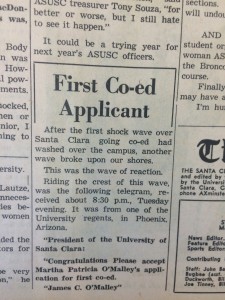
The article provides a statement from the President of Santa Clara, Fr. Donohoe.  In this he addresses the reasons for his decision.  He claims that the board of trustees strongly recommended the change and cited a national trend saying

“One third of the Jesuit colleges in the United States are co-ed”

This paints a clear picture of why Santa Clara decided to transition into a co-ed school.  It wasn’t because they personally felt it was the right decision, but because they were under pressure to do so.  However, they became the first Catholic school of higher education in California to become co-ed.  In this sense, Santa Clara was ahead of their time.

Unsurprisingly, as I learn more about the complexities surrounding the transition, more questions are raised.  For example, what was the next Catholic school of higher education in California that became co-ed?  Also, did Santa Clara initially attract many female students or did it take years before many were applying and choosing to attend?

IMG_2762

I’m not the only person researching Santa Clara’s transition into a co-ed school, and these articles in the archives go a long way to answering questions that I, and my colleagues are asking.


Categories: Uncategorized | Leave a comment

Archival Research

Is Change Good?

In 1961, Santa Clara University finally admitted 75 female undergraduate students, becoming the first Catholic coeducational university in California.  Unsurprisingly, this was met with some skepticism from some students and faculty, while others viewed it as a step forwards.  It comes as no surprise to me that some people were unhappy with the change to a coeducational university simply because people usually don’t like change.  However, there is little doubt in my mind that it was the right decision for the university to make.

I get a unique opportunity to go to the university’s archives this week and explore all the different sources that they have.  This will be my first time going to an archive.  So, in preparation, I read an article by Katherine E. Tirabassi in order to get a sense of what I would need to know in order to do good research.  The most important and challenging part I think has to do with what Tirabassi refers to as the “Principle of selectivity.”  This essentially states that there is going to be tons of information available to me in the archives and as a result, I’m going to need to be very selective, making sure to stay focused on a singular topic.

Context is Key

In preparation for all the resources I’m going to have an opportunity to explore, I’ve decided to research why the university decided to change from an all boys school to a coed school.  Were they acting out of their own choice or was the university under pressure from an outside source?  This is all context that I will need to gather at the archives too in order to really build up my knowledge of the scenario and try to understand the reasons behind the university’s decision.

Image Credit

http://katereedsenglishsite.weebly.com/archives.html

AI: Girls still have cooties


Categories: Uncategorized | 1 Comment

Being Lazy is Hard Work


Wait What?

It doesn’t intuitively make sense, but the more you think about it, the more you realize that everyone’s done it.  At some point in your life, probably recently, you decided that you didn’t need to do exactly what you were told.  You “understood” what the final product was supposed to be like and figured out a “genius” way to kind of accomplish the task, with little effort.  What we fail to recognize, however, is that we end up spending almost as much time being “lazy” and doing the task the “easy way” as we would if we did it the way we know it should be done.  A very prevalent example of this in my life are homework assignments, specifically research papers.

The first step to writing a good research paper is getting background information about the topic so you can formulate a position that you are going to write from.  While your teacher may have specifically asked you to go to the library and find magazines articles and books to do this, you decide that what she really wants is for you to just understand the topic.  Thankfully, the internet is here to help.  You quickly Google your topic of choice and without fail, the first hit is Wikipedia.  Is there anything wrong with using wikipedia for background information?  Not really.  But are you following directions and doing what your teacher asked? Definitely not.

However, you move on to the next part of your research because you decide that you’ve gathered all the background information that you need.  It’s only taken 15 minutes so far!  Not bad.

The Library of Google

Your assignment says that you need to use both books and journal articles in your paper and your teacher has “strongly recommended” that you go to the library to find these resources.  However, thanks to the advances of technology, you instead choose to just search through “Google Books” and “Google Scholar” to find resources.  In his Essay “The Great Research Disaster,” William Badke, A professor at Trinity Western University, describes these exact steps that Liw Ekdab did when writing a sophomore research paper.  After numerous searches and a lot of looking through different book lists, Ekdab finally found a snippet that was good enough to use.  However, he had to put in a lot of effort just so he could avoid going to an actual library.

His whole research process revolved around his decision not to go to a library, even saying

“I bet I could put together a paper from pieces of Google and never come near a library or even a library website.  I bet I could write a paper good enough to get at least a B+”

Not only did he immediately decided that by using google to find his resources he was saving himself time, which isn’t necessarily true, he also shut himself off from a whole collection of good resources.

What’s Good Enough?

His decision to ignore libraries and get a B+ by doing the assignment in what he thought was an “easy way” is common one among college students.  I’m guilty of doing it at times in my academic career, however, I’ve begun realizing that it is a mistake.  Had Ekdab decided to go to a library and get as many sources as possible, he would have done better on his assignment and also spent less time than he anticipated.  Much of the time that college students save by taking shortcuts on our assignments is spent skimming many different books to try to get a summary of what we are “researching”.  Also, much of our “saved” time is used making sure that what we wrote sounds “real” and not like we just gathered two quotes from the couple sentences we just skimmed.

Ultimately, if we focused on doing quality research it wouldn’t take much longer than we are already spending on our assignments and we would do even better than “good enough” which is never as good as we ultimately want.

Image Credit

http://giphy.com/gifs/lazy-scott-pilgrim-complaining-VMtTNzgBjvlHG

https://tattoosales.wordpress.com/tag/scrooge-mcduck/

http://hamonlibraryblog.org/2015/11/10/simple-web-tools-for-creating-graphics/

Categories: Uncategorized | Leave a comment