Reflecting…

In my last post, I wrote about a controversial topic about college education and how it can lead to social inequality.  I found that writing is hard, but writing for an educational blog post is even harder.  I did not really know what to expect when writing my last post, as I had never blogged before, so it was a very new experience.

However, even though it was challenging, it was interesting to write an educational blog post. To me, the term “educational blog post” seems to be a contradicting phrase because when I think of a blog post I think of text that is very informal and short, and when I think of anything educational I think of text that is formal and long.  I attempted to blend the two into this new educational blog post format, and hope that I did so in a way that was engaging, informative, and easy to read.

It took me a while to figure out what the most important points in my paper were because, as this is a blog and not a novel, I had to condense my seven page paper into an 800 word conversational post.  I also had to re-word my paper to make it sound less formal, and that was the part that I struggled with the most.

I genuinely could not figure out how to completely re-word my sentences while still getting the same idea that I had in my paper across.

I was just staring at my computer screen, and no ideas were popping into my head.

Everything that I felt like I wanted to say seemed to be stuck in my original paper.  I genuinely struggled in finding my voice and translating what I had in my paper into the more casual tone that is required for a blog post.  I attempted to include my own voice in the post, but I felt as though I could not really re-word my essay without completely changing its main points.  I added somewhat of a personal anecdote in the begging to attempt to draw the reader in,  but to me, the essay did not sound the same with the changes, even though it had all of the same information.  Essentially, I had writer’s block to the extreme.

So, I looked at my paper again and decided to break it up into its main ideas.  I took these ideas and made them into subheadings for my post, which helped me to create an outline as to what to write.  This informal outline helped me to make sure that I included all of the most important ideas of my essay, making it easy to condense it, and provided smooth transitions.  I also had to thoroughly condense my use of quotes.   I had to be very selective of the quotes that I used, and only chose the two most vital ones.  However, I think this actually made my quotes more effective because there were only two and they were very prominent, as I put them in block quotes.

I think that using subheadings and block quotes actually helped to make my blog post more aesthetically pleasing because it added blank space and really brought out the highlights of my argument.  This way, readers could get a glimpse into the body of my argument without even reading the whole post.

My enthralled readers when they see my blog posts

My enthralled readers when they see my blog posts

I also found that adding in images and gifs really helped move my blog post along.  It helped me to visual some of the key points or ideas, which helped me to get into a less formal mindset.  I also feel as though they helped to keep my readers engaged, as it was a nice break from the regular text.  It was important for me to find images that humorously (and one that statistically) added to my argument, so that someone who just paid attention to the images could understand my point of view.  I also had to choose which words and phrases were the most important, and italicize and/or bold them.  I believe that this was helpful because, like the images, they brought attention to the most important points of my paper.

Along with the images, I think the hyperlinks really helped to add to my argument.  It is nice that on a blog, unlike on a paper, you can just easily click on a link and connect to other writers and their ideas.  This puts me in conversation with people around the world, which is something that I find amazing.  However, the only challenge was that I had to find ways to include this hyperlink so that it flowed seamlessly with the text, and so that the word that the hyperlink was on correlated to the actual link.

https://media-mediatemple.netdna-ssl.com/wp-content/uploads/2012/06/clickhere_labels.png


Final Takeaways…

I still have a lot to learn about blogging, but through this assignment I realized just how much fun it can be!  Blogging is a way to connect to readers on a more personal level, which can be challenging, especially if one is writing about an academic topic.  No matter the topic though, I need to be able to connect to a broad audience, so that anyone reading my post will be able to understand it and want to read more.  If they like it, then my readers could easily share my blog post with others, so that I may enter into conversation with them.  Blogging is a way to put your thoughts out there in the world, to open yourself up to criticism, and to expand your own views.

However, although blogging may seem like all fun and games, there is a certain science behind it.  I had to put in images, hyperlinks, block quotes, and more so that my blog resembled what a professional blog post should look like.  If it is just a block of text, then no one will want to read that.  In a blog, I learned, I have to draw my readers in first aesthetically, and then with my content.  (This is very unlike regular college essays where the only important thing is the content).  Although these blog posts were a little challenging, they stretched my abilities and it was fun to be a little bit more creative than normal.  I very much look forward to the blogging that I will be doing in the future, whether it be in more English classes or not.


Images 

Image 1: http://giphy.com/gifs/computer-GyLc9e3hTYFWw

Image 2: https://media-mediatemple.netdna-ssl.com/wp-content/uploads/2012/06/clickhere_labels.png

Image 3: http://giphy.com/gifs/disney-big-hero-6-hiro-hamada-writers-block-XqQ6qRCtNQnfO

Image 4: http://cdn.skim.gs/image/upload/v1456337637/msi/woman-reading-blog-vert_j8tuqp.jpg

Image 5: http://giphy.com/gifs/blogging-4jJulEm0k81TG

Categories: Uncategorized | Leave a comment

To College or Not to College, that is the Question…

I have always thought that it was imperative to go to college.  From a young age I was conditioned to believe that success was synonymous with college.  The idea of going to college and getting a degree has been so drilled into my head by society and my family that I never thought otherwise.

However, a recent a controversial issue has been whether or not it is necessary to attend college.

Some people, like my parents, say that you have to go to college to learn and grow as a whole person and consider it to be an essential part of their learning process and success.  However, many other people believe that attending college is not necessary.  They argue that it’s costly, ineffective, and that it’s possible to be successful regardless of whether one has a degree or not.  Worst of all though, is that whether or not one attends college can cause social inequality.

Basically, the issue is whether to pay to go to college and experience a full and formative educational experience, or to not attend college and to simply start working towards a career and learn from that.

I honestly think that it’s not that important to attend college.  Although I realize that going to college is helpful because it takes a holistic approach to person’s education and helps them form a more well-rounded person, I still think that a person could learn what they need to in order to succeed through their job.


College is Not all it’s Cracked Up to Be 

It’s possible to become educated without attending college.  Just because you didn’t attend school for an extra 4+ years does not mean that you are not intelligent.  After all, there is a definite education that you get simply from going through every day experiences that life hands you, and an even more specific education through your job.  You can learn almost as much as others who attended college, but are looked down upon because you are just simply a “worker”.  However, you can learn infinitely more from working and real life experiences than you ever could from just sitting in a classroom because you are going to be dealing with actual problems as opposed to staged classroom situations.

Unfortunately, employers and society do not agree with this.  Professor and author Mike Rose has said,

“We reinforce this notion by defining intelligence solely on grades in school and numbers on IQ test.  And we employ social biases pertaining to a person’s place on the occupational ladder” (279).

According to this view, there are inherent biases on the people who do not attend college.  Society thinks of these people as lower class beings, only because they did not sit in a classroom for four years.  This is how education is turning into a problem of social inequality because in society’s eye, those who have been fortunate enough to receive a college education are supposedly “better” than those who have not.

They are viewed as more qualified, and now it seems as though employers only care if a student has a degree.

The B.A. that students, such as myself, work so hard towards and put so much effort into receiving is now just becomes a sort of screening device.  Basically if I were to apply for a job somewhere, a single sheet of paper would be enough for the employer to sum up my life, accomplishments, and worth.  The employer would look at me differently depending on what degree I received from whatever specific college I graduated from, and whether it is “prestigious” or not.  This is completely unfair and a total biased approach, but this is our new reality.


People who don’t Attend College aren’t Dumb

Today, if I did not receive a B.A., many would assume that is because I am too lazy or too dumb.  This is a false statement though, because there are many other issues that could go into my decision to attending college or not.  However, the biggest reason that people do not attend college is because of  financial issues.

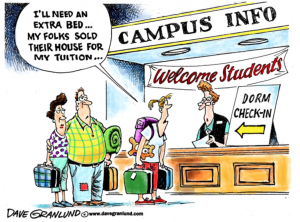
http://www.davegranlund.com/cartoons/wp-content/uploads/College-tuition-costs.jpg

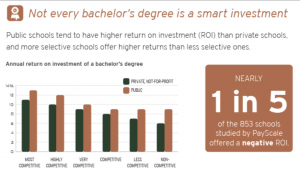
College is becoming more and more expensive, and not all families can afford tuition.  Not only is tuition an obstacle, but also the fact that there is not always a big return to education.  You could manage to receive large student loans to help cover the cost of tuition, but if you do not make much money after you graduate, then it will be very hard for you to pay off these loans, and you may wind up with debt.  After all, the more money someone has to pay to attend college, the lower the net benefit of attending.

http://www.brookings.edu/~/media/Research/Files/Blogs/2013/05/09-college-degree-investment-sawhill-owen/smart_investment.jpg?la=en

It may take years for students to pay off their loans, which is money that they could be earning, not losing, if they decided to go straight into the workforce instead of going to college.


But Maybe Going to College is a Good Thing?

While it is true that in many cases college graduates do earn more debt, they also earn more money than those who did not attend college.  However, not all the benefits that come with attending college are financial.  There are many non-monetary benefits that come with going to college, such as expanding your knowledge and escaping your socioeconomic status.  Author David Leonhardt explains that,

“…[a] force that can disrupt…inequality [is] education.  When a society becomes more educated, many of its less-wealthy citizens quickly acquire [a] crucial form of capital—knowledge—that can bring enormous returns” (546).

What Leonhardt is saying here is that these educated people will be able to move away from manual labor jobs into more skilled professions.  People won’t have to work long hours that cause strain on their body, but rather they’ll be able to move up to a comfortable managerial position.  Basically, education leads to people getting better jobs with higher wages, which allows them to have a better lifestyle.


So…Should I Go to College?

While there are good points and strong evidence backing the fact that attending college is an important thing to do, I still believe that it is not necessary.

After all, there are many negative aspects that come with attending college.  I mean, it’s a significant financial investment for a simple sheet of paper that society calls a “college degree”, that supposedly distinguishes one person from another.  I truly believe that it’s possible for those who didn’t attend college to learn just as much and be just as successful as those who did.  Although some might object that one receives a more of an official education in college, I would reply that an “official” education is unnecessary.  Most people just need to be educated and mentored in their specific field of work by others who have come before them in order to do well for themselves and be successful.  This idea of “being successful” only through a college degree is simply because of a societal standard to attend college.  However, it’s unnecessary that attending college or not causes these negative prejudices and class divisions.

I wholeheartedly believe that it’s important to abolish these stereotypes and the notion that it’s essential to go to college.  It’s better to just allow people to freely choose whether or not attending college is the right choice for them.


Works Cited

Owen, Stephanie, and Sawhill, Isabel. “Should Everyone Go to College?” They Say/ I Say: The
      Moves That Matter in Academic Writing, With Readings. Ed. Gerald Graff, Cathy Birkenstein,
and Russel Durst. New York: W. W. Norton & Company Incorporated, 2015. 208-223. Print

Rose, Mike. “Blue Color Brilliance.” They Say/ I Say: The Moves That Matter in Academic
      Writing, With Readings. Ed. Gerald Graff, Cathy Birkenstein, and Russel Durst. New York: W. W.
Norton & Company Incorporated, 2015. 272-283. Print

Leonhardt, David. “Inequality Has Been Going on Forever…but That Doesn’t Mean It’s
Inevitable.” They Say/ I Say: The Moves That Matter in Academic Writing, With Readings. Ed.
Gerald Graff, Cathy Birkenstein, and Russel Durst. New York: W. W. Norton & Company
Incorporated, 2015. 542-547. Print

Freedman, Josh. “Why American Colleges Are Becoming a Force for Inequality.” The Atlantic. The
Atlantic, 16 May 2013. Web. 9 Mar. 2016.

Kuper, Shaul. “Is a Bachelor’s Degree Still Worthwhile?” FoxNews.com. Fox News, 25 Apr. 2014.
Web. 9 Mar. 2016.


Images

Image 1: http://giphy.com/gifs/mic-education-michelle-obama-flotus-nnbyGJfJEp7zi

Image 2: http://giphy.com/gifs/AZMysyGs6X6yA

Image 3: http://www.davegranlund.com/cartoons/wp-content/uploads/College-tuition-costs.jpg

Image 4: http://www.brookings.edu/~/media/Research/Files/Blogs/2013/05/09-college-degree-investment-sawhill-owen/smart_investment.jpg?la=en

Image 5: http://giphy.com/gifs/college-workaholics-adam-demamp-4p4FaFkmulsU8

Categories: Uncategorized | 2 Comments