Automation has transformed the way we read, write, and talk to each other. Artificial intelligence is now a part of almost every writing process, from academic writings to web news. It can write emails, outline articles, and even polish whole reports in just a few seconds. But as more and more content is generated by machines, a new concern comes up: how can humans still believe what we read?
When every paragraph might be written by a person or a machine, being open about who wrote it is an issue of trust. It’s more important than ever to know who or what is behind the words. This is where AI detection technologies come in. They are becoming one of the most significant ways to keep communication safe in the current world.
AI detector insights to identify AI writing
AI has made it hard to tell the difference between writing with help and letting technology do all the work. It’s not about saying no to automation; it’s about knowing when it starts and ends. The connection between the writer and the reader gets weaker when readers or teachers can’t tell if a piece of writing shows what someone really thinks or how well a machine works.
AI detection techniques assist restore that relationship by making things visible again. They make things clearer when automation typically leaves things unclear. For teachers, this entails figuring out if a student’s work shows that they really learned something. For content teams, it involves keeping the brand’s reputation intact. And for readers, it’s a sign that authenticity is still important in a digital world that is becoming more and more influenced by algorithms.
Why AI detection protects authentic human writing
People who read don’t want perfect writing; they want honest writing. Text is relatable because it has mistakes, subtlety, and emotion. When writing gets too polished or has a steady rhythm, it loses the subtle tension that makes it sound like a genuine person.
Machines are brilliant at making things work, but they don’t always understand how people feel. They copy tone, but they don’t feel it. That’s why being real, which used to be an artistic choice, is now an ethical value. In a world full with instant content, it’s not just nice to know where it came from; it’s necessary.
This is the main reason why people are interested in solutions like JustDone AI Text Detector. They aren’t meant to punish people for using AI; they’re meant to help people stay responsible. Just look how it works here:
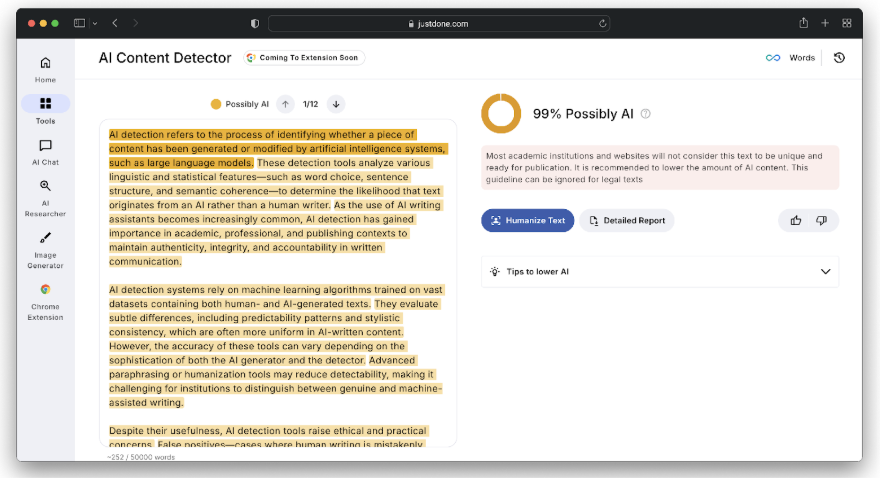
They give educators, journalists, and corporations a method to validate creativity and encourage honesty without inhibiting innovation. These tools help creators figure out how much of their work may have gone from assisted writing to automated writing by finding patterns that seem like machine writing.
Build reader trust with transparent AI detection
You don’t instantly trust content; you have to earn it by sending clear signals. An article, report, or assignment that seems like a person is saying it is more trustworthy. But in the age of AI, trust also comes from being open about how tools and procedures work.
Writers who use AI responsibly already say that they get help with brainstorming or syntax, but they maintain the creative direction and logic human. Detection tools can tell how open this is. They include a feedback loop that helps writers go back over their work and make sure it fits with their ideals of honesty.
AI detection can be used by businesses not to spy on people, but to make sure their work is good. It helps keep tone, intent, and accuracy consistent and supports editorial standards. In school, it teaches kids that being credible doesn’t mean shunning technology; it means utilizing it responsibly.
AI detector role in a healthy creative ecosystem
AI detection isn’t about control; it’s about being aware. It helps develop a creative environment where people and robots can work together well. AI can help writers think, but it can’t write for them. Teachers can look at more than simply the work that students do. Editors can keep their publication’s uniqueness while also getting help from digital tools.
In this ecosystem, detection tools are like quiet middlemen. They don’t get in the way of creativity; they safeguard it. They make sure that automation adds to, not replaces, the human perspective.
Being open and honest builds trust. And in a digital world full of content, trust is what makes real communication stand out from the noise. People are more likely to read, trust, and share a message if they know where it came from.
Write with AI, verify with an AI checker
AI will be all around the next generation of writers as they grow up. They’ll be able to type faster, edit better, and work together using tools that know what they want to do. The goal won’t be to outsmart the machine; it will be to stay true to yourself while utilizing it.
AI detectors aren’t walls; they’re reminders. They make sure that the human side of a process that could become invisible stays visible. They make sure that there is still intention, understanding, and decision behind every text.
Just because we live in an automated world doesn’t imply we can’t be original. It just wants us to learn how to write with awareness, utilizing tools that help us tell the truth instead of hiding it.
That balance is what will make writing believable in the future. Words can still inform, connect, and inspire when they are used with technology and openness, just like they always have.
Leave a Reply