It’s time to refine your tech pack strategy for Vietnam’s thriving garment industry. With $44 billion in 2022 exports, and a projected $6.71 billion revenue by 2024, Vietnamese manufacturers are highly sought after. You can streamline production, avoiding the 90% incomplete tech pack issue, and respect the 2.5 million workers, mostly female, earning an average of $251 monthly.
The Tech Pack as a Production Contract and Communication Tool
Your tech pack functions as a critical production contract and communication tool. Expert Chris Walker defines it as a common reference point, bridging language and cultural gaps between you and Vietnamese factories. This document ensures factories understand your exact design intent, which is mandatory for all startup brands to show product care and protect both parties from misunderstandings, leading to accurate price quotes.
Professionalism and the “9 out of 10” Rule
Demonstrating professionalism with a thorough tech pack is vital. It prevents factories from guessing your design intent, ensuring accurate price quotes. For startup brands, this shows you care about your product and protects against misunderstandings.
Bridging Language Barriers in Ho Chi Minh City and Beyond
Overcoming language barriers in Vietnam, from Ho Chi Minh City to other manufacturing hubs, is simplified with a clear tech pack. Chris Walker emphasizes its role as a common reference point. It bridges cultural gaps, preventing misinterpretations of your design.
A well-structured tech pack becomes your universal translator. It allows Vietnamese factories to bypass linguistic nuances and focus on precise execution, ensuring your design vision is realized exactly as intended, regardless of spoken language differences.
Visual Standards for Technical Flat Sketches
Your technical flat sketches are the visual language for the Vietnamese garment manufacturers. These two-dimensional, black and white drawings, created to scale without shading or texture, serve as the definitive blueprint for both the sample room and the production line. Clear, precise flats significantly reduce misinterpretations and speed up the development process.
Standards for 2D Technical Drawings
Presenting flats as two-dimensional, black and white drawings, created to scale without shading or texture, is non-negotiable. These drawings are the blueprint for the sample room and production line, guiding every step from initial pattern-making to final production.
Utilizing Close-ups for Intricate Design Elements
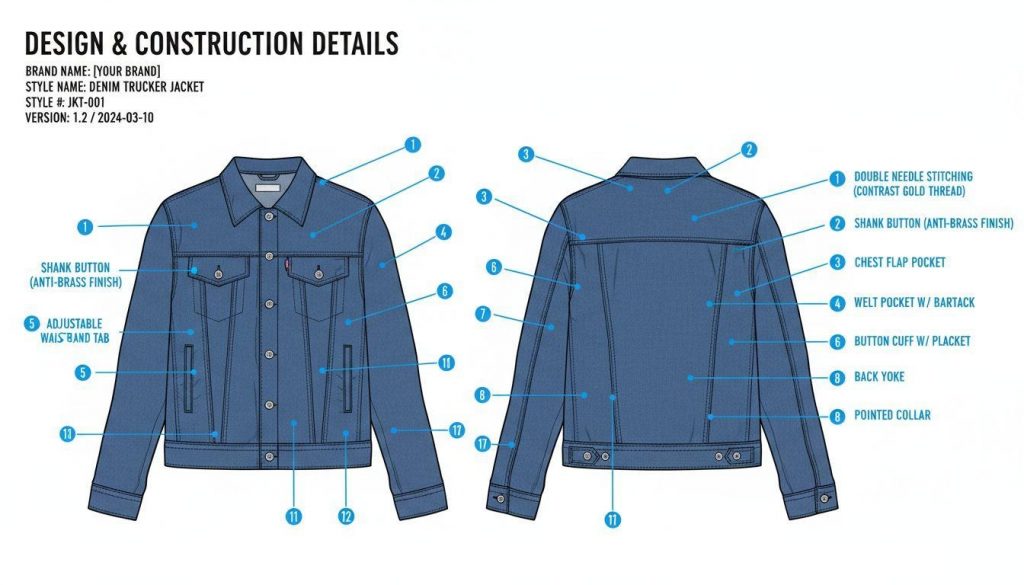
Including detailed close-ups of intricate elements like collars, plackets, and cuffs is crucial. This practice eliminates ambiguity during the initial pattern-making phase, ensuring your design intent is perfectly understood.
Specifically, close-ups of features such as collars, plackets, and cuffs are not just helpful; they are necessary to prevent misunderstandings. These detailed views provide the Vietnamese pattern makers with the exact information needed to translate your vision into a physical sample, avoiding costly errors and delays in the initial pattern-making phase.
Comprehensive Bill of Materials (BOM) and Sourcing Realities
Your BOM must be a dedicated page, meticulously detailing every component. This includes fabric composition, GSM, all trims, and precise Pantone/TCX color references. While Vietnam’s current localization rate is 49%, aiming for 60%, factories typically do not develop fabric. They are not fabric development specialists and will require specific samples or specialized sourcing from you.
Categorizing Fabrics, Trims, and Accessories
Clearly categorize all fabrics, trims, and accessories on your BOM. This organization helps factories quickly identify and source each item, streamlining their internal processes and reducing potential errors in material acquisition.
Managing Color References and Supplier Data
Precisely manage your color references using Pantone or TCX codes. Include complete supplier data for each component, ensuring factories can easily access necessary information for sourcing materials accurately and efficiently.
Providing clear and accurate color references, such as Pantone or TCX codes, is non-negotiable for Vietnamese manufacturers. You must also include comprehensive supplier data for every component on your BOM. This means listing not just the item, but also the preferred supplier, their contact information, and any specific ordering details. This level of detail removes guesswork for the factory, allowing them to procure materials exactly as intended and avoid costly delays or misinterpretations in the production process.
Measurement Specifications, Grading, and Tolerances
Your tech pack needs specific measurement details. A precise spec sheet includes a Points of Measure (POM) diagram alongside measurements for a base size, typically a medium. You must also establish clear tolerance levels for quality control and explicitly define how patterns shift across the full size range in graded size charts.
Defining Points of Measure (POM) and Base Sizes
You need to include a Points of Measure (POM) diagram in your precise spec sheet. This diagram accompanies measurements for a base size, which is typically a medium. These details provide a clear starting point for production.
Establishing Industry-Standard Tolerance Levels
Setting clear tolerance levels is critical for quality control. Woven garments typically allow for ±0.5 cm to ±1.0 cm deviations, while knits allow for ±1.0 cm to ±1.5 cm. These standards help Vietnamese manufacturers maintain your desired quality.
Defining these tolerance levels is paramount for ensuring consistency in your production. If you are manufacturing woven garments, you should specify a tolerance of ±0.5 cm to ±1.0 cm. For knitwear, the allowed variance is typically ±1.0 cm to ±1.5 cm. Communicating these precise figures in your tech pack helps factories understand your expectations for acceptable variations, preventing costly reworks and improving overall product quality.
Construction Details and Sewing Instructions
Manufacturers appreciate tech packs that leave no room for guesswork. Your construction details and sewing instructions must specify stitch types, stitches per inch (SPI), and seam allowances, providing the precision needed as the industry moves toward automation and modern machinery to boost productivity. Clear visuals for reinforcements like bar tacks and specific assembly methods for cuffs or fastenings are highly recommended, ensuring your design is understood and executed flawlessly.
Stitching Specifications and SPI Requirements
You must specify all stitch types and the exact stitches per inch (SPI) for each seam. This precision ensures consistency across production and aligns with the industry’s shift towards automated machinery. Clearly outlining seam allowances is also important.
Reinforcement Points and Assembly Diagrams
Provide clear visuals for all reinforcement points, such as bar tacks, and specific assembly methods for components like cuffs or fastenings. These diagrams are critical for accurate production. Visuals demonstrating how to apply bar tacks at stress points, for example, on pocket openings or belt loops, are invaluable. Similarly, detailed diagrams illustrating the precise sequence for attaching cuffs, collars, or creating specific placket constructions will significantly reduce potential errors. This level of visual instruction is vital for manufacturers utilizing modern machinery, as it directly supports their drive for increased productivity and consistent quality.
Sampling Phases and Quality Control Standards
Managing the Fit, PP, and TOP Sample Lifecycle
Your tech pack serves as the core document for tracking the development of Fit Samples, Pre-Production (PP) Samples, and Top of Production (TOP) samples. It must clearly outline each stage, ensuring a smooth progression from initial design to bulk manufacturing. This detailed record helps both your team and the Vietnamese factory monitor progress effectively.
Quality Assurance and AQL Level Requirements
You must specify Acceptable Quality Level (AQL) standards and fabric color fastness directly within your tech pack. This establishes clear expectations for quality from the outset, allowing manufacturers to understand your requirements for every production run. This section on Quality Assurance and AQL Level Requirements is critical for establishing a shared understanding of quality expectations. You are defining the benchmarks against which all production will be measured, including fabric color fastness. While Mekong Garment factories develop their own internal tech packs for production, these remain their intellectual property and are not typically shared with your brand. Therefore, your tech pack becomes the primary tool for communicating and enforcing your quality standards, ensuring the final product meets your specifications.
To wrap up
Presently, as global brands shift sourcing to Vietnam’s stable business climate, preparing a comprehensive tech pack is your primary path to success. You will overcome the lack of digital skills in some SMEs and thrive in a market focused on high-value, technology-driven manufacturing. Your detailed tech pack directly supports this digital transformation and smarter AI-driven supply chains.
Leave a Reply