
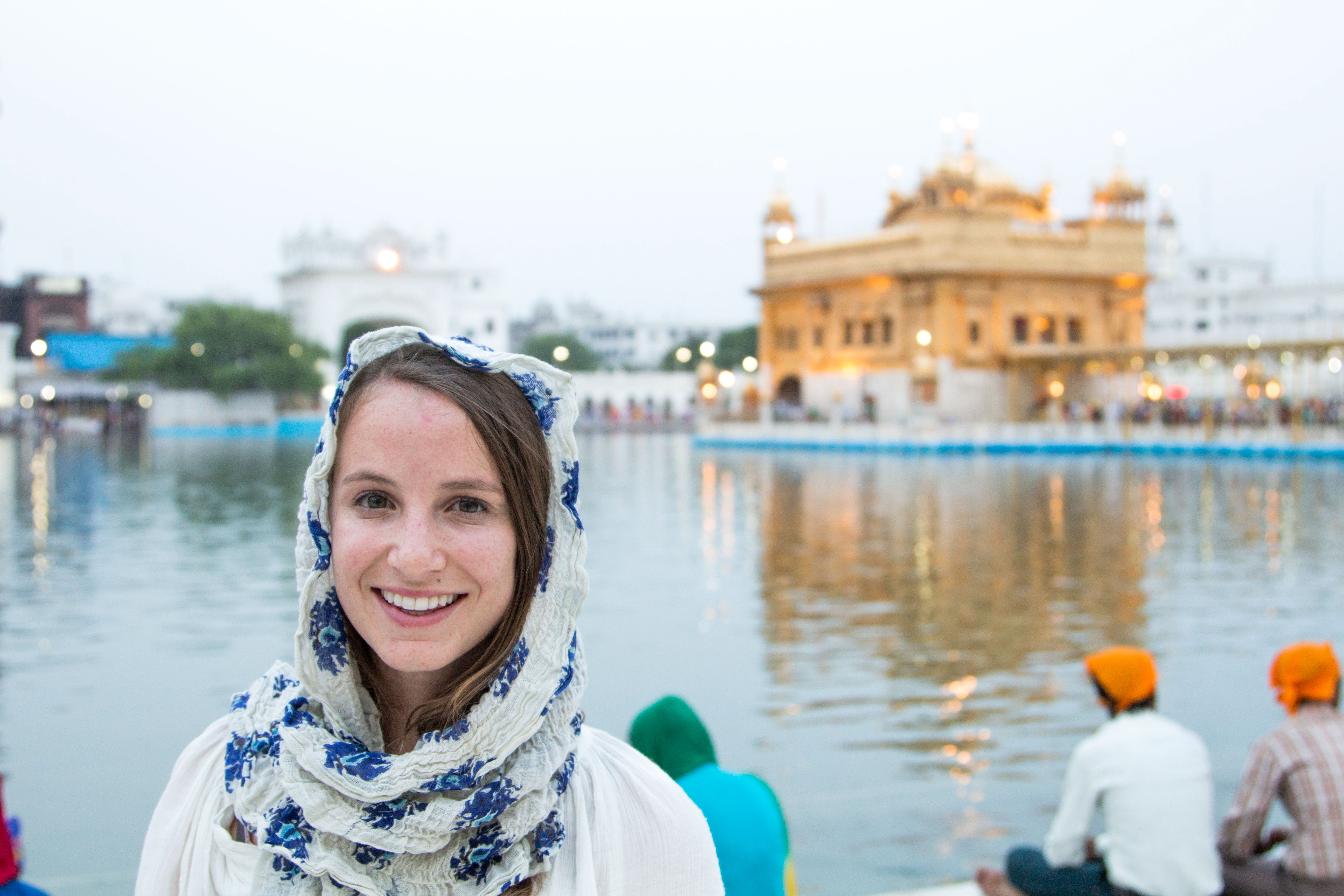
A picture of me standing in front of the Golden Temple with a scarf to cover my head for respect
Organized Chaos
A colorful Indian market
Sweat streaming down my body from pores I didn’t even know I had, crammed in a taxi that is even more crammed by the cars, motorcycles, cows, goats, and people surrounding it. Tattered women with babies and little boys with burns tapping on my window. My head ping-ponging back and forth trying to capture anything that was going on at every instant. Bracing myself and looking into the horrified eyes of a woman we almost hit. Welcome to India! Two days in, we had factory visits after factory visits. India was aggressively in our face, showing us all of itself right then and there. Over-stimulated, over-heated, and under-prepared for the real India, there we were. There was so much that I saw, felt, and experienced in the first few days, I didn’t even know what to put in my journal. After a week of shock, I realized that I could write poetry to wrestle with the experiences and thoughts I was having.
“It’s Normal”
Preparing for the blinding lights to turn into “the light.”
Swerving, honking, flashing brights; crisis averted.
Laughing at the almost head-on collision in the middle of India.
A mom carrying her baby through the streets that are always in motion
Hearing the driver say, “It’s normal” in his broken English and a little smile.
When things are normal, there’s no need to change them.
Frail bodies curled up on the street.
Whether or not they are alive is ambiguously chilling.
Tents seem to house most of India.
It’s normal.
The sun hidden by the smog.
The air more toxic than a cigarette butt.
Watching the beautiful distant mountain turn into a massive dump.
Traffic in India
Seeing the dump catch on fire, giving the thick smog its lifeline.
It’s normal.
Children with burns, women with babies, tapping on your window, rattling your soul.
It’s normal.
You can either find your place in this normality or deem it a tragedy.
But who wants to live a life flooded by tragedies? No one.
Living in this city, you quickly get desensitized.
Your fear softens, your soul rattles less.
Whether you feel the tragedies or not, both are warranted.
But only one is right.
Factories and Photos
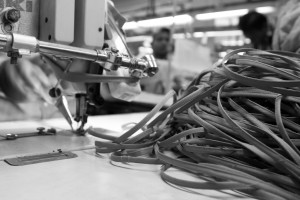
Sewing machine in an Indian factory
Running through the dimly lit factories, my mind was pounding with anxiety. The pictures were blurry at first, I didn’t know the culturally appropriate photographic behavior in India, and I didn’t know the language or the people. I just didn’t feel right snapping pictures of their faces. I have never been so negatively affected by photography in my life. I consider portrait photography one of my most valued hobbies. I get to know people, creatively figure out how to capture “who they are,” and take a picture with them. But I didn’t know these factory workers. I was just clicking away like a wealthy, white foreigner getting a high-class factory tour of this fascinating sight. I was taking pictures of this “fascinating sight” that they won’t leave in an hour and get tea and cookies along the way. This is their life. I realized in this first factory visit, that I have an extremely hard time carrying the stereotype of a white, wealthy, American college student. I try so hard to portray my humble, non-judgmental, and culturally respectful attitude because it pains me inside when people think otherwise. Although I love photography, I couldn’t fathom raising my camera to snap a picture of a passed-out person on the street. I even felt guilt every time I brought out my fancy camera and took pictures in the factory, even with the consent of the factory managers.
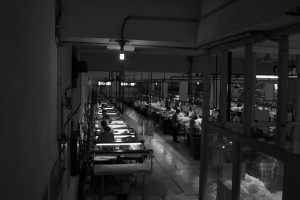
Factory floor in India
After some time, I started to realize that my cultural sensitivity was a gift, not a curse. Understanding India more, getting the head-bob down, and feeling more comfortable in the culture as a whole, my anxiety decreased and the quality of the photos increased. Roaming the streets and factories of India reminded me of how sensitive I am to what other people are thinking and feeling. I could have shot some incredible, shocking, and outrageous photographs, but I was too afraid to create an exploitative image of myself. Maybe I regret not taking more photos, but I also remember the intense inner struggle I was battling with most of the time that gutted all the photographic energy out of me. At the end of the day, I feel like I developed my photographic skills in the least exploitative manner, which is something invaluable for my personal development and future endeavors. I was thrown a difficult ethical challenge to wrestle with, and since I wrestled, I am much stronger than before.
Over and Over
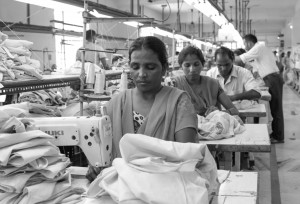
Factory workers on the job
Habits of buying the very best deal,
And perhaps even getting a “steal.”
Unknowingly we could be stealing more,
The freedom of a worker floor.
Factories come in more than one shape and size,
So this is not something to generalize.
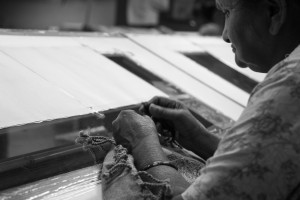
A factory worker methodically checking for mistakes on the scarf
Some find themselves happy and fortunate,
Others, though, trapped and desperate.
With little education,
There’s little ammunition.
Give a person confidence, knowledge, and a voice,
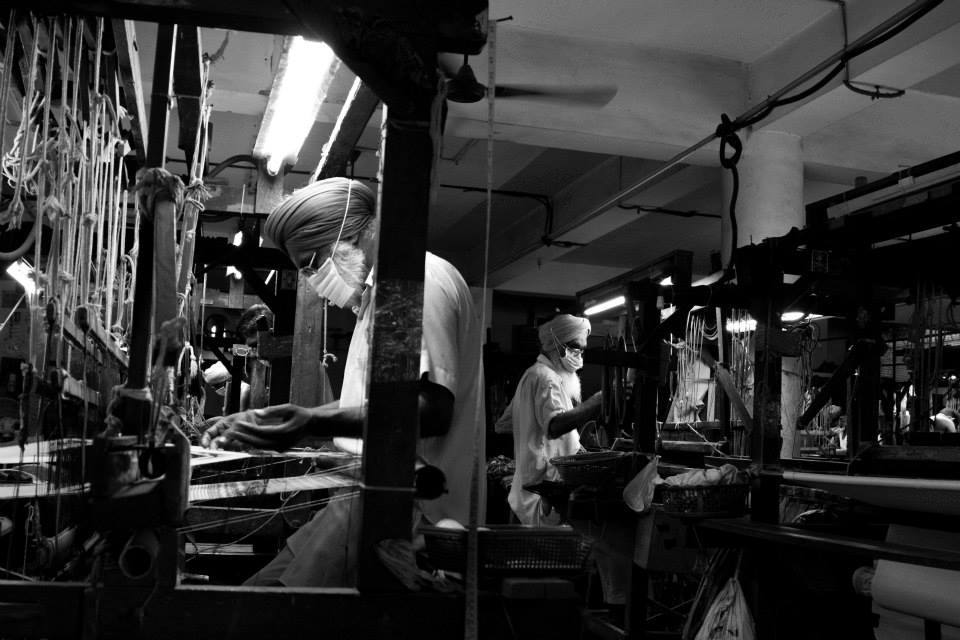
Factory workers using traditional wood looms to make scarves
And suddenly they’ll understand the concept of choice.
Walking through the worker floors,
Eyes burning me as I walk through the doors.
I’m just a white person, a consumer, the problem,
Walking with a camera, trying not to exploit them.
Watching a human become a machine,

A picture I found of a white woman on the wall of a factory. Workers try to put bindis on her, but the management takes them off.
A perfectionist couldn’t comprehend the scene.
The repeated motions are hardly creative,
But they look almost meditative.
I would have to meditate in those conditions,
Leaving would be my only mission.
Shopping frivolously is simply no good,
Save your money, if you’ve seen it you would.
For the Love of India
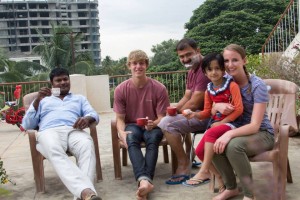
Raj, Matt, Swetam, Chaitanya, and I hanging out at their house drinking chai

Chaitanya, the daughter of our “Indian father,” monkeying around as per usual
Standing in a room full of Indian business men, marinating my senses; the smell of the smoking incense dominating the room, the humming mantras vibrating in my eardrums, the taste of the sweet, Indian treats melting in my mouth, and the warm, welcoming, and excited faces surrounding me. This was the first time I felt the door to the Indian culture swing wide open for me. It all started by being open to India. Two men we met on the street, after getting passed up by a frustrating five auto-rickshaws, offered to take us out to lunch. They were ecstatic to meet Americans roaming the streets of Bangalore. Matt and I looked at each other with the “why not” face, the first of many to come that day, and went out to eat an obscene amount of Veg Thali. Although they were hesitant, they asked us if we wanted to come to their friend’s business opening ceremony. After spending plenty of time with them, we could sense that they were harmless individuals that genuinely wanted to show us around the great city of Bangalore. So we hopped in the car and got to experience a local ceremony with local people. From that point on, Raj (or Raj Mahal as I call him) and Swetam, became our Indian brother and father. I learned from the beginning of my time with them that I am a trusting individual, maybe too trusting. They were genuinely scared for us because not everyone is “good like them” in India. Spending time with them, I got to realize that the culture in India and America are very different. But one is not necessarily better than the other. I remember feeling pity and almost disgust from them when I was discussing how we leave (or abandon) our families to go off to college and become independent. This concept is so looked down upon in the Indian culture. Why would anyone want to leave their families to fend for themselves and be alone? The relationships in India are so rich and intimate, I found myself envying this loving culture. In America, we have big walls between each of our homes, literally and figuratively. The hospitality I have experienced here cannot even begin to compare to that in India. Feeling pitied and having envy are two things I did not originally expect to feel. It took a few weeks to adjust to the non-stop motion of India, but once I did, I was happily along for the ride. By being open to India, India was more than willing to be open to me.
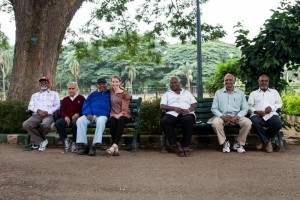
These men have come to this bench for decades. They were hilarious, kind, and showed me again the kind of love India has to offer
Breaking Norms
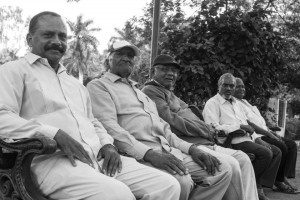
Best friends on a bench
6:30 am. Last week in India. I ran outside with my five-dollar running shoes and soccer shorts, feeling like I was dragging my stomach behind me. I was so nervous I could hardly crack a smile. An Indian man named Jose, drove me over to the local soccer field (a large, dry dirt patch). Not surprisingly, I got a lot of strange, confused, and amused looks. “A white girl in shorts is about to play soccer with us?!” Although I had no idea what they were saying I’m sure that was the gist of it. Every touch I had with the soccer ball was crucial. Girls typically are not allowed to play soccer with the men. If I messed up, it would have been a confirmation in their minds that girls cannot play soccer. Adrenaline pumping through my body, shocking at that early hour, we split up into teams and start the game. There were no pennies to differentiate the teams, absolutely no shirts and skins, little English, and no touching one another, which I found out the hard way. Indian soccer: a whole new sport to get used to and a new language to get yelled at in. But I played, and I played well. After I earned their respect, they started to try to get to know me, and invited me back to play every day. These Indian men showed me love and acceptance when I doubted them. It’s experiences like this that I will carry with me forever. I met a community of Indians that shared a common love of soccer. Finding the similarities in a place seemingly so different is a beautiful thing that I will seek out wherever my next adventure may be.
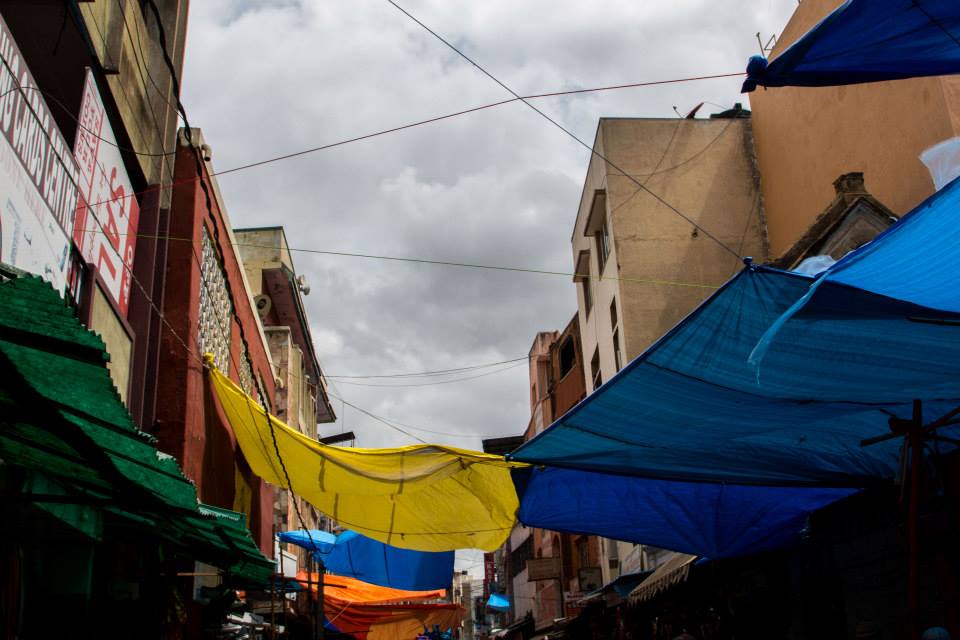
Colorful Indian markets
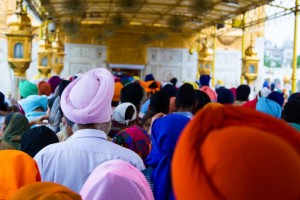
Colorful turbans at the Golden Temple
India Reveals
These vignettes only expose a fragment of the developmental, eye-opening experiences India gave me. These stories and poems are particularly significant, however, because they portray the battles I was having in my mind during my weeks living abroad. I had no idea how I would react to being thrown into the middle of India. What this experience revealed to me, is that I, yes, felt the culture shock, but rather than retracting from the new culture, I became enamored with it. The factory visits made me realize the sensitivity I have towards all human beings, and the love of finding common ground with anyone and everyone. Realizing that I am fascinated by other cultures and captivated by their unique beauty, I know now that I would like to continue working internationally. I think my skills of cultural awareness, empathy, and openness to connect with people of all sorts will aid me in my desired international, developmental, public health profession.