
A few weeks before embarking on this adventure to Mexico I watched Brené Brown’s Ted Talk on vulnerability. In a much more eloquent and inspiring way than I could ever capture, she concludes that vulnerability is essential to a happy life, and that in order to feel joy we must also open ourselves up to the possibility of pain. I immediately resonated with her view, thinking of the times I stepped out of my comfort zone as the most life-changing and rewarding experiences of my life. Yet I also thought of my life and it’s lack of vulnerability. I thought about how I rarely ever cry and how I tend to keep my daily life manageable and under my control. I desired the vulnerability she spoke of and the freedom and joy that accompany it, but I could hardly recognize it in my own life. Slightly disheartened, I moved on to studying for finals and forgot about the whole topic.
Fast foreword a few weeks later and here I am on an airplane heading out to Mexico for the next eight weeks. Although Paul and I have spent months planning and working with mentors to prepare for our research project with the social enterprise Sistema Biobolsa, there are still many unknowns. To distract myself from my anxiety about what was to come, I pulled out the book ¡Gracias! by Henri Nouwen, that my grandmother gave me. In this book, Nouwen, a Catholic priest, journals of his six months spent in Bolivia and Peru. I immediately identified with Nouwen’s call to Latin America, and as I continued reading I felt as though he was speaking directly to me.
For years I’ve jumped at every opportunity to return to Latin America, usually with the justification that I love the culture and the language. When I speak Spanish I feel so alive, and I often leave conversations brimming from ear to ear, experiencing a rush of adrenaline. But I’ve never been able to really explain this feeling. I assumed that the joy I felt was a sense of accomplishment; that after years of Spanish classes my hard work had finally paid off. While this is certainly a part of it, Henri Nouwen put into words ideas that have been brewing in my soul for years. He says:
“When we walk around in a strange milieu, speaking the language haltingly, and feeling out of control and like fools, we can come in touch with a part of ourselves that usually remains hidden behind the thick walls of our defenses. We can come to experience our basic vulnerability, our need for others, our deep-seated feelings of ignorance and inadequacy, and our fundamental dependency. Instead of running away from these scary feelings, we can live through them together and learn that our true value as human beings has its seat far beyond our competence and accomplishments.”
Henri Nouwen really hit the nail on the head for me. As I read these words, I realized that I love speaking Spanish because it forces me to be vulnerable. I talk slowly, I stutter, and I make more mistakes than I even realize. But rarely do people ever condemn me for my mistakes. Rather, they applaud my effort and continue on with the conversation. Nouwen’s words have helped me recognize that I love the freedom of speaking and not being fully in control, of knowing I’m not perfect and being okay with that. As Nouwen so eloquently puts it, “One of the most rewarding aspects of living in a strange land is the experience of being loved not for what we can do, but for who we are.” Although I did not consciously recognize it at the time, I appreciated that my host family in Argentina loved me despite my lack of language fluency. They loved me for the way I made an effort to get to know them, for the gentleness with which I interacted with the kids, and for my smile. They knew nothing of my accomplishments, my school, my family, or my history; they loved me for who I was in that three and half months that I joined their family. I believe that we all experience the most real kind of love when others see our faults, weaknesses, and shortcomings, and love us anyway.
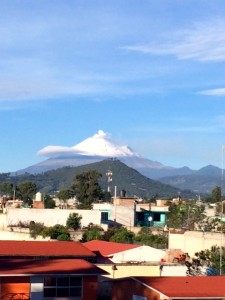
View of the Popocatépetl volcano from the roof of our apartment
After a day in Mexico City, on Thursday morning we finally arrived at the Sistema Biobolsa office in Puebla. Thanks to Henri Nouwen, I felt a rejuvenation of my passion for the Spanish language. But I had forgotten that choosing the road of vulnerability is not easy. Immediately thrown in as a translator, I quickly became overwhelmed. Not only was I managing my own thoughts and doubts in two languages, but I found myself in control of the ideas and opinions of the Sistema Biobolsa staff, the farmers we went to interview, my teammate, Paul, and our mentor, Mike. I struggled to make sure everyone’s voices were heard, including my own. I sought to be the both the best translator I could be as well as fulfill my duties as a teammate in contributing to the conversations and the development of ideas. Despite my enthusiasm for Mexico, my preparation for this project, and my newfound attitude toward vulnerability, nothing could have fully prepared me for this. For the first time in a long time I was acutely aware of my own faults and inadequacy.
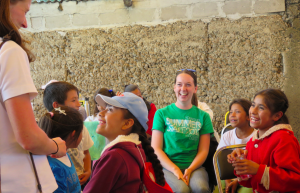
Laughing with the kids at the Sistema Biobolsa promotion event
On Friday we headed out to a Sistema Biobolsa promotion event. On the ride there I felt rather discouraged, wondering how I would be able to move on. Will translating get any easier? What is to come of our project? But I was reminded of Nouwen’s words and of the choice I have to either run from these feelings or embrace them and move forward. At the event I found myself surrounded by a group of adorable kids asking me random questions like, “What is the color of your house?” and “What are your parent’s names?” I laughed with these girls for quite a long time as I taught them some English and they struggled to say words like “red” and “heart.” Through their childlike joy and innocence these kids reminded me of what it is to be loved not for what I do or where I come from but for who I am. In taking steps of vulnerability by engaging with them, my heart was opened to so much joy.
Many questions still remain unanswered. I do not know how much easier translating will become, nor do I know exactly what lies ahead for our project. But I am certain that, although those first few days of translating were a bit overwhelming and exhausting, I came out on the other side with a stronger sense of my own strengths and weaknesses and a better appreciation for taking each moment for what it is and moving on. Although the next seven weeks will certainly contain more discomfort and feelings of inadequacy, I look forward to the ways these experiences will help me grow and encounter the joy and freedom born out of vulnerability.