“The True Cost” Documentary Review
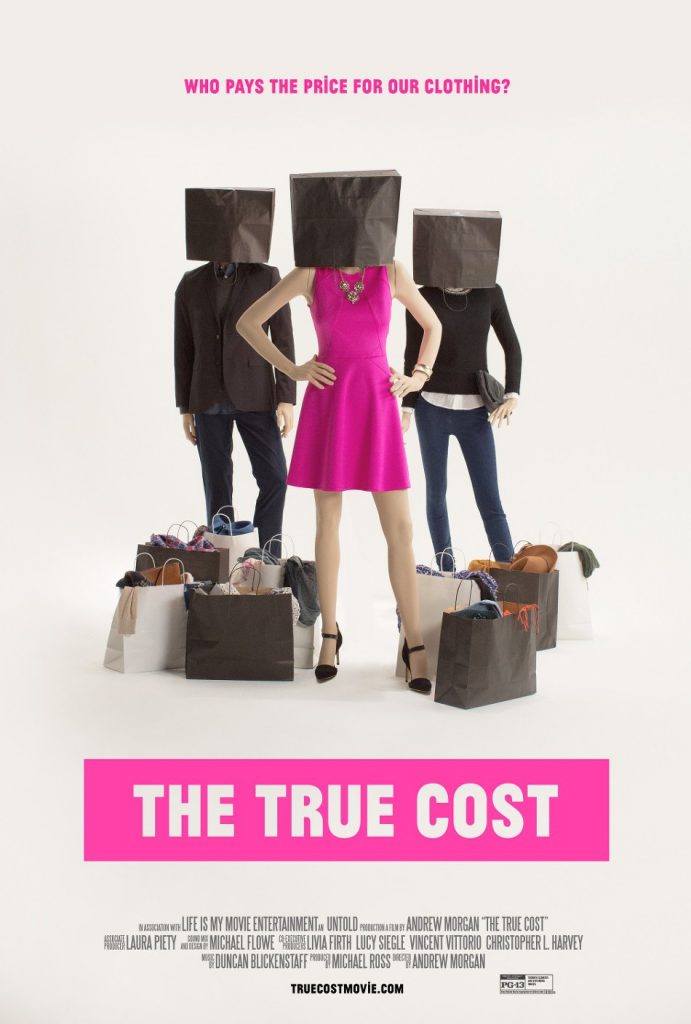
I recently watched “The True Cost” Documentary about the fashion market and modern slavery. I would highly recommend it as it is an eye opening film that made me reconsider my purchasing habits. It was astonishing to see the contrast between the clips of the thousands of shoppers rushing into stores on black Friday versus the garment workers in Bangladesh due to our materialistic desires. Our economic system is consumer capitalism which encourages individuals to purchase more “stuff” in order to make us feel rich or happy at the expense of others. Fast fashion is a huge issue that the film focuses on and is two fold regarding sustainability. It mainly focused on social sustainability and also touched on the environmental aspect. First, the film noted that U.S. clothing companies outsource most of our clothing and only make 3% of it within the United States. In the 1960s, we were still making 90% of clothing domestically. There has been a dramatic shift to making clothing faster and cheaper to gain more profits and “please” the consumer. However, one part of the supply chain has to give in order for the products we purchase to become cheaper and cheaper. Garment workers are the only part of the supply chain where the margins are squeezed. The film interviewed these workers and featured their harsh conditions. With suicides, ignored concerns, long hours, child labor, and other unethical practices, these workers are denied of basic human rights. In particular, the Rana Plaza disaster in which over 1,000 workers died in a garment factory due to unaddressed concerns and cracks in the building called attention to this issue in the media and around the globe. Yet, the year following this disaster was the clothing industry’s most profitable of all time. This just showed me that even this wasn’t enough to catch people’s attention enough to change behaviors. I was also staggered by the fact that some individuals and media platforms push the narrative that sweatshops can be beneficial to workers because they can generate economic growth, are better than alternatives, and provide jobs. This didn’t make sense to me that people could ignore others’ lives. The film also made me realize the “race to the bottom” issue. The top of the value chain has the authority to choose which factories to produce in and if a factory says they want better working conditions or higher wages, they can move to another factory. The issue is rooted in the power that large retailers have over low-income counties. Regulations aren’t strong enough to force companies to choose more ethical practices. Cutting corners and disregarding safety measures are nearly essential in the eyes of large retailers.
The film also touches on ecological sustainability. The natural world has limits even though capitalism depends on the concept that resources are unlimited — based on a concept that just isn’t true. That itself is unsustainable. The film highlights sustainable companies as well such as Patagonia, which made me think that the retail industry does not have to completely disappear but that we must change our practices for ethical reasons and for our future on this planet. It has too much effect on people worldwide and our resources to not make a shift.