
The Issue
There are two main types of ocean pollution that are cause for concern. The first is plastic, and the second is chemical. Both plastic and chemical marine pollution are largely caused by humans. As a dominantly consumerist society with generally poor environmental awareness, we litter consistently. This litter is either blown out or washed away to sea. Large trash pile ups, individual pieces, and invisible chemicals all contribute to the degradation of marine health (National Geographic Society). The environmental decline is serious and pressing, yet we are seeing very little action to make a change. Humans tend to align closely with the saying ‘out of sight, out of mind.’ This idea is made abundantly clear when it comes to ocean pollution. Oceans cover 71% of the Earth, and trash often sinks or conglomerates far at sea. When we don’t encounter the impacts of our littering, it can be hard to remember that it’s sitting in the ocean. It’s crucial that we remember that our actions have consequences and that just because we can’t see our waste, it doesn’t mean it stops existing. Ocean pollution is a pressing issue with an intense lack of action.
Source: National Geographic Society. “Marine Pollution.” National Geographic Society, 27 June 2019, www.nationalgeographic.org/encyclopedia/marine-pollution/#:~:text=Marine%20pollution%20is%20a%20combination,and%20to%20economic%20structures%20worldwide.
Let’s Break it Down Further
It’s been mentioned that the two main forms of ocean pollution are plastic and chemical waste. Let’s take a deeper look into each of those subjects.
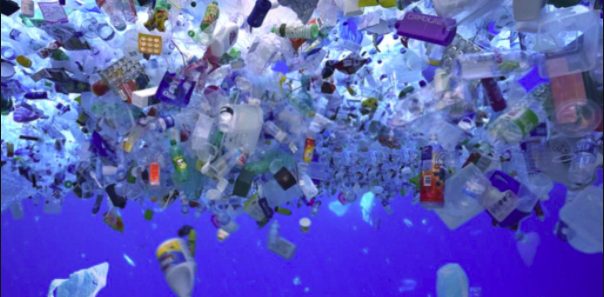
First, plastic. Plastic pollution can build up in large piles (either at sea or on land), be free floating, or sink. Scientists are estimating that up to 80% of waste that turns up in the ocean or on shorelines is plastic (Barnes). Plastic has detrimental effects on ocean wildlife. Sea creatures are currently struggling with entanglement and ingestion of plastic. Sea birds use plastic to nest, fishing equipment has been seen dragging from the bodies of whales and other larger sea creatures, and turtles consistently drown after getting trapped in fishing nets (Wabnitz). Due to entanglement, the physical health of marine creatures is declining. In extreme cases, plastic entanglement leads to death. Unfortunately, extreme cases are not at all rare. Not only are marine animals getting stuck in the plastic, they’re also ingesting it – at a much higher rate. Society is relatively well educated about sea turtles mistaking plastic for jellyfish and pieces of plastic turning up in stomachs after having been mistaken for a fish. What’s not well known, however, is that plastic is being found in the digestive tracts of marine species at almost all sizes (Law). As larger animals eat smaller animals, the plastic build up continues to grow. Though no plastic should ever be ingested, the more a marine species eats, the faster it will die. Evidently, oceanic plastic pollution is causing a host of issues for marine wildlife.
Sources:
- Wabnitz, Colette, and Wallace J. Nichols. “Plastic pollution: An ocean emergency.” Marine Turtle Newsletter 129 (2010)
- Law KL;Morét-Ferguson S;Maximenko NA;Proskurowski G;Peacock EE;Hafner J;Reddy CM; “Plastic Accumulation in the North Atlantic Subtropical Gyre.” Science (New York, N.Y.), U.S. National Library of Medicine, pubmed.ncbi.nlm.nih.gov/20724586/.
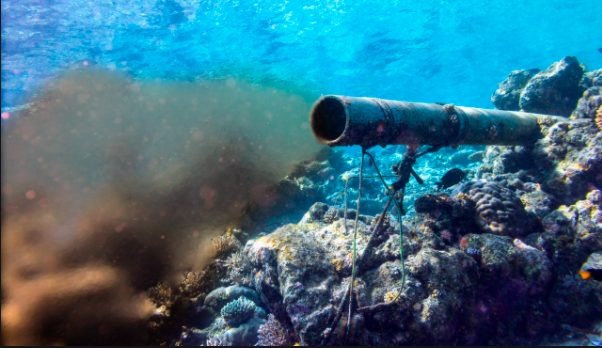
The second ocean pollution of great concern is chemical. Chemical pollution is dominantly caused by farming. As the chemicals and pesticides are washed off of plants, they run off into the oceans. This causes an increase of products like phosphorus and nitrogen. Both of these contribute to the growth of algal blooms (National Geographic Society). Algal blooms can be very toxic to marine life. Additionally, chemical pollution contributes to the breakdown of coral. Chemicals often harm the growth of coral and its ability to repopulate. In particular, chemicals interfere with the symbiotic algae that grows on coral reefs. As a result, bleaching has increased (Sánchez-Bayo). Without healthy coral reefs, the negative impacts once again work their way up the food chain. Coral reefs are the foundation of all marine life and therefore must be preserved at all costs.
Sources:
- A., Barnes David K., et al. “Accumulation and Fragmentation of Plastic Debris in Global Environments.” Philosophical Transactions of the Royal Society B: Biological Sciences, 27 July 2009, royalsocietypublishing.org/doi/10.1098/rstb.2008.0205.
- National Geographic Society. “Marine Pollution.” National Geographic Society, 27 June 2019, www.nationalgeographic.org/encyclopedia/marine-pollution/#:~:text=Marine%20pollution%20is%20a%20combination,and%20to%20economic%20structures%20worldwide.
- Sánchez-Bayo Francisco, et al. Ecological Impacts of Toxic Chemicals. Bentham Science Publishers, 2011.
Why Does It Matter?
If you’ve read this far, it’s probably safe to assume you care about the effects of ocean pollution, but for those of you not yet convinced, let’s discuss why what happens to the ocean impacts you. The same way pollution intake in fish increases as it goes up the food chain, when humans consume polluted fish, they also consume the fish’s toxins (Sindermann). Thus, when the oceans are polluted and us humans eat seafood, we ingest the same pollution that we subject the fish to. Depending on each individual’s intake of seafood, the health effects can range from general malaise to more severe cases including birth defects, kidney damage, and cancer. Oceans are also responsible for climate regulation. Oceans are estimated to hold 67 billion tonnes of carbon dioxide (Shutler). The carbon dioxide contained by the ocean helps control climate all around the globe. However, with increased ocean pollution, marine ecosystems are unable to store carbon which drives global warming and climate change upward. Though humans are dictated by ‘out of sight, out of mind,’ the impacts of ocean pollution circle back to us and need to be acted on.
Sources:
- Sindermann, Carl J. Ocean pollution: effects on living resources and humans. CRC press, 1995.
- Shutler, Jamie. “Guest Post: The Oceans Are Absorbing More Carbon than Previously Thought.” Carbon Brief, 26 Oct. 2020, www.carbonbrief.org/guest-post-the-oceans-are-absorbing-more-carbon-than-previously-thought#:~:text=While%20previous%20estimates%20put%20the,of%20CO2%20rather%20than%2043bn.