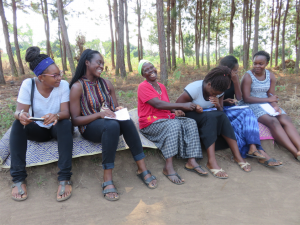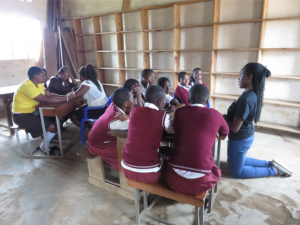
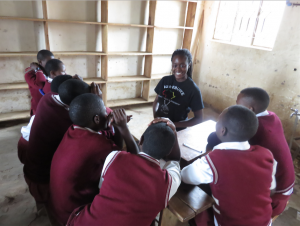
Me talking to a group of girls about healthcare careers.
“You have to be smart, kind, compassionate, humble, and passionate,” I said in response to one of the teenaged girls inquiries about the characteristics one needs to embody in order to become a good doctor. At the time, these characteristics just seemed like characteristics everyone should have, regardless of their career. I formulated this list almost instantaneously when I was asked, not really thinking about what each characteristic meant to me and how each informed my future career plans. As I look back at the experience, I now realize that this wasn’t just a random list of good characteristics–these are the qualities I am beginning to develop and I hope to embody and reflect in my daily life.
Smart. What does it truly mean to be intelligent? Does it mean having a high GPA and having high test scores? Does it mean being on the Dean’s list every quarter, or graduating Magna Cum Laude? I used to think so. I used to think that intelligence was measured by a number, a letter grade, a curve.
If this were truly the case, then those who do not have access to an education would automatically be considered unintelligent, because things such as GPA and test scores can only be measured through an educational system.
My summer with Bana taught me that being intelligent isn’t about hitting marks–it is about making them. It’s about setting the standard instead of fitting it. Being intelligent is about letting pure, unrelenting innovation and imagination run wild. Being intelligent is about going where no one else cares or dares to; asking the questions that no one else is willing to. Being intelligent is about trailblazing.
Those young girls, most of whom revealed to me were first generation secondary school students and planned on being the first people in their families to go to college, were intelligent beyond measures. They dared to challenge themselves by getting an education supported by their families. And one day, I sincerely believe that each one of those young women is going to do something astonishing for their community–whether it be in the field of healthcare or not.
Bana’s founder, Richard Bbaale, is intelligent. He dared to ask the questions no one else would in regards to women’s menstruation, and with innovation and drive, set forth on creating a company dedicated to solving the problems he discovered.
Alexa Canady, the first woman, and the first African-American to become a neurosurgeon was and is intelligent. Yes, she was booksmart–she was consistently at the top of her class. But she was also a trailblazer. She dared to pursue a career that was unheard of for someone like her, and because of her, I can.
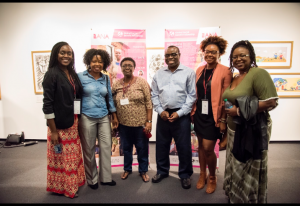
Déjàs mother, my parents, and Dr. Hinga looking smart at the Research with a Mission Open House.
Kind and Compassionate. Being kind and compassionate are key to success in any career path, especially those that require social interaction with others. The kindness with which Jeremiah and the rest of the Bana staff approached young girls whilst addressing menstruation, which can be seen as an uncomfortable topic, was key to the success of their programs. The environment they created during their educational programs fostered warmth, allowing for the girls to feel comfortable asking questions, and even inspired sharing their goals. Even the stories of girls and women’s interactions with Champions were filled with joy and appreciation for how those Champions treated them–with empathy and warmth. Many girls and women reported feeling comfortable and safe discussing their menstruation related health questions with their local Champions.
These are the types of interactions I want to have with people. I want to make people feel comfortable about discussing their health with me, and I want to inspire them to be healthy, goal-orientated individuals.
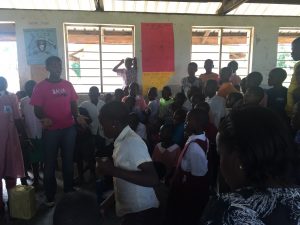
Jeremiah leading an educational program.
Humble. According to the 100people.org, I will become a part of the current 7% of the world that is college educated. I have been given an amazing opportunity to receive an education at Santa Clara University, to pursue a degree specialized to my own individual interests, and to do so in one of the most innovative places in the world. There is no doubt in my mind that I am extremely privileged in this sense.
With the privilege of education comes power, and with educational power comes a multitude of responsibilities. One of these responsibilities is to understand my privilege.
Growing up, I had never questioned whether or not I was going to college. It was always a part of my future. I hadn’t realized that a large population of americans didn’t share the same vision I did, and an even larger percentage of the world does not.
Because of this, I believe that it is my responsibility to use my education to make a difference for other people. Altruism has been embedded in my degree as a result of the Jesuit values reflected in my classes.

Déjà and I at the Equator
Passionate. Bana’s main fuel source is passion. Starting a social enterprise of this nature requires passion for making a difference for others, especially since the outcomes of the enterprise’s work may not directly benefit its founder.
This characteristic is what has kept my head in the game. This summer, I participated in this fellowship to answer various questions about my future career path and find parts of myself that I thought I had lost.
However, I’ve realized that this fellowship did nothing but affirm my previous vocational decisions and respark the passion I once had for healthcare. Upon my arrival back home, feelings of disappointment and angst took over as I failed to have that life changing “a-ha” moment I was expecting to have that would reveal some magical mysterious career path that I hadn’t yet discovered or been exposed to. No clear doors had been opened; no new ideas were discovered. There was just me and medicine, sitting at opposite ends of the same room, staring at each other as I clung to my chair, resisting its pull. I was wildly unsatisfied.
Attending the GSBI accelerator was a pivotal moment for me. The investors showcase was exciting and fun, and each entrepreneur had such an interesting story. It wasn’t the accelerator itself that helped me shift gears; it was Jeff Miller.
I can distinctly remember coming home after meeting him for the first time and practicing the advice he had given us earlier that day about looking in the mirror and calling yourself by the future title you wished to have, paying close attention to your own reaction to what you were saying. I stood my bathroom mirror and recited the statement: My name is Dr. Christina Egwim, and I am a neurologist. No reaction. “I must not be doing it right,” I thought. Once again, I repeated the statement with a slight variation, now with increasing volume and focus. “My name is Dr. Christina Egwim, and I am your neurologist.” I payed close attention to how my eyes lit up and to the satisfied grin the formed on my lips. A stream of memories rushed through my head as I stared at myself in mirror. I remembered meeting Dr. McNelis and Dr. Simone for the first time; I remembered the first Oliver Sacks book I had ever read; I remembered the first high school biology class I had ever taken; I remembered my first day as a Certified Nursing Assistant; I remembered my first day at the Stanford/VA Alzheimer’s Research Center; I remembered being inspired by the passion of the young girls in Uganda who also aspired to become doctors. I remembered all the experiences that I’ve had that have influenced my decision to want to go into medicine and once again I was filled with the passion and joy that I had been missing for a while.
After spending a summer working with a health-oriented social enterprise, I can still see myself pursuing a career in medicine. However, because of the lessons I have learned from working with Bana, I will strive towards further developing and embodying these traits throughout my career.

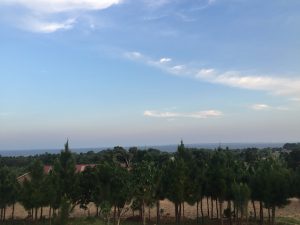
Our last sunset at Bana.