
Often times, we are our biggest obstacles. Self-doubt, low-self esteem, lack of confidence and fear act as the greatest barriers to our personal success. There is no doubt in my mind that a healthy level of caution about making a decision can act as the parachute we all need when we decide to take a plunge and make a change. However, when our uncertainties paralyze us from the inside out, they do more harm than good and can cause us to stay in the ‘ready…set…’ position while the world around us takes off at top speed towards the finish line.
Born and raised in the Silicon Valley, I have constantly been surrounded by creativity and innovation. Growing up, I was fascinated by how technology was updated, how new discoveries were made, and how both could be used to better the lives of others. As the years went by, I remember, can remember being astonished by the transition society made from bigger to smaller cell phones, as well as more efficient ways to recycle Faster models of cars, better ways to spread useful information, and advancements in medical technology left me awestruck. I saw those who approached the process of identifying a problem within something, whether that be technology or even society, as brave beyond measures, and I was inspired. At a young age I knew that I, too, wanted to gain the ability to identify and solve problems, but I was never certain as to what type of problems I wanted to solve.
In my senior year of high school, I discovered one of the biggest problems I would ever have. It was bigger than the fear of flying I learned to conquer during my sophomore year mission trip to Uruguay, or the fear of taking shots on the basketball court that I wasn’t skilled at. The problem was my fear of the unknown.
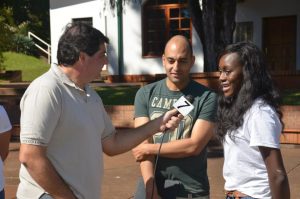
Uruguay, 2011.
Everyone around me seemed to know exactly what they wanted to do: my closest friends boasted about their dreams of becoming accountants, lawyers, doctors, and so on while I sank in a pool of indecisiveness. I have always been the type of person who likes to have a plan, even for the simplest of tasks, so not knowing what direction I wanted to take my life in was very unnerving. To me, not having a plan meant that you were destined to fail, and if there was anything that I feared more than uncertainty, it was definitely failure. I felt that I hadn’t found the mould I wanted to shape myself from, and this uncertainty drained my confidence.
The one thing I was certain of was my decision to attend Santa Clara University. My brother was currently in attendance, and he had very positive things to say about the school. I was instantly attracted to Santa Clara’s intrinsic beauty seen within its mission to create competence, consciousness, and compassion, as well as its external beauty, from the mission church to Palm Drive. Despite my approval, it wasn’t my first choice college; actually, it was my last. The only reason being that I wanted to get as far away from home as possible. I initially set my eyes on NYU until I realized that I could run, but I most certainly couldn’t hide, from my problems. Running away from home wouldn’t reveal my destined career path. I decided to stay right in the Bay Area, 15 minutes down the road from my home. I didn’t realize that by traveling so little, I would be able to grow so much.
I came into Santa Clara University’s College of Arts and Sciences with an undeclared major. My inability to discover my career passions early on in life continued to cause me to have a very low self-esteem as I began college. I had signed up for introductory biology and chemistry classes, as well as a few other core classes, but I wasn’t dead set on staying in them. It wasn’t until I went into my biology professor’s office hours during week 7 that I began to discover my career interests. She discussed how she discovered her love of Biology and that she wanted to become a professor, and I shared my insecurities about my uncertainties about my career goals. To my surprise, my lack of self-establishment didn’t keep her from offering me a position in her plant-cell biology research lab. Regardless of my lack of direction, she told me that she saw a passion for discovery in me that was necessary for solving anything. She described to me that she was taking an approach similar to shooting in the dark, meaning that although the specific area of research she was focusing on was unfamiliar to most, she wasn’t afraid to tackle it.
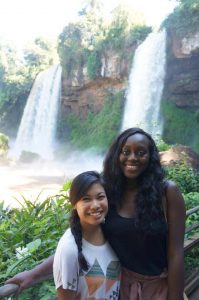
Iguazu Falls, 2013.
Initially, I was beyond excited. I didn’t know much about plant-cell biology, but the process of thinking through a research question and helping devise a solution was exhilarating! Then, I realized that being a part of her lab meant that I would need to face my fear of treading through unfamiliar waters. Like she had said, the aspect of plant-cell biology that we were studying was known to few, so we were bound to hit a few road bumps throughout the process.
I didn’t accept the offer as quickly as I should’ve because my fears of both uncertainty and failure kept me at the start line. My passion for problem-solving and using the scientific method had put me in the “ready…set…” position, but I couldn’t find the strength to take off, and start this race towards my future.
I sat on my bed the night after I met with my professor, and recited one of my favorite poems. Invictus. The word danced across my lips several times as I remembered how much inspiration the poem had given me during trying times. It reminded me that no matter what, I was in charge of my life and my decisions, and I was the only one stopping me from doing the things I wanted to do.
I sent my research advisor an email that night, accepting her offer to join her lab. I realized that the process of discovery and problem-solving is centered around trial-and-error, and in order for me to achieve great feats I would need to develop the ability to learn from my failures.
Being a part of that research lab has allowed me to further develop my problem solving skills, face my fears, and further discover my passions. My professor gave me the opportunity to use what I had learned from my biology and chemistry classes to devise a plan to make a discovery. I was able to attempt solving a problem, failing miserably, but learning tremendously.
Discovering my passion for science and research early on in my college career helped put me on the right path. However, I still felt a bit of uncertainty as I approached my sophomore year. I had three major concerns: I still hadn’t figured out exactly what my career interests were, I hadn’t figured out what I wanted to major in within the sciences, and I hadn’t discovered how I was going to use the problem solving skills to make discoveries that would impact the lives of others.
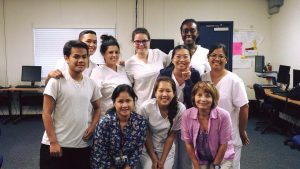
Certified Nursing Assistant Team, 2015
I grew more and more anxious as time went on because I still felt as if I didn’t fit a certain mould. My desire to compartmentalize myself and plan out my life is what had kept me from discovering my true passions. An academic advising meeting with Dr. Brian McNelis revealed to me that I didn’t have to fit a mould. If the classes that I was most interested in didn’t fit into the templates of a traditional major, why not create my own major? He suggested that I choose a list of classes that sounded the most interesting to me, and decide what subject those classes were most closely related. I was given the opportunity to tap into my sense of innovation, and, alas through the Individual Studies Program, I am a Neuroscience Major.
My interest in studying the function of the brain developed and blossomed after I read the book The Man Who Mistook His Wife For a Hat by the late Dr. Oliver Sacks. He effortlessly described even the most complicated neuropathologies in ways that an average reader could understand. He used his problem solving skills to make discoveries in neurology that gave people a better understanding of the symptoms they were experiencing, and helped them find solace in their health disorders. I aspire to be as brilliant, humble, and helpful as Dr. Sacks was.
The field of neurology is full of uncertainties. There is much that is unknown about the brain and how it works. To my surprise, I am very comfortable with this. For the first time I have found solace in unfamiliarity. Creating my major has given me the confidence I need to take matters into my owns hands and pursue passions I may not initially be very knowledgeable about.
Now that I had addressed two of my three major concerns, it was time to face the third: figuring out how I was going to use the problem solving skills I would acquire throughout college to make discoveries that would impact the lives of others. I have already discovered that the human brain and mind intrigue me in a plethora of ways, and I am excited to dedicate my career to studying and solving the problems that can occur within them. However, in order to be successful at this kind of work, I need to understand all aspects of mental health that can be limited by the social stigma surrounding mental health, including access. People often overlook the importance of mental health, and correspondingly, mental health care. Because of the stigma that exists, the remedies being discovered in regards to mental diseases are unable to make large impacts on the community. This is why I decided to apply for the Global Social Benefits Fellowship.
Participating in action research will give me the opportunity to use both critical thinking and expertise, apply classroom education in a disadvantaged community, and observe teams of professionals utilize real-world problem solving tools. Learning how to use the skills I have gained thus far in my undergraduate career through engagement with a community and a social enterprise will help me understand just how practical the knowledge I’ve acquired can be. Developing skills in social entrepreneurship through this internship will allow me to help diminish the stigma around mental health, thus increasing access to mental health services in the future. Being a part of this fellowship will give me the opportunity to identify and develop my strengths while ameliorating my weaknesses, allowing me to solidify a path towards fulfilling my vocational discernment.
With my partner Déjà Thomas by my side, and the support of my fellow GSBF 2016 cohort, the Miller Center, my friends, and my family, I feel ready to take off at top speed.
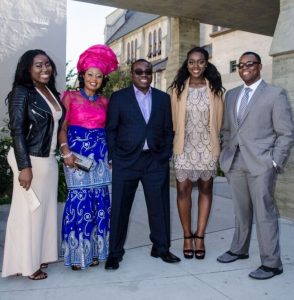
The Egwim Family, 2015.