
The passion with which Jeremiah and Richard described the future of Bana made it evident that they have huge plans for the company. After the first week of being there, I became increasingly more inspired to produce the best manuscript for them, so that their dreams can one day become a reality.
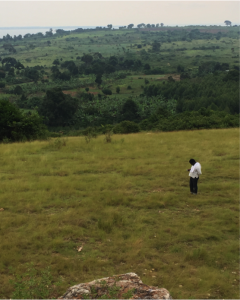
Bana CEO Richard contemplating life.
Richard’s drive is truly remarkable. He identified problems as a young man and dedicated his life to discovering ways to solving them. This type of passion and compassion for others can take years to develop. For some, it may even take a lifetime to discover the impetus needed to inspire them to make a change. Thinking about Richard’s early-developed passion led me to begin thinking about my own passions and vocational discernment.
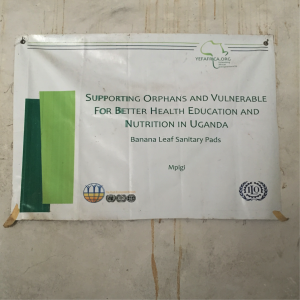
A Sovhen banner hung up in the dining area.
A banner representing Richards larger company, Sovhen, is hung up in the section of the production facility that we usually have our meals. One day, as I was scarfing down a delicious, hearty plate-full of matoke (plantains), beans, rice, and cabbage, I noticed the banner and the phrase it sported: “ Supporting Orphans and Vulnerable For Better Health Education and Nutrition in Uganda”.
I paused from eating for a while after I read the poster. The target beneficiaries of this larger company were identified as orphans and the vulnerable. For Richard, the vulnerable included rural girls and women who didn’t have access to the things they would need (education and methods of management) when they began menstruating. He identified this group at a young age, having witnessed the difficulties his sister went through while he was growing up.
Then, it hit me.
Several people, including Jeremiah during our orientation meetings, had stressed the importance of connecting the work we will be doing with Bana with the work we want to be doing for the rest of our lives. Even within the weeks leading up to our departure, people often questioned how this fellowship was going to act as another stepping stone towards getting into medical school or even how studying neuroscience would be applicable to the work I would be doing. The connection between participating in a social entrepreneurship fellowship and my vocational discernment became less clear and my confidence began to waver tremendously as the questions began to pile up and my rehearsed, interview-like answers became less satisfactory.
Reading the sign cleared my vision and the connection became evident again: As Richard has, I, too, want to work to support the vulnerable for better health and education. At that time, I began to identify similarities between Richard’s work and what I wish to do with my future. The vulnerable population I wish to work with is those who suffer from both psychological and neurological mental health disabilities. Both of the populations we have identified suffer from different stigmas prevalent throughout society. From the interviews and observations that Deja and I conducted this summer, it appears that the problems that surround menstrual health often sprout as a result of a lack of education due to the nature of the subject. People in the community we are observing feel uncomfortable discussing menstruation, which, according to the stories we have heard, have lead to the creation of myths explaining menstruation and how to deal with it. For example, someone told a story about how when they were growing up, their parents advised them not to climb trees while they were on their period because if the tree bore fruit, it would dry up. It was myths and attitudes similar to these that influenced girls to be silent about their menstruation growing, often times refusing to seek help out of embarrassment.
Stories such as these make me think about how stigmatized mental health disorders can be in the United States. It is common for people to be reluctant to seek treatment for mental disorders as a result of the embarrassment they may feel due to how those with mental health disorders are portrayed in society. No one wants to be seen as “insane,” “crazy,” or “unstable.” Thus, those who do suffer from mental health disabilities often do not receive the help they need.
I must note that there are still differences between these two health issues. First off, location is everything. In the US, yes, it is true that stigma often acts as a barrier to the accessibility and availability of mental health services. However, it would completely inaccurate of me to compare that lack of access to the lack of access to sanitary pads and menstrual health education here in Uganda. In the US, the mental health services are not nearly as limited as menstrual health services are in the Uganda. This, however, doesn’t suggest that the United States doesn’t have a problem. The presence of a problem is still a problem, regardless of how big or small it is.
After Working with Bana this summer, I feel that I have begun to develop the skills necessary to address stigmatized health topics such as menstruation in some cases and mental health in others. Observing Richard’s approach to addressing the stigma that exists around the problems experienced by a vulnerable population has begun guiding me towards becoming a better advocate for my patients. Medical school is still the ultimate goal—and one day I will become the neurologist I hope to be. However, I believe that understanding the problems of the population I wish to serve as a doctor on a more comprehensive scale, and discovering ways to ameliorate these larger problems, are just as important as directly treating mental health disorders. Healthcare should be more than just treating—it needs to encompass prevention. Bana’s mission clearly embodies prevention.
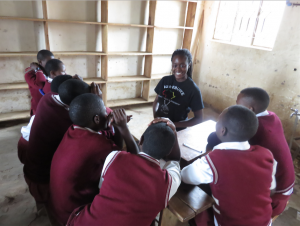
Christina speaking with students at the Kinoni Integrated Secondary School about the health care field.
Deja and I were given the opportunity to participate in Bana’s educational programs by answering career specific questions that the students may have for us. I was usually placed with the girls who desired to go into the healthcare field. During these breakout sessions, I would get a variety of questions ranging from the academic requirements necessary to get accepted into medical school to personal questions about my love life and marital status. These sessions always began with awkward silences and nervous laughter, but would then blossom into fun and fulfilling conversations about medicine and life. The amount of future surgeons, doctors, nurses, midwives, and other health care practitioners that I have spoken to amazes me. These young girls have such big dreams, and I am honored to have witnessed the way in which Bana helps these get closer to fulfilling those dreams. It was powerful to observe the drive and passion that these girls exude at such young ages, and I am blessed to have had the opportunity to have shared my experience as a women in pursuit of a career in health care.
I will never forget the look in one young student’s eyes as she asked me the following question: “Do you think someone from a poor family like me can become a surgeon?” Millions of things were running through my mind. Of course I wanted to jump up and say ‘YES! Absolutely! Anyone can become a surgeon if you work hard enough!’ However, I began to think about all the people in the world who are just as strong, smart, and caring as people who are surgeons today, but are not surgeons because they lack access to the resources they need to become surgeons. Opportunity sometimes hides itself from the most capable of beings, and talent is lost. I looked at her and I told her the truth: “yes, I do believe that someone like you can become a surgeon. I’m not saying it is going to be easy, you are going to have to work hard. You have to be smart, strong, and passionate, but with those qualities, you can do anything in this world.” I noticed the slight smile that appeared on her face and fought hard not to tear up.
I saw a bit of myself in that young girl: she had the desire to pursue something, but the obstacles to her dreams seemed to great to overcome, and doubt invaded and dampened her passion. I wanted to hug her and praise her for her bravery and tell her everything was going to be okay, but I couldn’t do that because I didn’t and still don’t know that. What I do know, however, is that I did not lie to her, and I need to stop lying to myself: the career path I have chosen is not going to be easy, and I am going to have to work hard. I have to be smart, strong, and passionate, but with these qualities, I can do anything is this world.
I was hoping that I would come to some huge, life-changing realization in Uganda that would deter me from wanting to go down the path of medicine and pursue something that “would be easier.” What I learned is that nothing is easy–everything challenges you in one way or another.
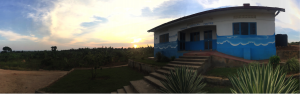
The Donna Medical Center located at Bana headquarters
I want nothing more than to become a doctor, and now that I’m out of excuses there is only one thing left to do: pursue a career in medicine wholeheartedly and relentlessly.