Directionality

The Ashanti flag has three colors; yellow for the gold of the kingdom, black for the color of their people, and green for the rich vegetation and forestry. It is missing a color though, and I don’t know what color it would be, maybe a silver, for humanity. A summer in Ghana, though I wish it was longer. A summer was not enough time for me to see everything I wanted to see, or do everything I wanted to do, but it was more than enough time for me to change in a way I never thought I would. Everyone has moments in their life that define them. Ghana has brought me many of those moments. It has made me come to understand the value of exploration. Not just of the physical world, but of the relationships you create, the boundaries you have set, and the certainties you thought you once knew. The best way for me to outline this is to just share a few anecdotes and examples.


Anecdote I

We had been in Ghana for about a week, maybe more. Enough time to get to know our fellow Farmerline team pretty well. We had stopped to get some food on the way back from one of our field visits. We sat eating. I loved Ghanaian food. The flavor is like something I had never tasted, and the textures of some of the grains were so foreign that every bite left me more and more intrigued. That being said I became full fast and didn’t finish my plate. I was sitting with a group of Ghanaians and one of them asked if he could finish my plate, and then he said this… “a farmer farmed this.” A farmer farmed this. A farmer in Ghana had put in many physical hours to produce the grain and other ingredients that went into the food I was eating. And I had the audacity to push my leftovers aside. I had the audacity to put my few minutes over their many days. I had the audacity to spite their masterpiece. No I did not. TI know how hard these farmers worked. I had seen it. I had even lived it for one day. That one sentence put into perspective so much of what waste truly is in this world. It is a blatant disregard for the energy, time, and effort dedicated to the tangible consumable presented to you . Perhaps it is an unconscious obliviousness, though either way there is a lack of respect for the effort that goes into the products we consume. From that moment forward I tried my hardest, as humanly possible, to eat every last ounce of food, not only on my plate, but everyone’s plate if they did not finish.
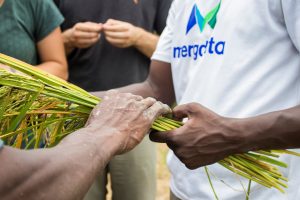
Exchanging rice with a farmer

Anecdote II

I would walk with Marisa and Ben up our uneven dirt road passing by the same vendors every morning. And every morning, without fail we would be greeted by the same people, with the same expression, a smile. Now every morning I wake in America it takes until about midday before I see my first smile. There are smiles in the early morning on exception, though that is the exception. Back in Ghana we would not just start our day with a smile, but everyone we met who was new would greet us with a hello and a smile. Taxi drivers, pedestrians, and peddlers alike, we were greeted with a smile. Now there is something to be said about that constant exchange. It made me feel acknowledged. It made me feel welcomed. It made me feel loved. And this was from people who were not even of my homeland. Why can’t my people do this? The power of a smile or a hello is a powerful thing. I wonder what kind of moral and social ecology America would have if we followed a similar baseline.
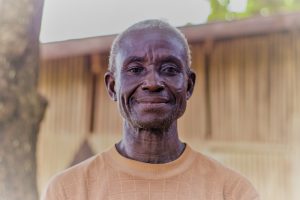
A smile

Idea III

The idea of a developing world was created by the capitalist thought leaders as a self-indulgent amplifier which enlarges the image of the “developed” a belittles the “developing” in a purely infrastructural sense. It supposes that those who are “developed” are better, of a higher order of society, with more intelligent thought structures to create a infrastructure of advanced technologies and sciences upon which society is mounted. Indeed by this definition, America, and Europe, and a lot of other places, are developed. Though I think this definition is far too narrow-minded and western-centric. Nations should not be judged purely on their infrastructural capacity. I think that a nation should be valued (if at all) as a sum of its whole, which includes not only infrastructure, but some of the intangibles too, like its culture or its progress, or the obstacles it has had to face. With these parameters in mind I think we would find we have a very different view of what is a developing nation or not. Ghana is so much more than an “African country,” Ghana offers so much more than starving children and broken down buildings. Ghana is home to millions of souls who ancestry and struggle have formed a united spirit which is visible, audible, and palpable. That, to me, is hardly a developing nation, and I know there are so many other nations like Ghana.
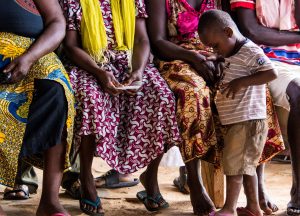
I have come to learn that social engagement is best done between two people. There is no message that is served with the most palatable amount of trust and acceptance than one given from one person to another person. Whether it comes to personal relationships, or professional ones, always look for a way to turn any setting into an intimate one on one experience. What this means to me is that it does not matter if you are hanging out with friends, at a large conference, in a one on one meeting, or anywhere in between; there are always opportunities to make someone feel special, and like they are the focus of your whole attention. When this is the case, and once moment has struck which forms a relationship, invaluable doors have been opened which allow for deeper forms of whatever type of relationship you might be in. This is something I realized while in workshops with Farmerline. One of the keys of their success is that they treat each farmer as they would a friend, neighbor, or even part of the family. In the moments that they are taking down information to add to their database, they don’t forget the human who is behind the phone. The most beautiful thing is that it is not forced. It is just the natural way they conduct themselves, and it is a way I would like to emulate.
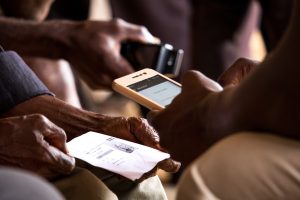
While the phone captures the business, the faces (not pictured) are exchanging the true information.

Looking forward I have already begun to discuss how I might make my mark on the world with other people. One of my longest friends and I have started the process of conceptualizing an idea for a social enterprise. Every week we bounce back and forth between one idea and another, reforming one, or scratching it to start with fragments of our old. During our last Skype session we came to the realization that it is incredibly hard to start a business in a country that neither of you are in. Which made us think that the social enterprise we wanted to make might need to wait until one of us is in one of the African countries we would like to launch in (probably Ghana). One thing I’ve learned from working with Farmerline is that it is important to know your target impact population. If you don’t know them, what they need or want, you can’t serve them. Otherwise you are just like any other non-profit or foreign organization who thinks they know what’s best and is pushing their ideas on people who they have no right or true understanding to do so. If neither of us are where we need to be, and have lived there long enough to at least begin to understand, or invite people to join us who do understand, then there is no point. So we have redirected our focus back to the American market, attempting to solve problems in a fairly business saturated population. We shall see where we end up, but I am confident that we have many skype sessions ahead.
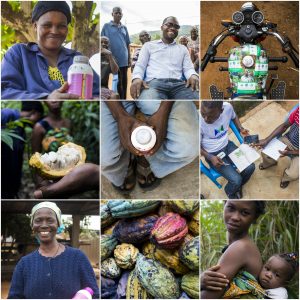
My thoughts about my future are about as scattered as this paper is. I have no concrete ideas. I do have aspirations however, and I do believe that at least some of them will come true. I know that this far life has taken me to where I need to go (or a least have come to believe, where I need to go). I trust in life just as I trust in the people of Ghana. Respect origins, remember everything and everyone came from somewhere. Smile at life, and life will smile back. And never forget that you might not be as developed or as proud, accomplished, or whatever as you think you might be. It is all about perspective. It has always, always been about perspective.
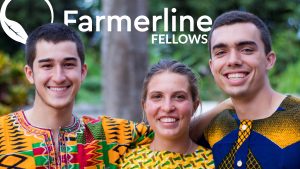
Happy us

Much peace and love,

Caleb

Reflecting on a Summer in Ghana

Alas I have a structured space to sit and reflect. There have been so many thoughts in my mind and I will try now to form them in some semblance of understandable narrative.

This summer was soulfully revolutionary. Two months in Ghana and I felt I’ve lived a life I was always meant to live. I slept, ate, worked, laughed, and adventured in Ghana. I knew I loved people, and now I know I really love Ghanaians. They are smart, kind, caring, extroverted, and a million other adjectives. Most of all they are welcoming.

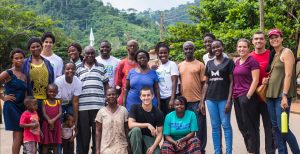
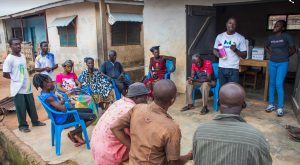
Upon arrival in Kumasi, Schandorf picked us up from the airport, excited to meet us and share with us the Ghana handshake. He drove us to our homestay where we met our host family, Ernest, Rosemary, and Emmanuela. The next day was in the office, and then the following day we had an early morning for a field day. It was on this day that I really began to see the beauty of the Ghanaian people. When we arrived we waited as the village began to gather for a Farmerline workshop. The workshop went by and they we waited; a whole bunch of farmers, a few people from Farmerline, and two Obronis. To be honest, it was a slight bit awkward at first, then things changed when one of the farmer’s daughters brought out her baby. Isn’t it funny how the youngest of children build the biggest of bridges.Before long we were all mixing and mingling and waiting for the other half of our field team to come over from another village. Once we all got together some of the farmers took us out to their fields to share how they work.

Now I could go into detail about the process that is farming, though all you need to know is that it is tedious, and all I want to say is what I learned. What I learned is this: people work to goddam hard for not nearly enough. Not enough recognition for their work, not enough return yield on their crop, not enough money for what they do yield. And yet, they were so thankful for the hour we spent with them, that they could just share their work with us. We spent even more time with them, shared some sugar cane and smiles as our language was not mutual. That is how I understood that language is but a tool, and true expression need not be verbalized. I could not speak a lick of Twi, and they not much english, and yet, we seemed to get along just fine. Sometimes you just know, you just kind of feel when someone wishes you well and when someone wants to be a friend to you. That’s how I felt about them, and I assume them to me.

This first field experience was far and beyond the rest, and I think that was because we were able to spend so much time with the farmers. The other times that we went out into the field we never went out into the field. We instead went to towns and villages and had workshops, and I capture photos and film, though we never went out into the farms again. That being said, I was able to have a few more moments like the first in other places.

In Dawu, it was just me and Schandorf. Schandy was giving the presentation as I walked around with my camera capturing. This one woman singled me out later and kept talking to me in Twi. Schandy kept laughing and not translating. Eventually he told me that she wanted me to stay with her, work on her farm with her, etc. I laughed and said that up to him (Schandy), and he said no. She just wanted to share things with me. Her name, her village, her home, her life. A similar experience happened in Atwima Takadori and in Montonsua among other places. People just wanted to share and give and show. The hospitality shown by every person that I met truly affected me.

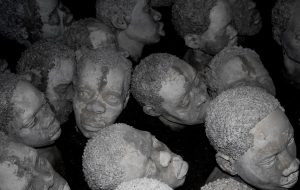
One weekend we were able to go to Cape Coast. There we went to Cape Coast castle, which was used as a slave hold for millions of slaves as they were transported across the Atlantic. Our tour there made me terrified of the humanity (or lack thereof) that used to exist. A lot of other emotions aside, it also made me wonder how forgiveness could ever be given to my people (white people) for what they did. I know I am not responsible for my ancestors mistakes, though I still feel a terrible remorse. What white people did, has and will continue to echo throughout history. Is it white guilt I feel? Probably, though it is beyond that. It is an understanding of the roots of the struggle. I fully sympathize, though I will not ever be able to fully empathize, however hard I try. That is the sad reality. That our human history is so shattered that our stories may never merge again.

I went back to field visits after that experience and I had new eyes and an older soul. How could people, people who were so directly affected by the brutality of my people, want to share anything with me? Even the same air I breathe. I would imagine there must be so much hate. And perhaps there is, but it doesn’t show the way I would imagine. Why is that? I still don’t have an exact answer yet. All I know is that getting closer to an answer means listening to people as they tell their story.

So now I’m a senior and I’m going to graduate and get a job and live life and how does all that fit into my future. I think it actually defines my future. I think it means that whatever I do, wherever I go, I find a way to connect people. If I pursue marketing that means that I follow one mantra. Tell stories.

30 Days

30 days, but I’ve lost count.

Ghana is a place where clouds never part, but the sun comes from the people, where every step is a step forward, where “welcome” actually sounds welcoming, and where business does not have to exploit.

Farmerline is quite the business. I came in thinking I knew about the business model and operation here, and so far have been constantly buffeted by the amount I didn’t know. The biggest thing I’ve learned is how fast Farmerline changes. Week by week this business is growing, whether it be in program capability, inputs loaned, business deals made, or simply farmers registered. Farmerline has a lot of passion within it, which makes it boundless. The people I work with love what they do and know what they are doing is making a difference.

We go out into the field 2-3 times a week. It’s a process that starts at 5 in the morning. We get to the field at anywhere between 7-9am, depending on how far away the town is we are going to. At that point Schandorf (our boss) lets it be known we are there and farmers assemble. We get started with a workshop on their new input loan service, and as that transpires I take photo’s and videos.

The field experiences have been quite revealing as to how much personal trust plays a role in Farmerline’s success. The towns that we go to who have been Farmerline towns for a while are quick to adopt the registration and the input service without many questions asked. They trust Farmerline with their content services and trust Farmerline to do the same with the new input program. When we go to towns who are not as enveloped in Farmerline’s services the farmers are much less trusting. They are a lot more cynical in the questions and the end result is that there are less farmers registered and less inputs handed out.

This lack of trust seems to come from a history where other people/ organizations/ businesses have come in and asked for similar information/ promised similar services and have not delivered. I remember at a workshop in Montonsua, one Farmer stood up and while I don’t speak Twi, it sounded like he was quite frustrated and almost yelling at Schandorf. I turned and asked Lily what he was talking about and she relayed that he couldn’t trust Farmerline to deliver inputs on time because other organizations, like the government, don’t deliver their inputs, so why should Farmerline. All they have is blind trust they have to fall on, and a lot of Farmers do not want to make that leap, because they have very little money to loose, and any money lost could mean quite a lot to loose. This is the current paradigm that Farmerline has to work around and work within.

If they continue to provide quality service though and continue to follow through on their promises, then they continue to gain trust, and thus farmers.

Nevertheless, this place is incredible and beautiful and wonderful. 30 days have passed, but I’ve lost count…

Find pictures at this link:https://goo.gl/photos/VPGTPMainXH5p1QA7

Graham Miti

I am a man of many words though few disclosures. I find can speak to almost any occurrence, happenstance, circumstance, action, or passing, though I hardly speak freely about myself. With that in mind, what follows is something I usually don’t do… open up.

There are two main things about me. 1) Family means everything to me, though it doesn’t mean the same thing it means to you. When I say family you probably think of your mom, dad, brother, and sister right? Well when I say family, I don’t necessarily mean that, I mean those who make you feel accepted and understood when you are being you. In this way your blood and kin can be family, but those who are the furthest away from a physical reflection of yourself can also be some of your closest family members. I also believe that you are a reflection of your family, which leads to my second point. 2) I pride myself on being a sponge. I absorb. My life is a patchwork of experiences. I am only me because of the things I’ve been through and people I’ve crossed paths with. Many might say the same, though where I differ is in how impressionable I am. Since I was little, I have always had an inherent affliction for introducing myself. I am most in my element in a crowd of strangers, and I see each person as a nugget of life. A quilt of their own experiences who may just be able to give me a patch or two to sew onto mine. In essence, my character is a conglomeration of those I have met.

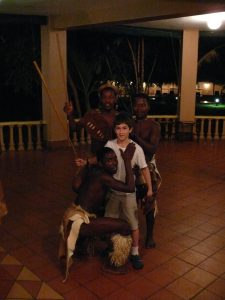
While I could go on and on about my “family” I’ll go ahead and try to explain this through anecdotes.The first time I experienced this other definition of family was when I was in South Africa at the age of 10. I was staying in the Kazulu Natal region with my mom. We were there for safari. Very touristy, I know, I get it. But of course, as a little 10 year old I was loving seeing all the animals and nature. At night we would have dinners, and every so often some of the native Zulu tribesmen would come around and put on a dance. The first night they did this I found them as I was wandering around. I walked out of the dining area because I heard music and over to a little porch where I peeked over the heads of a lot of older white people sitting and saw this fantastic men kicking their legs wayyyy over their heads with cow hide shields and wooden spears in a dance portraying none other than their flexibility and strength. The performance was near ending and one of them saw me swaying to the beat over on the side and invited me over to them. Of course I went. They showed me the kicking move and I tried it and brought my knee to my forehead, hard. I stood there stunned for a moment as I realized I had just kicked myself in the head, but then I realized that no one else had noticed because the warriors were still dancing so I kept on dancing, with dazed tears in my eyes. The dance ended. I was sweaty and people parted. I got their names, but also was so tired from the dancing that I quickly forgot. My mom was here at this point and she wanted to go soon so I said goodbye. Not before befriending one of them in particular. I am sad to say that I don’t remember his name, I only remember what he did for me.

[Moments after that first time I was invited to dance]

I left that night a happy little camper. About four days later I was at another reserve with my mom having dinner when I heard a familiar beat. I ran up from the table over to an auditorium area where lo and behold, my friend from a few nights before was performing. I watched on in wonder as he continued these powerful stomps and high kicks. His performance ended and he saw me again and came over to say hi. We started talking and his friends came over too they were all very nice to this young boy. They said they would walk me and my mom back to where we were staying. I was ecstatic to be escorted by a troupe of warriors. On the way back I stopped and proposed a trade. –before I go any further it should be noted that I love dancing and at the age of 10 I considered myself a pretty darn good dancer—So I offered up a trade. One of my dance moves for one of his. Now, this was a big deal for me. At school I didn’t like to say or show that I was a dancer for fear of what people would think of me. Here however, this one warrior had brought me up to dance with him, I had hit myself in my head with my knee in front of him, and yet he still said hi the next time I saw him. So I thought I could share my secret with him. I was a breakdancer. He agreed to a trade. He first taught me how to properly throw my leg up (as to not hit myself) and in return I taught him the “coffee grinder.” He went wild when I showed him the dance move, and because of his inherent flexibility he picked it up quite quickly. His friends were going crazy at the move as well, and he made me a promise. He told me he would add it to his repertoire of moves. The largest smile crossed my face. I had shown someone a part of me, they had not only accepted it, but adopted it. And that’s when I knew he was family.

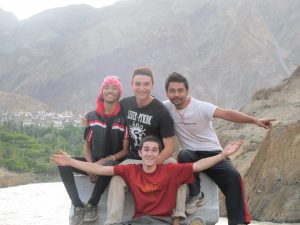
My second defining moment happened my Junior year of high school. I had the incredible opportunity of spending a month in India. Not the India that is generally thought of though; not the hot crowded streets, but rather the sparse and spiritual ridges of the Himilayas. There I lived with a family of six. My host mother and father, and three brothers and a sister. For a month I lived with them, woke up and went out into the barley fields harvesting the barley which had just broke the golden threshold, and then lugging it up the steep slopes back to the village level for processing. I was living a whole another life, a simpler life, and in most regards, a better life. When we first arrived only my eldest brother, Tundup, was receptive to my travel partner and I. My other two brothers, Stanzin and Nurbu were more reserved. Day after day we had breakfast went out and worked, had lunch, came back in did an activity, and slept. Slowly, Stanzin and Nurbu started to warm up to me. One day about two weeks in all the kids and teens in the village were all playing volleyball at the top of the village and when we were down we all walked down together. Nurbu was walking next to me and then grabbed my hand in his hand. I was surprised at first, but then a smile spread across my face. Boys hold hands when they are good friends.

[Me and my brothers with our village in the background]

Three days before I was to leave, me, my trip partner, and my brothers went out for a walk down the road out of the village. We stopped in a picked barley field under a ripe apricot tree. Nurbu climbed up the tree and dropped down the ripest of apricots for us to eat. They were delicious. At the edge of the field was a small cliff 30 foot cliff and then another field further below. We began an apricot pit spitting contest. At one point someone tried to spit it and it only went about a foot. We all started laughing. A deep laugh at the moment. The laughter died down and Tundup looked at my partner and I, smiled, and said “you are Tunpa.” Tunpa was the family name (sort of like a last name). In that moment I felt at home. I am a single child, and that was the first time I felt like I had actual brothers.

About a week ago this last moment happened, which only goes to show that my definition and person is constantly being strengthened and evolving.

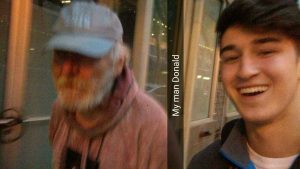
 [Me and Donald trying to find somewhere good to eat]

It was Easter (4/16/17) and I was alone. My family is all in Washington or Texas and all my friends were busy with their families for Easter dinner. So like any normal young guy would do, I decided to go into San Jose and find someone to have dinner with. I drove into San Jose, parked on the side of the street got out and started walking. Before long I ran into a gentleman asking if I had a smoke. I don’t smoke, but I started talking to him. His name was Donald. Donald is 67 years old. I asked him if he had had dinner yet, and he hadn’t so I invited him to join me. As we were walking along trying to find a place to eat we ran into two people outside of a bar, Dakota and Ebony. They seemed to take a liking to Donald and I and they recommended a Greek restaurant right down the way which they ended up showing us too. Donald and I sat down to dinner and started talking. He spoke about his Russian roots between bites of kebab and hearty laughs. I asked him if he had any family in the area, and he didn’t. He had run away from home when he was 21 from New Jersey. He noted that he recently reconnected with his family a few months ago however. He was such a nice guy and said hi to everyone who left the restaurant, we were sitting by the exit. At one point this one woman walked out and he said hi to her and she said hi back. She was a Chinese woman and he was a white man, though he turned to me and said “she’s family,” and then laughed. I asked him how and he just looked at me and smiled. No words are needed to explain what is already understood.

We all have families. These families aren’t always blood, but they are always heart. As Lilo said from Lilo and Stitch “Ohana means family, and family means nobody gets left behind or forgotten.” A trivial quote, but a quote which surmises how I feel about my people, my family.

My family is worldly. My family is loving. My family is in South Africa, India, England, Czech Republic, Italy, Vietnam, America, Canada, Mexico, France, and so many other place. My family shapes who I am and I shape them just as much. I always want the best for my family. I will always look out for my family, and my family is everyone.