A couple days ago, I saw one of the best examples of “breaking the fourth wall” ever since I was first introduced to the idea back in my high school AP Lit class.
Uprooted, the culture show put on by SCU’s Vietnamese Student Association in Mayer Theatre was filled with fantastic references to the audience and comedic plot breaks that kept us all engaged. Here’s a quick attempt at a plot summary:
The VSA student board members all sit around on stage and they try to figure out what to make their annual show (the one we’re watching) about. They each pitch random ideas (ex: a Star Wars inspired one), but not one idea works well. Finally, one girl, Diane, suggests they all go to Vietnam in attempts of getting inspiration for the show. During their trip to Vietnam, we see glimpses of Vietnamese culture, as well as the way each character develops to gain better understanding of themselves. Finally, they all come back to America and agree to make a show about their trip to Vietnam, essentially recreating the one we just watched. By randomly acknowledging the audience during various parts of the show, it’s great to see that closer connection.
However, what really got me about this already impressive show was the way Jon, a white Caucasian male, came to direct this show about Vietnamese culture, something he obviously wasn’t raised in. He was able to direct so well based on the fact that he first addressed this obvious disconnection as the “elephant in the room”. A lot of times, we fail to point out some of the most obvious issues because it can be hard.
By first stating that he was white near the beginning of the show, Jon actively pointed out what everyone was already thinking, therefore validating his purpose. It’s certainly hard to do because of the immediate awareness you put on yourself, but it’s worth it.
Addressing the obvious makes it possible to move onto greater things. It’s why, for the rest of the show, the audience was able to comfortably watch a show produced by someone outside of the Vietnamese culture. Doing something so bold is great, encouraged even, if done in the right way. So props to you, Jon!
Perhaps in our own writing we can learn to point out the obvious, or the big ideas that need to be said, before moving on to the nitty gritty details. It’s an interesting point that needs to be made, though a lot of times we forget to do so.
Still confused on what it means to address the elephant in the room? Here’s another great example of Jack Carroll, on Britain’s Got Talent.
Reader, I hope you take away an important lesson from this post. Avoidance is not the answer to moving onto the bigger and better things in life.
Wanted to take a second here to respond to my classmate Alex’s post on a specific Tedtalk: “Do Schools Kill Creativity?” by Sir Ken Robinson. I mean this topic comes up a lot and I feel like it’s not exactly a new idea, but it’s still so interesting every time I come across it.
I think we’ve all heard the argument that the school systems we all partake in focus so heavily on certain ways of becoming “smart”, that anything out of the norm is immediately squashed into bits and blown away. Unfortunately, a lot of the time, creativity flies out the window as well. Creativity, something so special, is so easily pushed aside we often forget how important it is. When was the last time you truly did something out of the box? We always talk about being unique, special, out of the ordinary, game-changing, yet too often we fall to the same routines, over and over again. There’s another video/speech that I really want to talk about that pertains to this topic- I think i’ll write about it in my next post. Before it’s too late, we must learn to snap out of the default setting that our bodies get so used to, and go back to where creativity first started.
Something Robinson points out is, the current way we formulate students results in the creation of university professors. Not saying there’s anything wrong with professors (Robinson used to be one himself), but surely there has to be other methods of being talented than this. I’ve never really thought about the end result of my education in this way before, so props to looking at what I do in a new way.
I think there’s always this expectation that we all learn a certain way, but that’s subject to change. An appropriate quote for this situation:
Everybody is a genius. But if you judge a fish by its ability to climb a tree, it will live its whole life believing that it is stupid.
Cliche, I know. But it’s popular for a reason! Defining intelligence in only one way, and squashing creativity results in many, many people who will spend the rest of their lives being scrutinized for things they just weren’t meant to do. And until we re-asses the learning system put in place by people no smarter than us, we will remain locked away with our potential.
Normally a popular comedian who uses YouTube as a platform to reach his 1.3 million subscribers, this video that he released is something entirely different. Though I didn’t necessarily laugh, I did finally see one of my pet peeves addressed in a perfectly-worded way that I couldn’t have done myself. I thought it would be interesting to pull out some of the lines he said and talk about them here today. Hats off to you David!
Video:
This video highlights one of the most uncomfortable things I experience (which thankfully doesn’t happen too often), and explains it to those who never have to go through it. I’m talking about walking into a new place, and having people automatically assume that I don’t know how to speak English. Everything I do to be a better person, live a good life, help others, all that is erased when someone looks at my appearance and assumes that my identity is nothing more than “foreign.” We’re all immigrants here. Really. But why are people of my ethnicity still so far removed from society that many of us have to sit through the discomfort of knowing that we have to somehow “prove ourselves” as English speakers? Honestly, this frustration is so hard to explain, but I feel like David really does do a good job.
He talks about a time when he decided to give his car away to his parents, then proceeded to purchase a new one for himself. Upon entrance there was no one else in the store. David attempts to ask someone for help, then repeatedly gets ignored by the salesperson (who gives him condescending glares) for around 45 minutes. To make matters worse, another couple comes in and the salesperson immediately goes over to help them. Finding this unbelievable, David gets frustrated and leaves. Just as he’s about to go, the salesperson finally approaches him and says “hey buddy, do you need some help?”, but with exaggerated gestures and huge hand movements, making it apparent that he doesn’t think David speaks English.
David departs after telling the man off- and hopefully teaches him a thing or two about respect. Two of my favorite lines from the video are:
“You do not get to treat us however the f*** you want based on your preconceived notion that you are better than us. F*** you.”
and,
“You do not get to treat us like second class citizens because of your perception of wealth and status”
The next time assumptions are unfairly placed on my family or any of my Asian brothers and sisters, the above quotes will probably be quoted. It’s honestly pretty shocking to get a taste of the ignorance that still lingers in today’s society. I feel like there’s always this perception that people who look like they may not speak English are somehow are less intelligent, or less capable of being good human beings. Hell, believe it or not, people CAN BE SMART but just in a different language. I don’t understand why this is SUCH a hard topic to comprehend, yet it’s apparent that for a good amount of Americans, and people in other English-speaking countries, don’t get it. Even if someone actually can’t speak English, they shouldn’t be judged before they get to share their story. There’s never a time, or place for that.
Well, that’s that. This conversation is far from over but I hope more people are able to understand this pet peeve of mine.
I think about it. A lot. All the time, really. Everything I do in life is meant to teach me more about myself, and that’s a subject I’ll never get bored of. But this is something new that I’d like to do. Every once in a while, even when this CTW class is over, I’m going to keep writing in this blog to keep myself in check with my future goals.
So for this first brain dump, let’s talk career. Obviously this is going to only be a very small portion of my life after SCU, but it’ll be interesting to conjure up a picture of what I’m thinking.
After being accepted to Santa Clara Consulting, an entirely new opportunity has been presented to me: the world of consulting. As a freshman I never thought I’d get the chance to work in this field, simply because SCU tends to focus on other aspects of the business world.
So naturally, this is the path I’d like to pave in the next 10 years. Upon graduation, I plan to work in the consulting industry for two to three years before going back to get my MBA. One of the biggest aspects of my long-term professional goal would include the ability to be independent to the point where the company I represent would have no problem sending me out to a new environment, and having me adapt to any working conditions.
This calls for a strong, daring personality, someone who is eager to push the so called limits that humans put on themselves. After all, these goals constantly prompt me to understand myself on a stronger level, getting me out of my comfort zone and into a new level of achievement.
In doing so, I’d make consulting a very viable option for future SCU students. If no one steps up to the challenge of making this career path more available now, the resources and connections needed to be successful might never be there in the future. I’ve talked to many students who have already made their entrance into the consulting field and the number one thing I’ve come to realize is that it’s honestly just difficult. Straight up, there’s too much of a focus on the accounting aspect of SCU that many other parts are pushed aside. That’s what I want to fix by the time I get out of here.
^ that’s the end goal for now. A method to the madness will present itself amidst multiple cups of coffee and hours of hard work. Hopefully more people will be there to join me when the time comes!
This future update has come to an end but I’ll be back for sure to keep writing.
You could argue that everyone does research. Technically, any form of searching up a topic and reading more about it equates gaining a higher understanding. But can we, and should we be trusting any online source we come across? The internet has made information readily available, but once you let in the good, you also let in the bad.
A lot of times, what you see above is what happens. We sloppily throw some articles together, quote them, then hope for the best. It’s starting to really become a problem. That’s why Joseph Bizup of Columbia University proposed an entirely new way of looking at research in his article “BEAM: A Rhetorical Vocabulary for Teaching Research-Based Writing”. Forget the primary, secondary, and tertiary sources. It’s time to be sure about the sources we use while correctly applying them in a way that adheres to self- improvement.
The Main Reasoning:
“If we want students to adopt a rhetorical perspective toward research-based writing, then we should use language that focuses their attention not on what their sources and other materials are but on what they as writers might do with them” (Bizup 75).
In other words, Bizup is urging all of us to dismantle the current structure in which research is normally conducted. How do we do this?
1. Background:
Relying on background sources refers to any materials that writers use authoritatively. These are known facts that can also be known as “common knowledge”. When using background sources they are typically uncited, though we should be aware of where the writer is pulling the information from. Depending on the topic, background information can be vastly different for every person. As for me, when writing about white privilege, it was certainly important to be aware of the different ways people would react to my work depending on the preconceived notions they brought in.
2. Exhibits:
Interpreting or analyzing exhibits comes from materials that can be used as an example. Depending on the exhibit, some need to be carefully laid out and explained, while others don’t need much more information in order to be understood. Not to be confused with evidence, which simply supports or refutes a claim, exhibits can provide a setting, or clarify terms. I found it thought-provoking that Bizup mentioned how “rich exhibits may be subjected to multiple and perhaps even conflicting “readings.”’ I saw this within my archival essay since a lot of the documents I referenced didn’t just exist to prove the point I was trying to make. Instead, they laid out all the possibilities which then allowed me to dive in and talk about what I thought was necessary.
3. Arguments:
Engaging in arguments with sources allow writers to enter into a conversation by providing unique views on various topics. Often times research papers written by neuroscientists or historians are meant to prompt others in their field to respond. For students, that doesn’t happen as much, which is often while it feels like a one-sided conversation when we write papers. In high school, a lot of my papers definitely didn’t make any attempts with entering conversations because that’s just not how I viewed any of my assignments. Even now, it’s still hard to enter an argument without knowing everything there is to know about certain subjects, but it’s worth trying. In my first post on this blog (Let’s Talk Race. And Education.), I tried to stay relevant by first noting that many before me had begun to discuss this topic, then went on by establishing a different stance.
4. Methods:
Following methods is a little harder to define because it can take many forms. Mainly though, when taking a recognizable name and hinting at their influence, or using a certain “prose style or mode of exposition”, that’s considered using a method. The one time I can truly recall using a certain method would have to be again, in my first post, where I took on the ideals that one woman, Peggy McIntosh, used to describe white privilege. Going with her method of explanation I “used a particular terminology” to better articulate my thoughts. I feel like its generally harder to notice when you use a method, but being more aware of where sources come from helps a lot.
So Now What?
Once you can safely say that you’ve at least attempted to research a little differently through BEAM, then you’re one step closer to stronger research and increased ethos, logos, and pathos. Hopefully my explanations and examples of BEAM provide clarity.
TL;DR: Yes. You should BEAM. Do it so humanity doesn’t have to sit through one more poorly crafted “research paper.”
Sometimes I feel like I can’t actively pursue my own agenda without sounding like an angry Asian woman. Pretty much every time I write about something remotely based on race, I feel better about spreading information but I also feel like my ideas may not be coming across as well as I’d imagined.
It’s getting to the point where I feel like I’ve almost talked about race too much, and now I just can’t bring myself to continue the topic for 10 weeks as my final project. There comes a point where you elaborate on ideas so much that you just feel like a broken record and that’s really how I’m beginning to see things. It’s sad. There’s still so much ignorance that people carry, yet I’m running out of ways to get people to listen.
I could go on.
I could keep advocating and lamenting the lack of resources in the archives about the Multi-Cultural Center, or I could comment on the disappearance of Native American artifacts. That in itself is already a very interesting topic, and it goes back to the process of choosing what the university should keep, and what information it throws out. I’ll keep an optimistic mindset. Maybe 10 years from now, more artifacts will be submitted to the archives and future SCU students will be able to learn about our history. However what’s prevalent now is that the documents aren’t present.
But how much am I going to keep talking about something that just doesn’t exist?
I know it honestly sucks but it’s coming to a point where I’m finding it difficult to find out a way to keep the conversation going. It doesn’t mean I’m going to be leaving this topic behind for good. Really, I’ll look for ways to keep contributing to the conversation, but it feels like now there’s good reason to move on.
I’m not too sure where the future will take me but I’m not afraid to explore. Although my race is a huge part of my identity, it certainly doesn’t mean that I should be the only one creating content on the topic. I hope that for this project someone else takes the reins and provides their thoughts on race/diversity. As for me? I’m going to keep my options open and look elsewhere.
That’s the phrase I continually wondered about this weekend, and without a clear answer, I’ve been a little weary of writing this post. That, and finals are coming up, so I’ve got a bit on my plate. But no excuses. I’ve given it enough consideration so if I don’t begin now this is never going to happen.
Have you ever had someone read your work over your shoulder while you type? Or edit your essay while you’re sitting right in front of them? That’s kind of what blogging feels like because everything I say is now public and under the scrutiny of whoever stumbles to my page. All eyes can access it. I mean even though (usually) no one’s actually there to critique your carefully chosen words, it feels weird, to say the least. An out of body experience where what once was only shared with few, (private journaling), can now be viewed by anyone who remotely cares about the topics I discuss here.
So i guess that’s the very first thing I noticed when blogging online versus handing in an essay to a teacher. Having an audience is so much more real now. You are no longer an abstract figment of my imagination, but physical human beings who can leave comments and suggestions, which also are viewed publicly. What I am doing as a blogger is more than sharing my thoughts. I am opening up an ongoing, facilitated conversation.
That being said, this is still a place for me to express my thoughts, but it’s just as important to think about how I word my thoughts. Instead of limiting my writing, blogging pushes me in a direction that forces me to be succinct, eloquent, calculated, open-minded, etc etc. Though it can be kind of challenging, I’m really starting to enjoy it.
My previous post, Let’s Talk Race. And Education, started off as an 8 page paper that I had originally turned in for my writing class at SCU. After being tasked with turning it into a blog post, I felt pretty stumped. Semi-intellectual, professional ranting on large, controversial topics, is a serious task.
But after doing a reverse outline, I was able to really categorize the various topics I had touched upon, and it came down to two major topics that I thought would be important to cover.
Race: What was I going to say about race? Why did I feel the need to talk about race? How can I describe the feeling of being a minority to someone who’s never been in my situation, without sounding angry?
Education: I’ve been lucky enough to have grown up in an area that provided top-notch education, starting from elementary school. How do I analyze it without sounding ungrateful or harsh?
And most of all, how do I take the complex connection made between these two topics in my essay, and convert them to blog form?
After a lot of trial and error, I thought it would be best to point out simply, that different people all have different privileges. Whether you’re white, Asian, Indian, disabled, straight, cisgendered, or anything else, what you go through in your daily life will never be the same as what anyone else goes through. Point is, different kinds of privileges exist, but we must be willing to acknowledge them first before talking about anything else. Instead of starting with a whole thesis, I got right to the point I was trying to make. I used everything from bolded words to short paragraphs. i also found myself taking out a lot of the explaining because my condensing my essay meant keeping only the most crucial parts.
Following that discussion, I began to make my assertions about why certain minority groups need more help than others. It all goes back to that privilege thing. People with less privileges (doesn’t only have to be based on race) should get more help when it comes to improving their social welfare via education. And that’s all fine and dandy.
What I really wanted to get at, though, was my third and final point: diversity. So, I went from talking about privilege to urging everyone to include more diversity in their own definitions of “multi-cultural.”
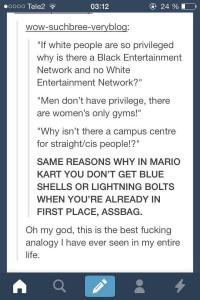
After getting all my points down, I proceeded to keep my audience awake via links to other interesting articles beyond my word count, and pictures that showed my point. These pictures made my ranting surprisingly clear, so after a long paragraph, I made sure to include one or two. The one [hyperlink] that I found to be the most effective would have to be making an analogy of white privilege using Mario Kart blue shells. The first time I saw the picture myself, it definitely made a big impact (hence the reason why I chose to include it). I’m hoping it wasn’t offensive but it truly makes a strong statement.
Continuing the usage of helping images, I used two pictures of “diversity” to illustrate the need for more inclusion of all races. I thought that they did a much better job of explaining the situation than I could, in a way that you all could understand. I found the value in adding in many more pictures, and the result was certainly different from the 8 page essay I turned into my professor.
Overall, both blogging and writing formal essays have their own importance- hopefully this post gave you an insight on what it’s like to convert between the writing styles. As I continue posting, I’m sure I’ll face a lot more obstacles, but without a doubt, they’ll be overcome.
Education in itself is a bold topic of discussion. Add ethnicity into the mix and you’re looking at a melting pot of ideas that could rub many groups of people the wrong way. So before we delve into all of that, let’s start with the basics.
Race:
I know. It’s a topic that’s been covered hundreds of times, but I think there are a couple things that need to be cleared up.
White Privilege: Now stop. Before you get angry and demand that white privilege no longer exists, hear me out. As a chinese-american female, give me a chance to explain what I see from my view, and what you may see from yours. Just keep in mind: you don’t have to feel guilty about having white privilege, because it wasn’t in your control to be born with white skin.
HOWEVER! It truly does exist, and the moment you refuse to stay aware of the fact is the moment when you’re now guilty.
After reading Peggy McIntosh’s 1988 now-famous piece, “White Privilege, Unpacking the Invisible Knapsack,” there are a couple key facts that show why white privilege does NOT mean everyone is calling you a lazy middle or upper class citizen. Read, please.
“I can turn on the television or open to the front page of the paper and see people of my race widely represented.”
“When I am told about our national heritage or about “civilization,” I am shown that people of my color made it what it is.”
“If a traffic cop pulls me over or if the IRS audits my tax return, I can be sure I haven’t been singled out because of my race.
I understand that this list (and more that she has come up with) could certainly rub people the wrong way, because in some of the points she makes, “race” could easily be switched out with “class.” But please, try stepping in my shoes and at least agree that some points may or may not indicate that YOU have white privilege.
And it’s ok.
It doesn’t make you a bad person in any way whatsoever, and it also doesn’t downgrade your hard work as an individual. So, at the end of the day, it’s important to realize that we all have different privileges and experiences.
Now again, that picture isn’t assuming that every white person has all the privileges in the world. It’s simply urging people to be AWARE of what privileges they hold, even if it was out of their control.
Acknowledging white privilege ALSO confirms that minorities many have to work differently in some senses, especially when it comes to education. Obviously, we all have our own set of privileges, because THIS is a great list that Gina Crosley-Corcoran put together, displaying the other privileges one could have. After reading this list, I was pretty surprised about how much more privilege I have than i’d imagined. It’s always great to reflect on the things we often take for granted, and to be more aware of our surroundings and how we use our privileges.
So, I DO have privileges, but it’s time we all discover what we carry in our “invisible knapsacks.”
NOW, that conversation isn’t over, but I want to move on to my next point.
Education:
Affirmative action usually goes hand in hand with education, because it serves as a method of supporting minorities who have been oppressed for decades.
Though it is a VERY important topic, (learn more here) I don’t want to focus on every aspect of it- it’s too much to cover in one blog post.
The only reason why I want to bring up affirmative action is because it explains a lot of what’s been happening to the definition of “diversity” over the past couple years.
When diversity, and education is mentioned, the spotlight of this conversation is usually put on two major racial groups: blacks and Hispanics. Now this makes a lot of sense, granted they make up the largest % of minorities in America.
We can see why this spotlight is happening. In the chapter “King’s Dream Remains an Elusive Goal: Many Americans See Racial Disparities,” written by the Pew Research Team, a nonpartisan think tank based in Washington, D.C, their analysis of “progress towards racial equality” (627) compares blacks, Hispanics, and whites.
“Today, white adults 25 and older are significantly more likely than blacks to have completed at least a bachelor’s degree (34% to 21%)” (627)
This disparity with regards to education shows how important it is for the rest of society to be aware of what is happening, so they can provide support whenever possible.
As a result of this focus on helping people from black or Hispanic (or both) backgrounds, much of the media attention began to revolve around them, and these two groups were able gain a stronger political stance, which is fantastic!
At the same time though, the definition of being “diverse” is starting to look more like this:
Now, don’t get me wrong, BOTH of these pictures are wonderful because of the differences we see. But the second one is a more true definition of diversity, one that isn’t only measured by the number of black and Hispanic people in the picture.
I can see why, though. Sheryl Sandberg, a person of Jewish descent, agrees in the chapter “What Would You Do If You Weren’t Afraid” of her book Lean In, when she elaborates on her background.
“All three of [her siblings, including herself,] were encouraged to excel in school and engage in extracurricular activities” (644).
Sandberg’s story is a strong testimony to the culture that has become associated with Jewish and Asian people. Growing up in a different culture makes education a top priority, and as a result, studies have shown that these two groups in particular have risen at a faster rate from oppression. This may be a reason why our stories are not shared as often, but is not a good enough excuse for our conversations to end here.
At the end of the day, i’m advocating for the INCLUSION of many other ethnically diverse people in the conversation when it comes to promoting higher education. It is great that people from disadvantaged backgrounds are getting the help and recognition they need, but this can’t be done by disregarding all the other hundreds of races and cultures out there. Being “colorblind” isn’t going to solve the problem, and recognizing privilege is the first step to being more aware of your surroundings.
So, when was the last time you checked your privileges?
Sources:
“Explaining White Privilege to a Broke White Person…” OCCUPY WALL STREET. N.p., n.d. Web. 11 Mar. 2016. <http://occupywallstreet.net/story/explaining-white-privilege-broke-white-person>.
McIntosh, Peggy. White Privilege: Unpacking the Invisible Knapsack. Wellesley: Peggy McIntosh, 1988. 1988. Web. 11 Mar. 2016.
PEW Research Center. “King’s Dream Remains an Elusive Goal; Many Americans See Racial Disparities” They Say/I Say. Eds. Gerald Graff, Cathy Birkenstein and Russel Durst. New York: W. W. Norton, 2015. 697-716. Print.
Sandberg, Sheryl. “Lean In: What Would You Do If You Weren’t Afraid?” They Say/I Say. Eds. Gerald Graff, Cathy Birkenstein and Russel Durst. New York: W. W. Norton, 2015. 642-58. Print.
Hi there, I’m Bella! A first-year at Santa Clara University, I currently pursue an Economics and Finance duel major, looking to expand my horizons in the business world. This is my mind dump for anything related to the Critical Thinking and Writing class i’m currently taking, and i’m hoping to continue writing here post-Spring quarter.
Get to know me better as I explore race, culture, technology, education, and more over the course of the next couple months. These are all topics of relevance to the universe of thought that we currently exist in.
Race. I’m Asian. Chinese, from Teochew. Born in Australia, I came to America when I was three. Race is a part of me but often times I do not hear my voice echoed in the conversation of ethnicity.
Culture. A strong believer of widening perspectives, culture is the best place to hear the hearts of what others call home. A place for revolving expressions, culture brings out the best, and arguably the most unique parts of a person.
Technology. Here in Silicon Valley, technology is never out of sight, or out of mind. Technology will be forever changing, and I strive to use it in a way that enhances my inner self instead of smothering it. I’m trying out a round of social media cleansing at the moment- thought I needed to get away for a while!
Education.By far a topic that must be handled with care. Education can go both ways. Before, it used to be clear to me that it was for everyone, but as my life grows more complex, I see that we’re not all necessary cut out for a traditional 4-year college degree.
Thanks for coming along for the ride! As a reward for reading my first post, here’s a peaceful castle.