
Summary of topic in 7 words: Effect of presidential campaigns on college campuses.
Getting into politics is an important, but difficult process. That’s why when I came up with my research topic, I found it very intimidating. Because political science is such a broad topic in general, I decided to focus specifically on presidential races, and how exactly they’ve impacted students in higher education, over the past few years.
Throughout the course of my ongoing research, I have been looking at ways in which various college students have banded together, or have had heated conversations, all in the name of the presidential election. I’ve also noted voter turnout and any overall trends pertaining to my topic.
These are the key points I’ve picked up.
1. Low Voter Turnout
Election campaigns have changed over the years, each time attracting less traditional methods of caucusing.

Because in general, people no longer rallied together on college campuses for pertinent events, it was apparent that the desire to for civil unity was decreasing. Another one of my sources also pointed to the lack of a strong community bond that would have prompted students to vote. Many college students are not from around the area, making it much harder and less desirable to place a ballot.
2. Less School-Wide Rallies
In attempts to prove the reasoning behind low voter turnout, many of my other sources also listed the decrease in school-wide rallies or protests particularly related to presidential campaigns. Accounts from students at UC Berkeley and Harvard share similarities, noting that college campuses used to unite to protest the Vietnam War. Today, the shift has been less on political events, and more towards tuition cuts, class size changes, and anything else the current student would care about.
3. Fear of Standing Apart
Additionally, the student from Harvard pointed out another interesting trend: the fear of “looking foolish by being passionately liberal” (Watson 2). She’s referring to the way students don’t seem to support passion for politics because it detracts from the other topics that students tend to focus more on. I do have qualms about this one though- not sure if other Harvard students feel the same.
4. Recent Upturn in Interest
I also took some time to read through articles that broke down the current 2016 election.

Similar to the 2008 Obama race, Clinton, Trump, and Sanders have all said some bold statements, causing quite the stir on social media. The reason why I’d assume that college students are starting to be more influenced by presidential races is because the polls have been on the rise, ever since 2008. One of my sources even noted that students from colleges and universities in Iowa went back to school over winter break, just so they could vote in the primaries for Obama. Other articles pointed out that many students today are having heated debates on the three candidates.
Another reason college students probably want to vote has to do with this man.
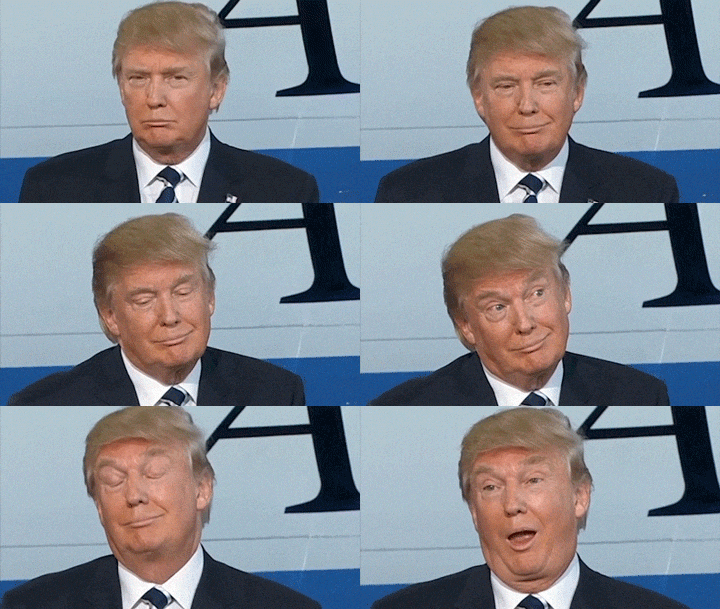
If we don’t take action now, we’ll be the ones living with the results.
Conclusion:
Overall, it appears that young voters are really starting to care, and that is a sign that polls will only go up from here. There’s still a lot of information to sift through, so I’ll continually post updates on any new findings I’ve discovered.
Links:
http://www.pollster.com/blogs/2010-04-08-McDonald-Turnout-Rates.png
http://a.abcnews.go.com/images/Politics/GTY_clinton_sanders_trump_jef_160129_12x5_1600.jpg
https://media.giphy.com/media/xTiTnHXbRoaZ1B1Mo8/giphy.gif