
Afterthoughts.

How to publicly reflect on your thoughts.

That’s the phrase I continually wondered about this weekend, and without a clear answer, I’ve been a little weary of writing this post. That, and finals are coming up, so I’ve got a bit on my plate. But no excuses. I’ve given it enough consideration so if I don’t begin now this is never going to happen.

Have you ever had someone read your work over your shoulder while you type? Or edit your essay while you’re sitting right in front of them? That’s kind of what blogging feels like because everything I say is now public and under the scrutiny of whoever stumbles to my page. All eyes can access it. I mean even though (usually) no one’s actually there to critique your carefully chosen words, it feels weird, to say the least. An out of body experience where what once was only shared with few, (private journaling), can now be viewed by anyone who remotely cares about the topics I discuss here.

So i guess that’s the very first thing I noticed when blogging online versus handing in an essay to a teacher. Having an audience is so much more real now. You are no longer an abstract figment of my imagination, but physical human beings who can leave comments and suggestions, which also are viewed publicly. What I am doing as a blogger is more than sharing my thoughts. I am opening up an ongoing, facilitated conversation.

That being said, this is still a place for me to express my thoughts, but it’s just as important to think about how I word my thoughts. Instead of limiting my writing, blogging pushes me in a direction that forces me to be succinct, eloquent, calculated, open-minded, etc etc. Though it can be kind of challenging, I’m really starting to enjoy it.

My previous post, Let’s Talk Race. And Education, started off as an 8 page paper that I had originally turned in for my writing class at SCU. After being tasked with turning it into a blog post, I felt pretty stumped. Semi-intellectual, professional ranting on large, controversial topics, is a serious task.

But after doing a reverse outline, I was able to really categorize the various topics I had touched upon, and it came down to two major topics that I thought would be important to cover.

  1. Race: What was I going to say about race? Why did I feel the need to talk about race? How can I describe the feeling of being a minority to someone who’s never been in my situation, without sounding angry?
  1. Education: I’ve been lucky enough to have grown up in an area that provided top-notch education, starting from elementary school. How do I analyze it without sounding ungrateful or harsh?

And most of all, how do I take the complex connection made between these two topics in my essay, and convert them to blog form?

After a lot of trial and error, I thought it would be best to point out simply, that different people all have different privileges. Whether you’re white, Asian, Indian, disabled, straight, cisgendered, or anything else, what you go through in your daily life will never be the same as what anyone else goes through. Point is, different kinds of privileges exist, but we must be willing to acknowledge them first before talking about anything else. Instead of starting with a whole thesis, I got right to the point I was trying to make. I used everything from bolded words to short paragraphs. i also found myself taking out a lot of the explaining because my condensing my essay meant keeping only the most crucial parts.

Following that discussion, I began to make my assertions about why certain minority groups need more help than others. It all goes back to that privilege thing. People with less privileges (doesn’t only have to be based on race) should get more help when it comes to improving their social welfare via education. And that’s all fine and dandy.

What I really wanted to get at, though, was my third and final point: diversity. So, I went from talking about privilege to urging everyone to include more diversity in their own definitions of “multi-cultural.”

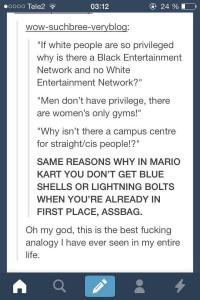
After getting all my points down, I proceeded to keep my audience awake via links to other interesting articles beyond my word count, and pictures that showed my point. These pictures made my ranting surprisingly clear, so after a long paragraph, I made sure to include one or two. The one [hyperlink] that I found to be the most effective would have to be making an analogy of white privilege using Mario Kart blue shells. The first time I saw the picture myself, it definitely made a big impact (hence the reason why I chose to include it). I’m hoping it wasn’t offensive but it truly makes a strong statement.

Continuing the usage of helping images, I used two pictures of “diversity” to illustrate the need for more inclusion of all races. I thought that they did a much better job of explaining the situation than I could, in a way that you all could understand. I found the value in adding in many more pictures, and the result was certainly different from the 8 page essay I turned into my professor.

Overall, both blogging and writing formal essays have their own importance- hopefully this post gave you an insight on what it’s like to convert between the writing styles. As I continue posting, I’m sure I’ll face a lot more obstacles, but without a doubt, they’ll be overcome.

See you next quarter!


Links:

http://stream1.gifsoup.com/view4/4332722/jimmy-fallon-conversation-o.gif

http://cdn1.matadornetwork.com/blogs/1/2014/03/writer-moments13.gif

http://authorkimberlyknight.com/wp-content/uploads/2013/04/writing-bad.gif

http://3.bp.blogspot.com/-q5j3jizOL60/VV52DuTGcaI/AAAAAAAAIUQ/ZGG6FzWp0pw/s1600/tmhnks.gif
Let’s Talk Race. And Education.

Education in itself is a bold topic of discussion. Add ethnicity into the mix and you’re looking at a melting pot of ideas that could rub many groups of people the wrong way. So before we delve into all of that, let’s start with the basics.

Race:

I know. It’s a topic that’s been covered hundreds of times, but I think there are a couple things that need to be cleared up.

White Privilege: Now stop. Before you get angry and demand that white privilege no longer exists, hear me out. As a chinese-american female, give me a chance to explain what I see from my view, and what you may see from yours. Just keep in mind: you don’t have to feel guilty about having white privilege, because it wasn’t in your control to be born with white skin.

HOWEVER! It truly does exist, and the moment you refuse to stay aware of the fact is the moment when you’re now guilty.

After reading Peggy McIntosh’s 1988 now-famous piece, “White Privilege, Unpacking the Invisible Knapsack,” there are a couple key facts that show why white privilege does NOT mean everyone is calling you a lazy middle or upper class citizen. Read, please.

  • “I can turn on the television or open to the front page of the paper and see people of my race widely represented.”
  • “When I am told about our national heritage or about “civilization,” I am shown that people of my color made it what it is.”
  • “If a traffic cop pulls me over or if the IRS audits my tax return, I can be sure I haven’t been singled out because of my race.

I understand that this list (and more that she has come up with) could certainly rub people the wrong way, because in some of the points she makes, “race” could easily be switched out with “class.” But please, try stepping in my shoes and at least agree that some points may or may not indicate that YOU have white privilege.

And it’s ok.

It doesn’t make you a bad person in any way whatsoever, and it also doesn’t downgrade your hard work as an individual. So, at the end of the day, it’s important to realize that we all have different privileges and experiences.

TL; DR: (sorry in advance for the profanity)

http://procrasti-nation.eu/racism-sexism-privileges-for-the-underprivileged-mario-kart-analogy/
Picture credits: http://procrasti-nation.eu/racism-sexism-privileges-for-the-underprivileged-mario-kart-analogy/

Now again, that picture isn’t assuming that every white person has all the privileges in the world. It’s simply urging people to be AWARE of what privileges they hold, even if it was out of their control.

Acknowledging white privilege ALSO confirms that minorities many have to work differently in some senses, especially when it comes to education. Obviously, we all have our own set of privileges, because THIS is a great list  that Gina Crosley-Corcoran put together, displaying the other privileges one could have. After reading this list, I was pretty surprised about how much more privilege I have than i’d imagined. It’s always great to reflect on the things we often take for granted, and to be more aware of our surroundings and how we use our privileges.

So, I DO have privileges, but it’s time we all discover what we carry in our “invisible knapsacks.”

NOW, that conversation isn’t over, but I want to move on to my next point.


Education:

Affirmative action usually goes hand in hand with education, because it serves as a method of supporting minorities who have been oppressed for decades.

Picture Credits: http://changefromwithin.org/2012/06/06/are-white-students-being-disadvantaged-by-affirmative-action/

Though it is a VERY important topic, (learn more here) I don’t want to focus on every aspect of it- it’s too much to cover in one blog post.

The only reason why I want to bring up affirmative action is because it explains a lot of what’s been happening to the definition of “diversity” over the past couple years.

When diversity, and education is mentioned, the spotlight of this conversation is usually put on two major racial groups: blacks and Hispanics. Now this makes a lot of sense, granted they make up the largest  % of minorities in America.

Picture Credits: http://www.lpstrategies.com/wp-content/uploads/2011/10/US-Population-by-Race-Ethnicity.png

We can see why this spotlight is happening. In the chapter “King’s Dream Remains an Elusive Goal: Many Americans See Racial Disparities,” written by the Pew Research Team, a nonpartisan think tank based in Washington, D.C, their analysis of “progress towards racial equality” (627) compares blacks, Hispanics, and whites.

“Today, white adults 25 and older are significantly more likely than blacks to have completed at least a bachelor’s degree (34% to 21%)” (627)

This disparity with regards to education shows how important it is for the rest of society to be aware of what is happening, so they can provide support whenever possible.

As a result of this focus on helping people from black or Hispanic (or both) backgrounds, much of the media attention began to revolve around them, and these two groups were able gain a stronger political stance, which is fantastic!

At the same time though, the definition of being “diverse” is starting to look more like this:

Picture Credits: http://media.salon.com/2015/10/people_grid-620×412.jpg

Instead of this:

Picture Credits: https://sjames1501.files.wordpress.com/2013/06/istock_000016367688medium-2.jpg

Now, don’t get me wrong, BOTH of these pictures are wonderful because of the differences we see. But the second one is a more true definition of diversity, one that isn’t only measured by the number of black and Hispanic people in the picture.

I can see why, though. Sheryl Sandberg, a person of Jewish descent, agrees in the chapter “What Would You Do If You Weren’t Afraid” of her book Lean In, when she elaborates on her background.

“All three of [her siblings, including herself,] were encouraged to excel in school and engage in extracurricular activities” (644).

Sandberg’s story is a strong testimony to the culture that has become associated with Jewish and Asian people. Growing up in a different culture makes education a top priority, and as a result, studies have shown that these two groups in particular have risen at a faster rate from oppression. This may be a reason why our stories are not shared as often, but is not a good enough excuse for our conversations to end here. 

At the end of the day, i’m advocating for the INCLUSION of many other ethnically diverse people in the conversation when it comes to promoting higher education. It is great that people from disadvantaged backgrounds are getting the help and recognition they need, but this can’t be done by disregarding all the other hundreds of races and cultures out there. Being “colorblind” isn’t going to solve the problem, and recognizing privilege is the first step to being more aware of your surroundings.

So, when was the last time you checked your privileges?


Sources:

“Explaining White Privilege to a Broke White Person…” OCCUPY WALL STREET. N.p., n.d. Web. 11 Mar. 2016. <http://occupywallstreet.net/story/explaining-white-privilege-broke-white-person>.

McIntosh, Peggy. White Privilege: Unpacking the Invisible Knapsack. Wellesley: Peggy McIntosh, 1988. 1988. Web. 11 Mar. 2016.

PEW Research Center. “King’s Dream Remains an Elusive Goal; Many Americans See Racial Disparities” They Say/I Say. Eds. Gerald Graff, Cathy Birkenstein and Russel Durst. New York: W. W. Norton, 2015. 697-716. Print.

Sandberg, Sheryl. “Lean In: What Would You Do If You Weren’t Afraid?” They Say/I Say. Eds. Gerald Graff, Cathy Birkenstein and Russel Durst. New York: W. W. Norton, 2015. 642-58. Print.

Image Credits:

http://procrasti-nation.eu/racism-sexism-privileges-for-the-underprivileged-mario-kart-analogy/

http://changefromwithin.org/2012/06/06/are-white-students-being-disadvantaged-by-affirmative-action/
http://www.lpstrategies.com/wp-content/uploads/2011/10/US-Population-by-Race-Ethnicity.png

http://c.tadst.com/gfx/600×400/worlddaycul-diver.jpg?1

https://sjames1501.files.wordpress.com/2013/06/istock_000016367688medium-2.jpg

http://media.salon.com/2015/10/people_grid-620×412.jpg

More Links:

https://www.youtube.com/watch?v=gJgQR6xiZGs       

Welcome!

Hi there, I’m Bella! A first-year at Santa Clara University, I currently pursue an Economics and Finance duel major, looking to expand my horizons in the business world. This is my mind dump for anything related to the Critical Thinking and Writing class i’m currently taking, and i’m hoping to continue writing here post-Spring quarter. 

Get to know me better as I explore race, culture, technology, education, and more over the course of the next couple months. These are all topics of relevance to the universe of thought that we currently exist in.

Race. I’m Asian. Chinese, from Teochew. Born in Australia, I came to America when I was three. Race is a part of me but often times I do not hear my voice echoed in the conversation of ethnicity.

Culture. A strong believer of widening perspectives, culture is the best place to hear the hearts of what others call home. A place for revolving expressions, culture brings out the best, and arguably the most unique parts of a person.

Technology. Here in Silicon Valley, technology is never out of sight, or out of mind. Technology will be forever changing, and I strive to use it in a way that enhances my inner self instead of smothering it. I’m trying out a round of social media cleansing at the moment- thought I needed to get away for a while!

Education. By far a topic that must be handled with care. Education can go both ways. Before, it used to be clear to me that it was for everyone, but as my life grows more complex, I see that we’re not all necessary cut out for a traditional 4-year college degree.

Thanks for coming along for the ride! As a reward for reading my first post, here’s a peaceful castle.

imgres