
Introduction
Our group is part of Dr. Lee Panich’s Difficult Dialogues course titled “Native People and the Legacies of the California Missions”. Throughout the quarter, we were given the opportunity to engage with different types of archives, written and material artifacts, in order to contextualize Native histories in the mission period. Our work culminated in three projects: writing biographies about Ohlone people in Mission Santa Clara, transcribing Ohlone-authored documents, and analyzing Native material culture from the Mission period. This work is especially powerful at Santa Clara, where we have the opportunity to learn about the history that is right here, underneath our campus!
In this blog post, we’ll be discussing how our experience with material, or archeological, culture in relation to other archival sources allowed us to cultivate an understanding of Indigenous people and the lives they led at the mission. In engaging with history and culture in this way, we were given the freedom to understand history from the source material, not marred by misconception and colonial written histories. We had the privilege of working with archival materials from the Santa Clara University Library Archives and Special Collections, the de Saisset Museum, and the Community Heritage Lab. Cross-referencing archives from different centers on campus allowed us to piece together Santa Clara’s history ourselves, and form a deeper understanding and appreciation for historians and archivists in the process. This approach also allowed us to move beyond surface level engagement with Indigenous history, such as land acknowledgements, creating a more respectful and accurate representation of who the Ohlone people were in the Mission Period, personalizing their experiences, and understanding the complex issues tribes face today
Inside the Archives
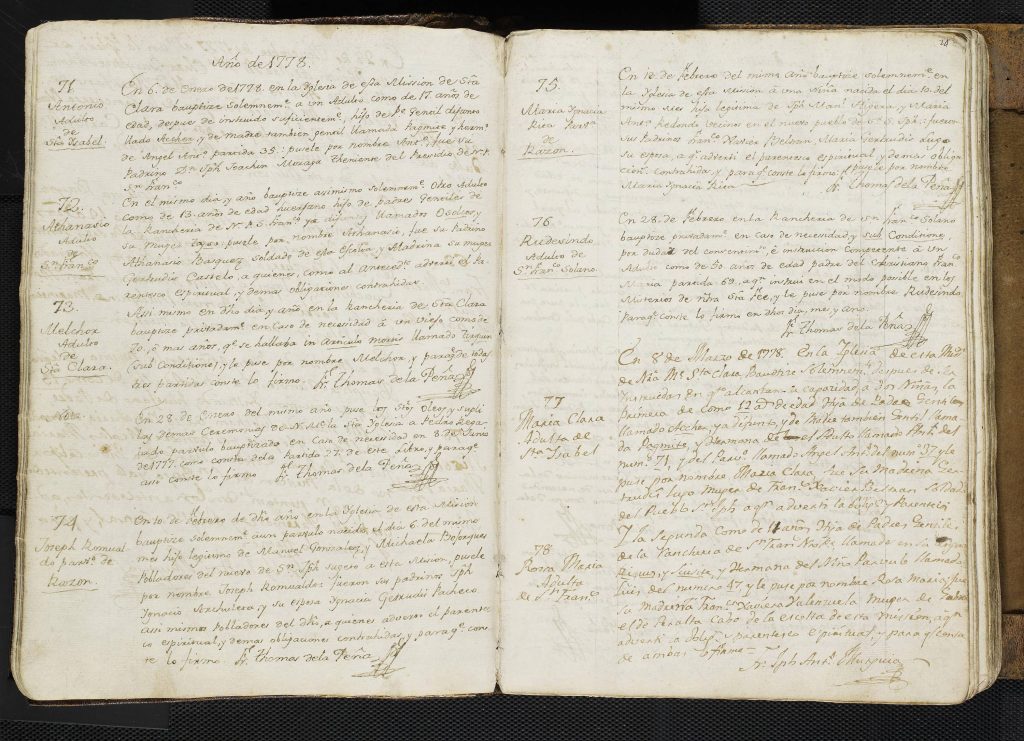
Our interaction with special collections, sacramental records, and archaeological materials showed us how vital context is when we interpret history. As we examined sacramental records, which often include only brief entries such as baptisms or marriages, we noticed how these documents omitted or generalized individual Native experiences. The archives revealed that missionaries and colonizers routinely grouped Native people into broad categories, erasing individuality and reinforcing Eurocentric narratives. Having SCU staff members, like Dr. Monica Keane, present while we worked with these materials deepened our understanding because they offered nuance, cultural background, and a critical perspective that the documents alone could not provide and that we did not know before entering the archives. Professional guidance became especially important when we studied archaeological items in the de Saisset Museum and Community Heritage Lab. Items that initially seemed ordinary, such as pottery fragments or tools, gained meaning once experts helped us place them within Ohlone daily life and mission structures. Without that interpretation, we could easily misread or oversimplify these materials and repeat the silencing found in the original records. By working directly with specialists, we built more accurate and human-centered narratives of Native individuals and ensured that we researched people rather than just documents.
What Archaeology Reveals about Ohlone Life in the Mission
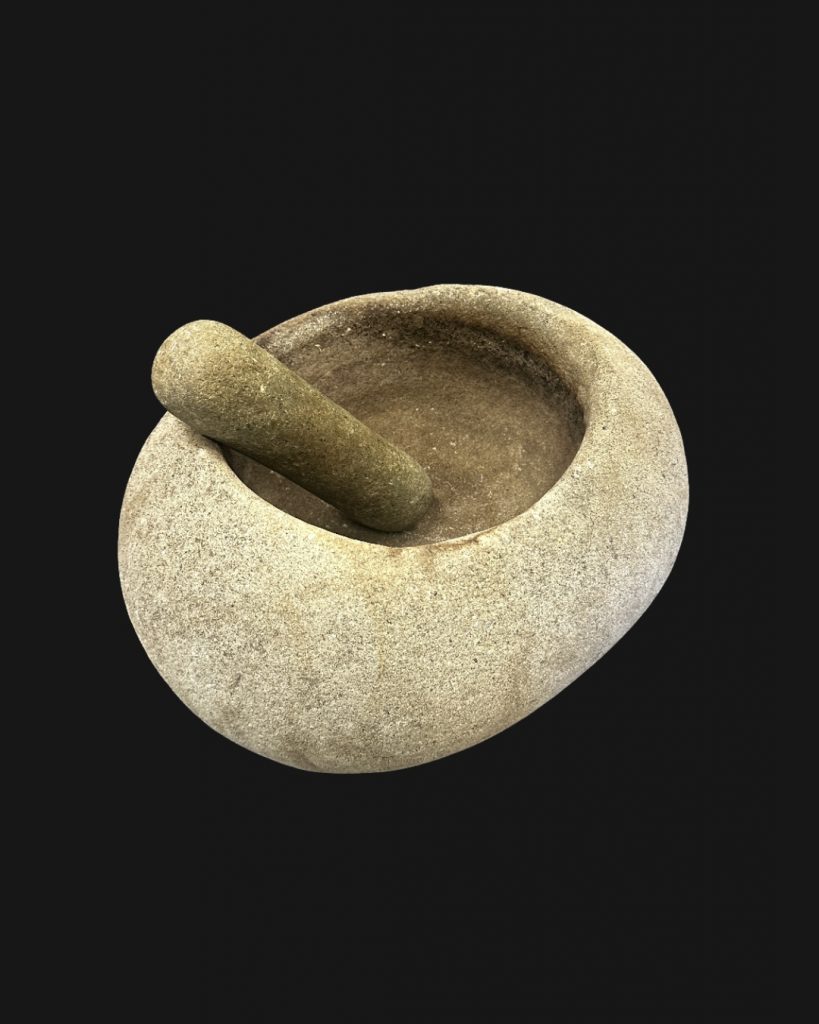
Engaging with the archaeology at the museum’s California Stories from Thámien to Santa Clara exhibit allowed each of us to hone in on an object that resonated with us and understand how Indigenous lives unfolded within, and often in resistance to, the mission system. These physical pieces of history were critical in our understanding of the cultural persistence that has been absent or skewed in written colonial records. For example, mortars and pestles containing acorn traces demonstrate that Native cooking practices continued inside the missions rather than being fully replaced by a homogenized mission diet. Basketry further reflects this continuity, as while environmental damage and restricted movement made accessing traditional plant materials more difficult, many baskets show adjustments in size or material use while preserving core techniques passed down for generations. Archaeologists also interpret roof, floor, and inscribed tiles as traces of Native labor under colonial rule, grounding mission life in the physical work Indigenous individuals performed daily.
A particularly meaningful artifact that deepened our understanding of Indigenous history was the bird bone whistle inlaid with abalone, which offers clear evidence of both inter-tribal and mission trade. Because abalone could not be sourced near Mission Santa Clara, its presence reflects ongoing networks that connected Native communities across regions, as abalone also held ceremonial importance for the Ohlone and was commonly used in burial contexts. When Ohlone representatives visited our class, they explained how the discovery of these whistles has helped revive musical and dance traditions that were disrupted but not erased by colonization. Finally, the chocolate pots (one crushed and one flat) reveal insights absent from written records, as although chocolate circulated strategically through colonial political relationships over several centuries, its consumption remained associated with luxury, elite status, and power. Taken together, these objects reveal how archaeology can bring forward hidden histories essential to honoring Native life, an experience that was profoundly impactful for each of us.
Reframing Ohlone History Through Archaeology and Archives
The presence of archival material on campus, both in the form of sacramental records taken by mission priests and legal letters written for Native people after the mission period, provides opportunities to challenge dominant narratives (Mission Santa Clara Manuscript Collection). However, a majority of the documents held in the archives were produced and initially stored by colonizers rather than Native people, therefore silencing the voice of the Ohlone people who lived at Mission Santa Clara, and depriving the archives of their perspective. By combining information from the archives with archaeological evidence, we can unearth knowledge about sustained indigenous culture inside the missions, stories of resistance, and other pieces of information that colonisers might have deemed as unimportant contributions to the archives.
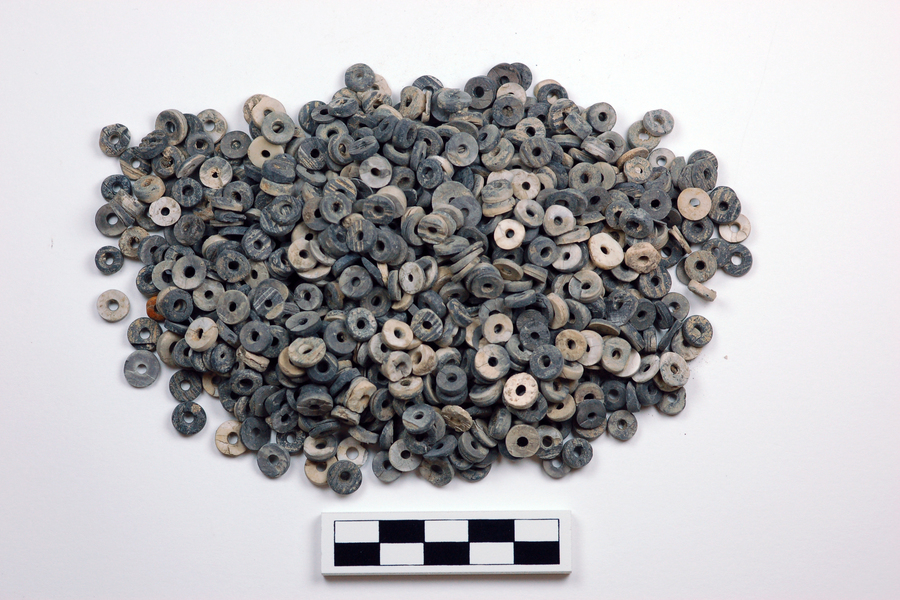
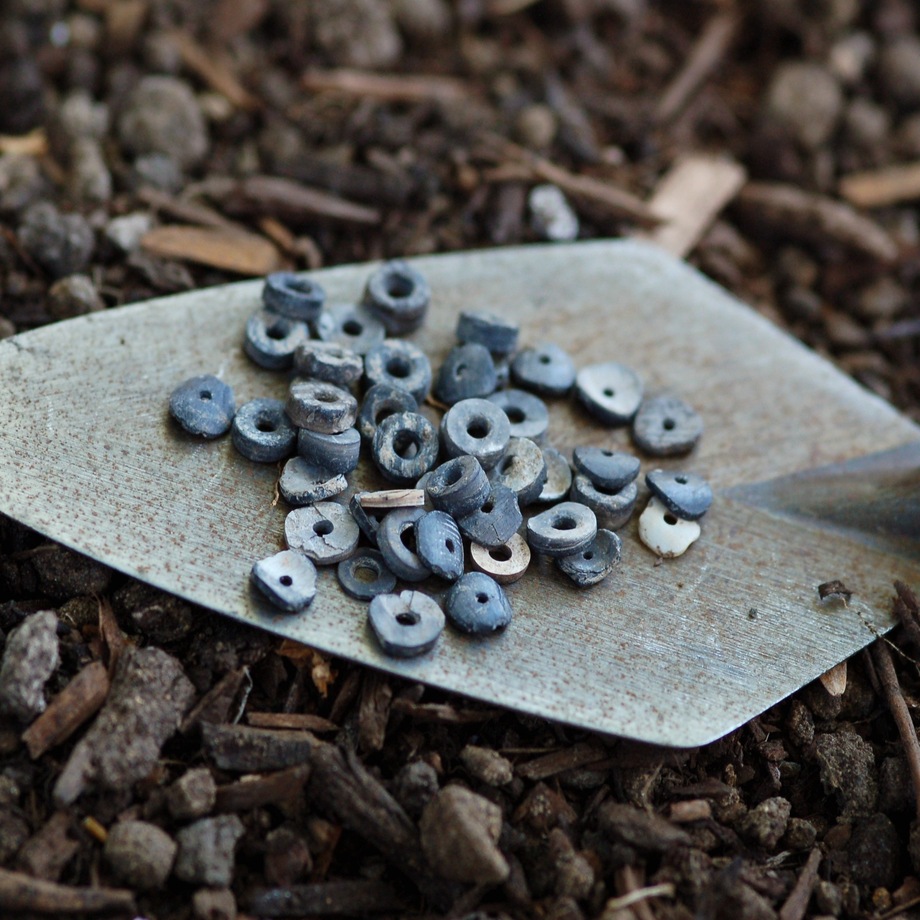
As an example, the discovery of a multitude of shell beads at mission sites as well as on campus at SCU has shown how the Ohlone people adapted and continued their burial rituals at the mission, pushing back at the preexisting narrative that portrayed them as passive victims to Westernization (Panich, 2014). Additionally, when viewed in a post-mission context, basket weaving as a cultural practice is a testament to the withstanding cultural tradition of Native people as well as a sign of resistance to forced Western practices. Having an archive of physical artifacts gives students the opportunity to interact with these different forms of historical documentation and gain a deeper understanding of the history of the land SCU rests on. Other Native-made artifacts, such as chocolate pots used by the missionaries, provide insights into hierarchies not shared in administrative surveys and sacramental records (Graham and Skowronek, 2016). These lasting artifacts of the mission period highlight the importance of a physical archive, such as in the de Sassiet Museum and Archives & Special Collections, providing opportunities to break preconceived notions about the mission period. Having access to materials in an archive that show both sides of the story helps create a more inclusive narrative that brings a voice to people who have had theirs taken away from them for centuries.
One cannot truly understand what was happening at Mission Santa Clara based purely on the insights gained from written archives or archeological evidence. To accurately see the full image, we must look at both resources, while cognizant of the gaps they hold, and build out a narrative that fairly represents the Ohlone people.
Works Cited
Graham, Margaret A., and Russell K. Skowronek. “Chocolate on the Borderlands of New Spain.” International Journal of Historical Archaeology 20 (2016): 645–665.
Panich, Lee M. “Native American Consumption of Shell and Glass Beads at Mission Santa Clara de Asís.” American Antiquity 79 (2014): 730–748.
Blog post by Molly Stover, Julia Singh, Ayush Gupta, Darasimi Ogunleye, and Miles Burrello (Honors 20, Fall 2025).
Title Photo: Beads recovered from Native Californian residential areas at Mission Santa Clara. Courtesy of Lee Panich.