
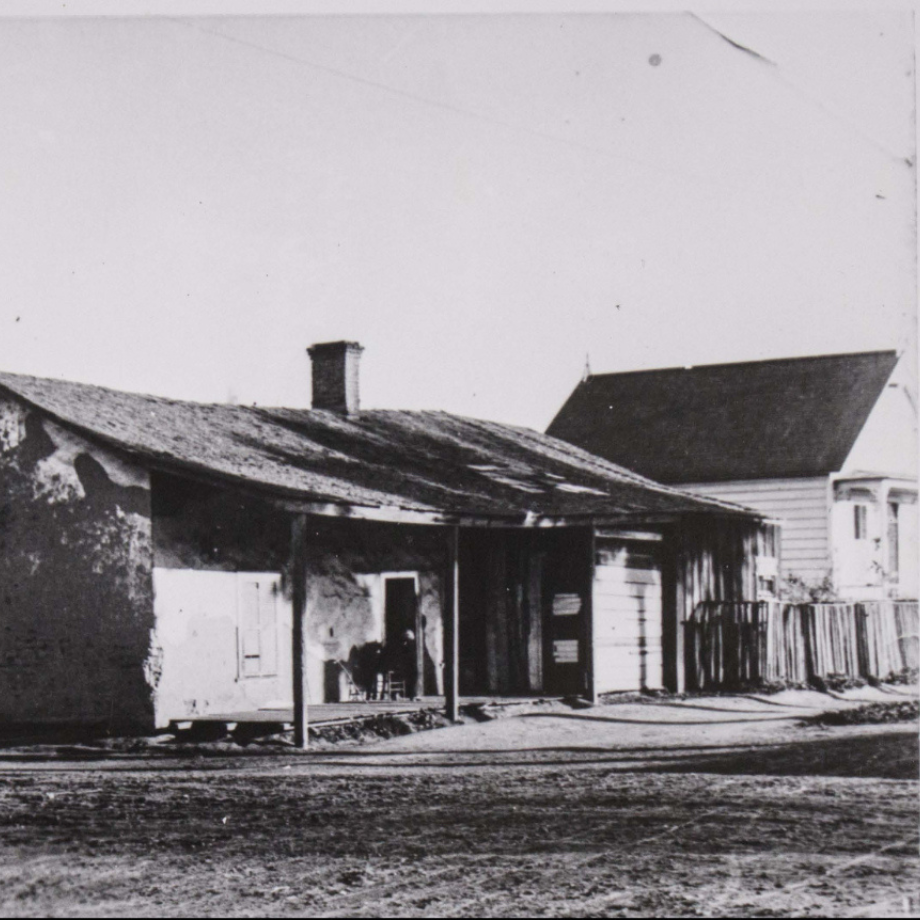
Built around a former Mission, our university sits on land layered with meaning. Long before brick buildings and manicured lawns, Ohlone communities lived, worked, gathered, and resisted here. Their history did not begin in 1777 with the founding of Mission Santa Clara de Asís. However, most of what students encounter about this land, in their daily lives and in our archives, starts there. This is in part because the Mission-era records, which still survive today and are available to view, offer only a sliver of this history, and largely from an outsider’s perspective.
Many of these documents were never designed to tell Indigenous stories; rather, they operated as accounting tools, cataloguing baptisms, marriages, and deaths. Thus, while they offer some records and insight into Ohlone and Mission history, they overwhelmingly reflect colonial priorities with a focus on conversion and assimilation. In other words, they tell us who entered the Mission, but not who they were. As such, the primary documents we have as a university are not enough to tell the full story. We need more context and humanity in our sources. Luckily, one step we can take towards accomplishing this goal is centering Ohlone-authored texts, which are essential for recovering agency, humanity, and resistance that our current primary records have erased.
An Incomplete Archive
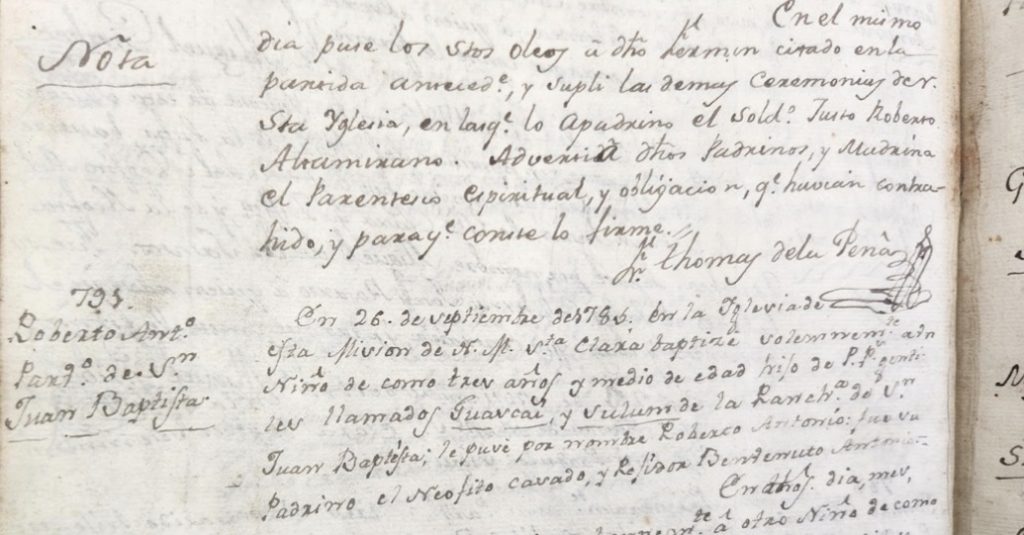
The imbalance in viewpoint is most visible in the records which are currently one of our closest archival ties to Ohlone people who passed through the Santa Clara Mission: the sacramental records found in SCU Archives & Special Collections’ Mission Santa Clara Manuscript Collection. These records keep an account of baptisms, marriages, and burials which, at first glance, appear to offer entry points into Indigenous lives. However, while they are useful in tracking people, lineage, and kinship ties within the Mission, these records are bereft of any real personal information. At best, they contain a reference to a job, a godparent, or even more rarely a given Native name; more commonly, though, they list a Spanish name and a date, and leave the reader to make inferences about the person. This emerges as “proof” that Indigenous people existed within the Mission, but not how they lived, resisted, or understood their own circumstances.
An example of this phenomenon is shown through Roberto Antonio, an Ohlone man in the Santa Clara Mission system. Born just five years after the establishment of Mission Santa Clara de Asís in 1777, Roberto’s life unfolded entirely alongside the rapid expansion and fall of the California missions. His life, however, is reduced in the archive to moments of Christian incorporation, starting with his baptism in 1785. Unfortunately, this is the reality of most Mission-related sources. The personal lives of the Native Americans who lived were not seen as important to those running the Mission, for whom the conversion of the local people was seen as the primary goal. Thus, much of the Native perspective has been excised from these documents.
Finding the Ohlone Perspective in the Archive
Occasionally, Indigenous presence breaks through the paper walls of the archive in a document authored by a non-Native: For instance, in a 1799 letter from Father José Viader to the Spanish Governor, we catch a rare glimpse of Native leadership at Mission Santa Clara. In his letter, Viader describes an election held by Native residents of Mission Santa Clara to select an alcalde—a local official—revealing Indigenous participation in local government and leadership within Mission society.
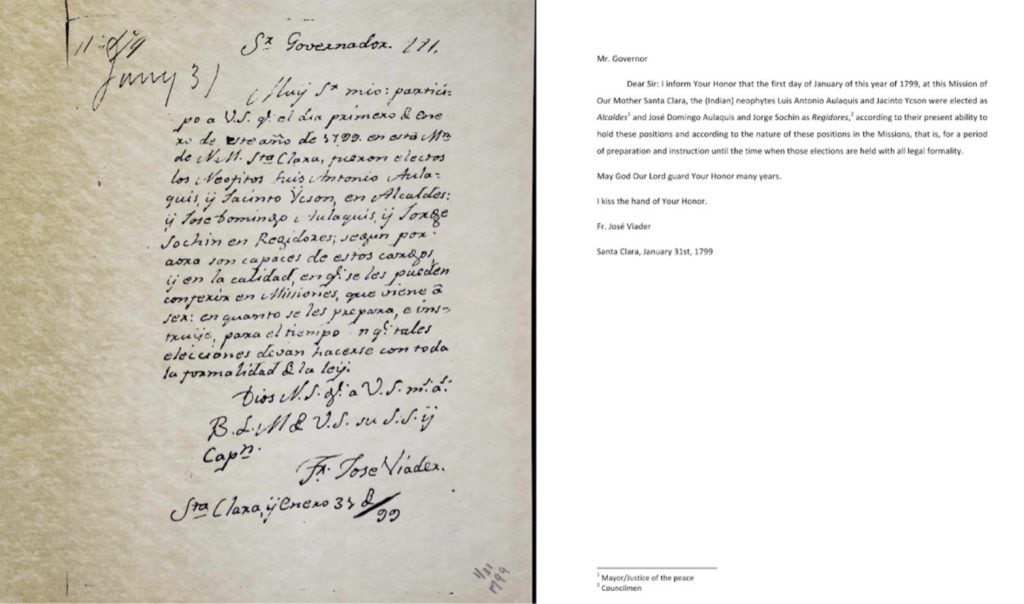
This, however, is not a perfect document. Even here Native voices remain filtered, constrained to a priest’s pen, but it does show a measure of agency beyond what many primary documents like the Mission sacramental records share. It works as an example of what could be gained from looking at more Ohlone-centered documents, such as the post-secularization records of Native Americans petitioning for emancipation and land.
In the 1830s, a wave of Native individuals sought legal separation from the Missions and a return to their traditional land. As historian Lisbeth Haas (2003) explains, approval most often went to high-ranking Natives because they required an accompanying statement from a missionary or military officer attesting to Christian education, conduct, and ability to support themselves. One example of an Ohlone person who navigated this system successfully was none other than Roberto Antonio of the Santa Clara Mission.
In 1844, Roberto received legal ownership of Rancho Los Coches—land located near his birthplace and close to his ancestral village. For the first time in his life, Roberto lived as a landowner, outside the direct control of the Mission. For three years, he experienced autonomy that had been denied since childhood.
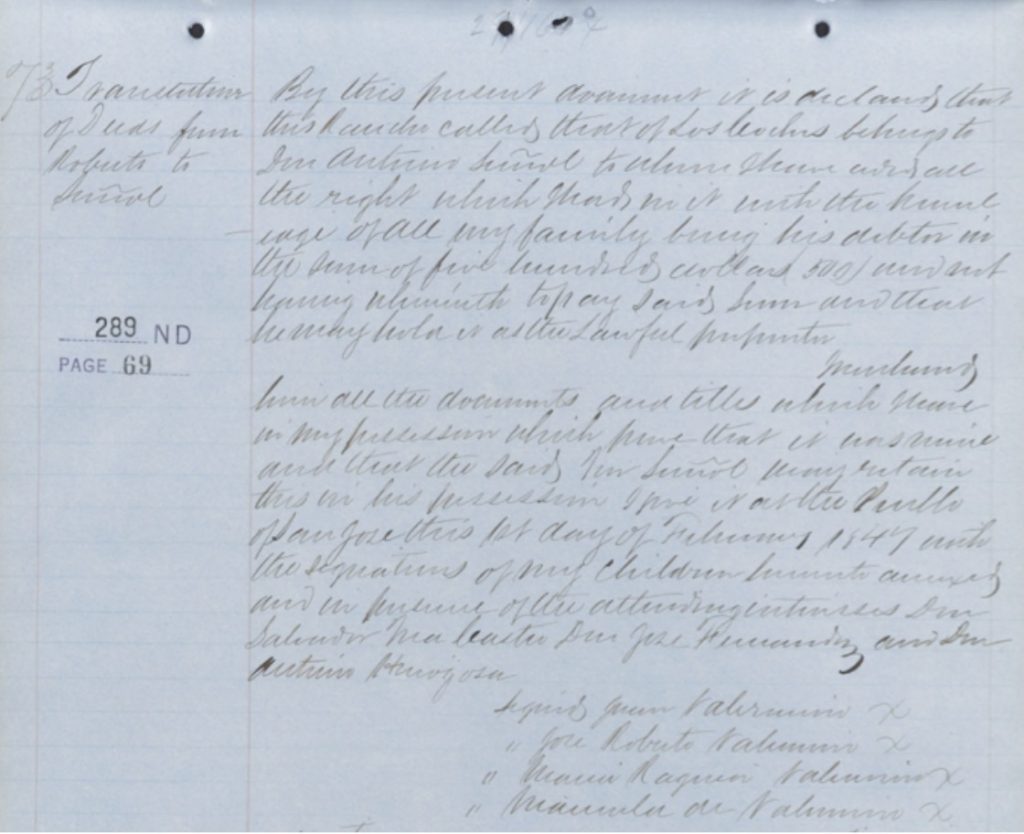
Roberto’s brief reclamation of land and autonomy, however, was neither secure nor permanent. A legal record reveals that Roberto and his family had incurred a debt of five hundred dollars, and the land, as his only asset, became the means of repayment. A letter documents the authorization of the transfer of Roberto’s rancho to Don Antonio Suñol, written on his behalf and signed only with an “X,” demonstrating his likely illiteracy under colonial education.
This record, more than Father Viader’s letter and the sacramental records, speaks to a real, human experience. Instead of being lumped in a monolith, Roberto stands out as a person with history, not just a birth date but a real person who did try to have agency in his life.
Ohlone-Centered Does Not Just Mean “About Ohlone People”
This record still isn’t a perfect one. While it does good work in revealing the effects of economic vulnerability and colonial coercion, it still focuses on the institution more than the Indigenous experience. As this is a legal document, Roberto’s voice does not appear, so, like the Mission archives, this land sale confirms existence but withholds personhood. However, this petition carries with it its own sort of agency that, even if not acknowledged in its time, offers a more Ohlone-centered view than other documents.
Roberto’s case exists as part of a larger pattern of Indigenous petitions of the era of Native Ohlone demanding recognition of their rights following the secularization of the Mission. Historians have documented cases of native people like Iñigo and Juan Santos, who also passed through the Santa Clara Mission system and experienced a trying time with the local legal systems post-emancipation, used the very system that tried to put them down to assert personal and communal freedom, demanding recognition of rights that colonial rule had systematically denied.
This isn’t to say that they quite succeeded – Iñigo submitted repeated requests for livestock and farming equipment, only for his claims to be misplaced or removed entirely from the colonial paper trail, and Juan Santos’ family lost their rightful land grant due to a lack of “official” authentication (see “Posolomi y Posita de las Animas” and “Rincon del Alisal” land cases, respectively). Yet even when ignored or erased by institutions, these writings remain acts of authorship, using legal language to assert agency and leaving behind records that speak against the Mission’s attempts to make them disappear.
These documents also consistently foreground family and community—Roberto’s land sale was witnessed by his wife and children, just as many freedom petitions named entire households. For instance, in his emancipation petition, Juan Santos asks if “he can go free with his aforementioned family to enjoy the civil liberty that the law grants all citizens in this town of San Jose,” showing the strength of his familial bond as well as the desire to secure a better life for them (Juan Santos, 1839).
In a manner markedly different from the first two documents, Fr. Viader’s letter and the land sale document, these petitions offer a window into their personal experience. Most of this feeling comes from the fact that, unlike those initial documents, these were authored by Ohlone people. While perhaps not literally written in the cases in which the petitioners were illiterate, these documents were deliberate forays into the post-Mission system in a way other documents are not. They demonstrate agency and individuality and, in this, speak to the Ohlone experience because they do not represent the individual as part of a faceless mass. By refusing to let individuals be lost, these Ohlone-authored documents center themselves by keeping the nuance of individual situations.
Decolonizing the Archives
Against the silences and distortions of the colonial record, Ohlone-authored texts offer the foundation for a decolonized archive by providing counter-narratives that restore humanity, intention, and agency to Ohlone communities. Although the record remains fragmentary, the texts we have access to allow glimpses into daily life, family relations, and social obligation that Mission documents systematically exclude. In doing so, they challenge historical misrepresentations and correct the erasures embedded in the institutional record, making clear that Indigenous people were not passive subjects of colonial systems but active negotiators of their own futures.
Yet integrating these texts into a broader archival narrative requires more than simply locating them. Meaningful interpretation demands human expertise, cultural knowledge, and an approach grounded in Indigenous perspectives, contextualized within the social, political, and linguistic worlds from which they emerged. A decolonized archive recognizes that colonial documents—whether baptismal registers, Viader’s letter on Native elections, or land-sale records—offer only partial insight. When placed alongside other materials and archives, however, their limitations become legible, and a fuller history takes shape.
Moving forward requires careful preservation, ethical interpretation, and an explicit commitment to centering Indigenous narratives. This approach not only reconstructs a more accurate past but also sets a standard for future archival practice. A future where the story of this land does not start with the Mission—but with the people who lived, loved, and thrived here long before it.
A future where their voices finally are heard.
Works Cited
Panich, Lee M. Narratives of Persistence: Indigenous Negotiations of Colonialism in Alta and Baja California, University of Arizona Press, 2020.
Haas, Lisbeth. “Emancipation and the Meaning of Freedom in Mexican California.” The Journal of the California Mission Studies Association, vol. 20, no. 1, 2003, pp. 11-22.
Juan Santos to Prefect, 27 July 1839, Bancroft Library, C-A 150 [Documents from the Spanish and Mexican periods in California, 1780-1849, reel 9], no. 1560, 475.
Posolomi y Posita de las Animas (also called “Ojo del Caballo”) [Santa Clara County] Robert Walkinshaw, Claimant. Case no. 410, Northern District of California. 1852-1862. University of California Berkeley Library Digital Collections, University of California Berkeley, Berkeley, CA. https://digicoll.lib.berkeley.edu/record/264257?v=pdf.
Rincón del Alisal [Santa Clara County] Julian and Fernando Santos, Claimants. Case no. 202, Northern District of California. 1852-1856. University of California Berkeley Library Digital Collections, University of California Berkeley, Berkeley, CA. https://digicoll.lib.berkeley.edu/record/267518?v=pdf.
Blog Post by Jacklyn Alonzo Heredia, Perry Stevick, Emma Clark, and Joe Potts (Honors 20, “Difficult Dialogues,” Fall 2025).