Category Archives: CTW II Posts

Classmate’s Multimodal Composition

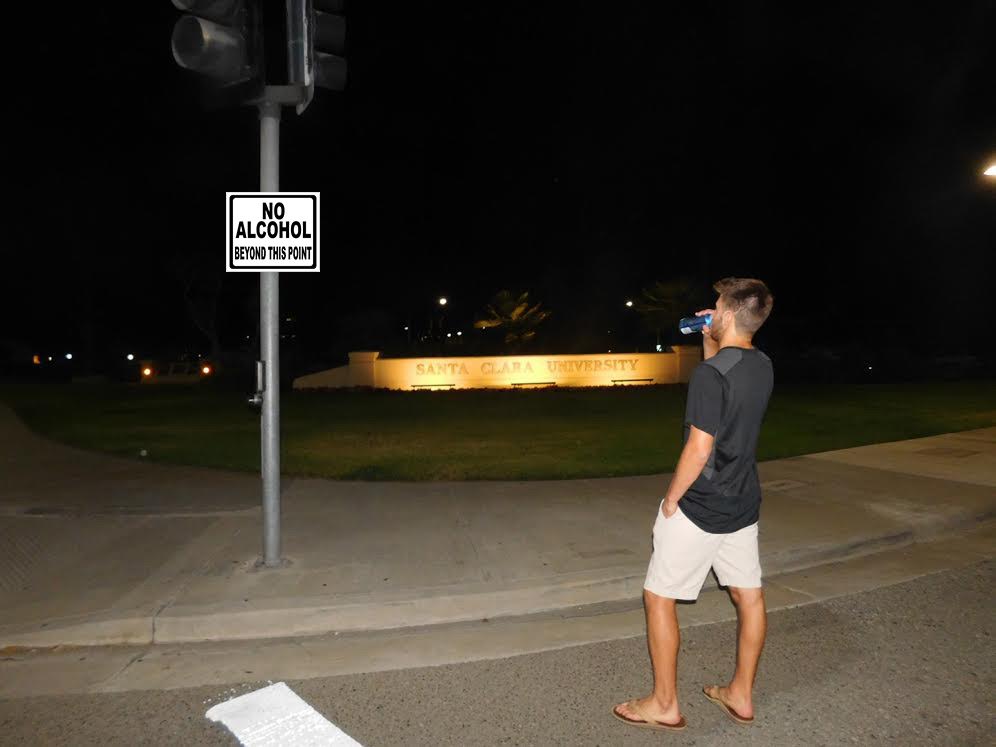
On the last day of class, my classmates presented their multimodal projects and I saw a variety of different mediums of expression. Graham Honig, although he was not present in class on Friday, shared with me his multimodal project privately and that is what I would like to discuss. Me and Graham peer edited each others multimodal compositions before the day they were due. Graham’s research paper was about alcohol policies on college campuses, and their inability to limit irresponsible drinking among students. His claim was that they could not limit the drinking problems because most of the drinking occurred off school grounds which means the school had no ability to enforce the rules they have for the school campus.

Graham’s picture was that of him standing outside Santa Clara’s main entrance. On one of the lamp posts was a sign reading, “No Alcohol Beyond This Point.” Graham appeared to be looking at this sign while drinking a beer. The idea Graham wanted to communicate to his audience was that students were just drinking outside of the school’s jurisdictional abilities. He used this over exaggeration as an example to communicate these thoughts. His multimodal project is:
Displaying final ctw alcohol pic.jpgDisplaying final ctw alcohol pic.jpgfc628042-c39e-4f8b-8000-61c264a44cd3

His image is effective because the way he positioned himself to be looking at the “No Alcohol” sign really draws attention to the sign itself. The juxtaposition of the sign and himself really highlights the dilemma college campuses are facing. Overall, his message was clearly communicated to his audience through the image.


Multimodal Composition’s Role in the Writing Classroom

In the writing classroom, there is often a level of redundancy with the assignments assigned. Many English class are all about taking in information, and regurgitating it out in an essay format. What I have enjoyed about CTW at Santa Clara University is that we write a wide variety of pieces about varying topics, acquiring the information for each essay in a different fashion. For example, we wrote an essay about artifacts we gathered from the archives and we wrote an essay about information we gathered through surveying other students. What I enjoyed the most about writing varying pieces was how at the end of the quarter we synthesized and  combined all the information we gathered in to one culminating and concluding paper of our beliefs and what we have learned throughout the CTW process.

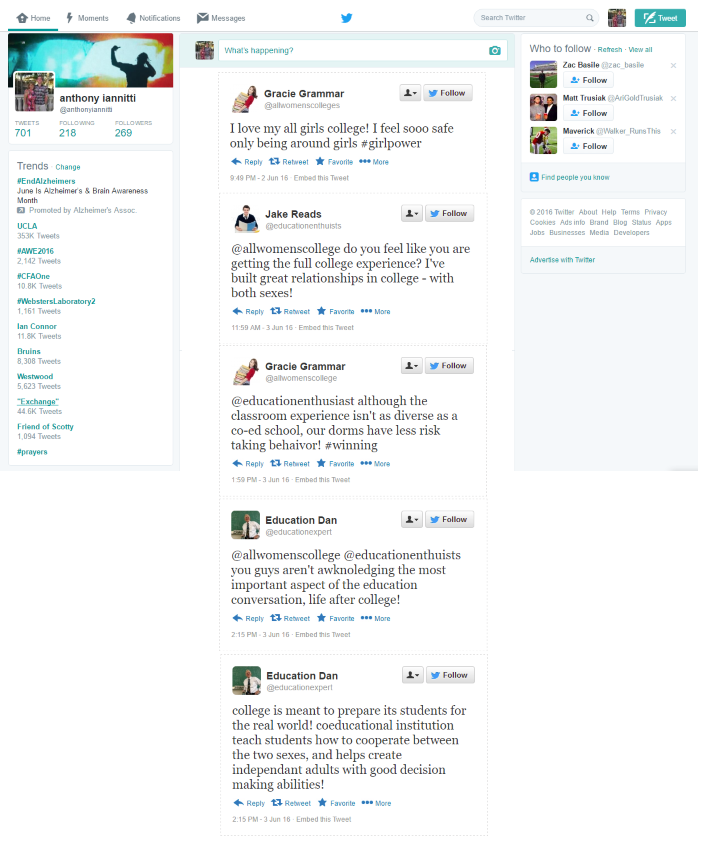
After creating a final paper, we then translated our final essay into a multimodal composition. A multimodal composition is using words, images, audio, and video to further an idea through a visual creation of the ideas communicated through a more serious piece of writing, such as an essay. For my multimodal composition, I created a fake twitter feed in which various twitter users were having a conversation about coeducation and its benefits. My multimodal composition is linked here. I enjoyed creating a multimodal composition of the beliefs I formulated in my final paper. I believe multimodal compositions are a strong way to depict ideas and arguments in a creative and easily relatable way. Multimodal compositions resonate with the viewer of the piece and help express the ideology of the composition in terms the viewer clearly understands. Multimodal compositions serve a useful and engaging purpose in the writing classroom. They serve a strong purpose in helping display content and ideas that would normally just be put in a standard, mundane essay. Multimodal compositions are beneficial and informative in the writing classroom and help to add variety to the types of ways writing is done and ideas are argued.

Reflecting on My Final Essay

While preparing to write my final essay, I worked through multiple ideas and eventually formulated what I wanted to argue in my essay and how I would prove my ideas. At first, I thought I would argue in favor of same-sex education. Eventually I realized I did not believe the arguments my sources were portraying and realized I sided more with coeducation. In addition, my conference with Professor Lueck helped me recognize what I wanted to talk about in my essay. Professor Lueck helped me realize that there was a huge gap in the conversation of coeducation verse same-sex education. I realized that those arguing in favor of same-sex education were ignoring talking about life after college.

graduation2

Coeducation is much more beneficial because it prepares students for life after college. In a coeducational learning environment, students of both sexes must learn to cooperate together in order to achieve their goals. While researching education, most of my sources did not comment on life after college. That is the research gap I planned to comment on and explore. Locating a research gap was beneficial in formulating my thesis and understanding fully what I wanted to write about in my essay. In addition, my survey results corresponded with the research gap I located which I used as real world evidence to back the conclusion I was arguing in my final essay. Overall, I believe I created a successful thesis and built an essay around a strong idea that I formulated based on research done over the quarter.

Response to Matt Haworth’s Blog – Why Santa Clara University?

In CTW class, we have been doing a large amount of our writing and researching about Santa Clara University so when I read Matt Haworth’s blog entry “Why Santa Clara University?” I thought it would be an interesting blog to respond to. While reading Matt’s blog entry, it made me reflect on my own college decision process, and why I ultimately decided to come to Santa Clara University.

broncos

Just like Matt, I got into my two dream schools: Santa Clara University and University of California Santa Barbara. This made my decision extremely difficult. I loved both the schools, but for different reasons. UCSB’s campus is right on the beach and is extremely beautiful, not to mention their lacrosse team is outstanding as well. SCU’s campus is in the middle of the epicenter of the hi-tech industry and is extremely beautiful, and has one of the best business schools in the country. My decision seemed impossible to make, until I started researching what I would study in school.

question

As it turned out, UCSB does not have a business school. It offered marketing and economics majors, but through the college of arts and sciences. I knew I wanted to study business and valued this highly when considering what school I would attend. In addition, I loved the fact that Santa Clara University was a Jesuit institution. I went to a Jesuit high school and absolutely loved the Jesuit programs and environment my high school provided. While choosing what university I would attend, I ended up choosing Santa Clara University and could not be any happier with my decision. Many factors went into me choosing SCU, such as its beautiful campus, its awesome extracurricular clubs and activities, and Jesuit campus life, but what ultimately made me chose Santa Clara University was its academics. Santa Clara University’s academics were unparalleled by any of the other universities I was accepted by. The Leavey School of Business is top tier and was the best option for me since I want to enter the business field after college. I am glad I chose Santa Clara University and am excited to spend the next four years learning and growing at this amazing university.

Week 3: Artifacts from the Archives

As I walked up the stairs to the third floor of the library, I had no idea what I was I getting myself into. I knew our CTW class was meeting in the back corner of the library, in some room called  “the archives”.  An archive is a “a collection of historical documents or records providing information about a place, institution, or group of people”. We had learned about archival research and all the amazing artifacts we might be able to find in the archives in the weeks leading up to our journey into the unknown . As I rounded the last flight of stairs to the third floor, I was full of anticipation. I could not wait to see what an actual archive was like.

As I entered the archive, I instantly noticed the large amount of books and magazines and objects scattered about the room. There seemed to be an abundance of resources filling the entire room. There were books shelves covering every wall filled with books of all ages.  The archive was truly unlike anywhere else I had ever been.

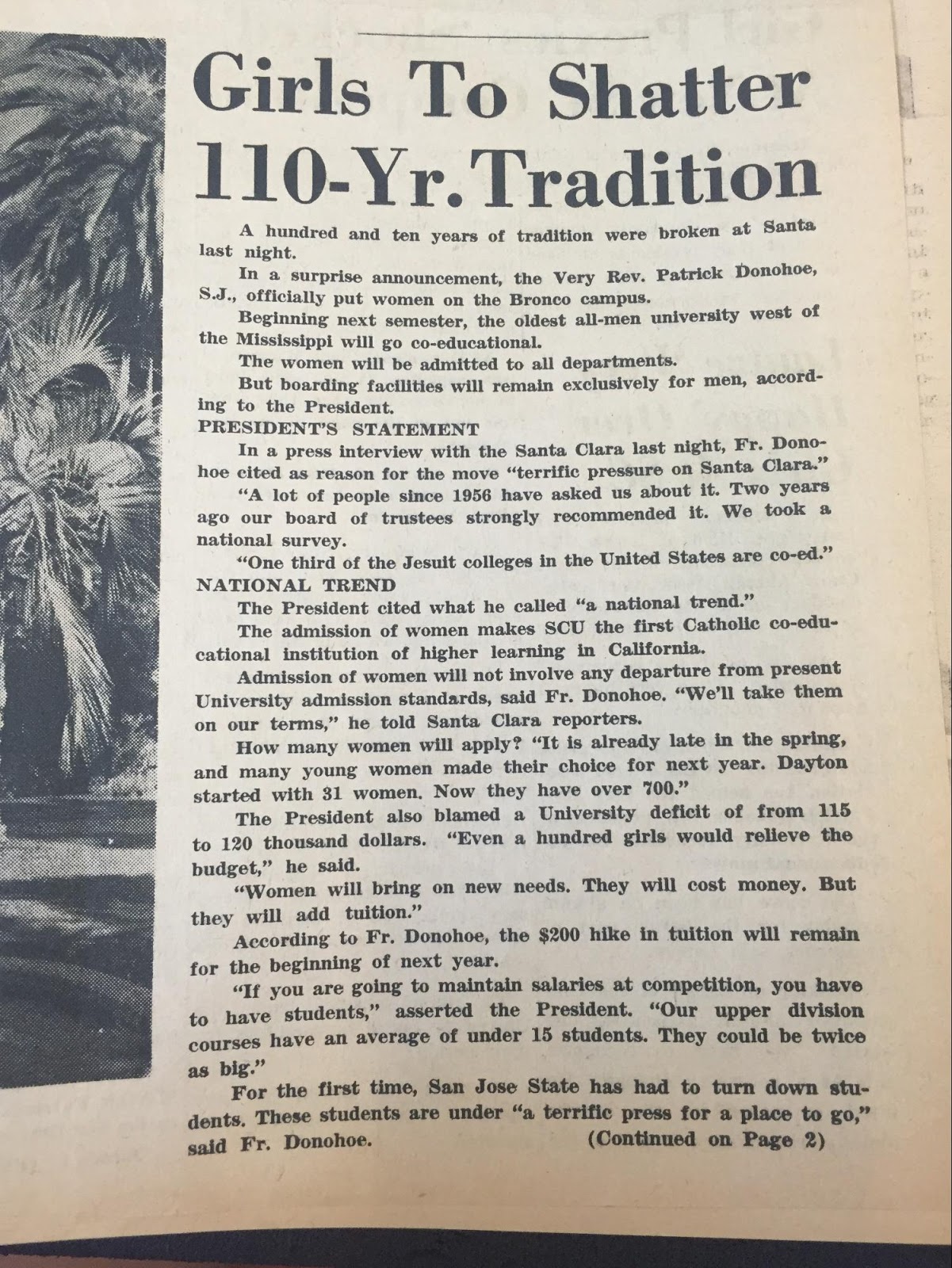
Not only was the archive filled with artifacts, but the artifacts it contained were extremely interesting. The archive curator laid out all sorts of artifacts pertaining to Santa Clara University and its interesting history. For example, I found this great article about the addition of female students to the university:

nice

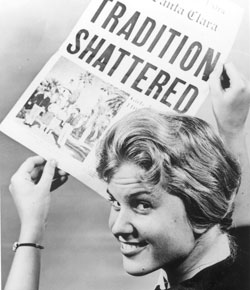
This artifact, an article from The Santa Clara dating back to the 1960’s, was extremely interesting to me and became the main focus of my archival research paper. I found the old student newspaper articles to be fascinating because they were first hand accounts of campus life from this time period. No other source could truly captivate the feeling and atmosphere of the campus the same way a student written piece from the time period could. The archive was an interesting and engaging way to do research that ended up yielding some intriguing and significant sources.

Week 2: Research Question

As CTW class has gone on this quarter, I have been immersing myself in the research process. I have spent the past two class periods in the archives doing actual archival research. After examining many sources and finding some solid evidence, I have finally figured out what I want my research question to be.

How did the addition of females change the culture at Santa Clara University?

When our class first went to the archives on the third floor of the library, I had no idea what to expect. I did not really know what topic I wanted to write about, I did not know what type of materials we would be looking at, and I had no clue what an archive was going to be like. The first day of class in the archives was interesting. The professor who looked over the research explained in detail what the materials were that were sprawled all over the desks in this library room. The bookcases lining the walls were stuffed with books and there seemed to be an overwhelming amount of research in just one place. Apparently, that is only part of the research the archive has collected. I did in-depth examination of each tables’ materials. The materials I found most interesting were the older articles, in particular the ones pertaining to the culture of Santa Clara University. One of the tables had multiple books all flipped to articles and documents about the addition of women into Santa Clara University and how that affected the University. These resources caught my attention. I was interested to see how changing from an all male school to a coed institution affect the students, teachers, and the school itself. For example, the Graham dormitory was at one time a residence hall for only girls. This topic interests me because I have a personal connection to this topic. I went to an all guys high school. In my mind, it would be crazy to imagine girls being added to my old high school. The changes my high school would undergo would be immense. It is interesting for me to see the changes Santa Clara underwent after the addition of females to the University.

The research I found pertaining to Santa Clara University and its addition of female students was varied in opinion. On one hand, many articles wrote about the joy and excitement there was over the addition of girls to the university. On the other hand, some articles argued adding females was breaking tradition and changing the true meaning of Santa Clara. Through my researching I hope to gain a better insight on the general opinion of students about the transition to a coed university. I am excited about the research I gathered from the archives. I have a different variation of types of sources and I have sources from different arguments of the topic. My research is all relative to my topic and highlights insightful points about the time period, the culture, and the changes that were all happening at Santa Clara University.


Week 1: The Research Process

This week we have begun to dive into the topic of the research process. Thinking of the research process brings back memories of reading through books for quotes and staring at my computer screen for hours reading online sources. The research process, one of the most crucial aspects of writing an intellectual piece of writing, is also one of the most tedious. This is where an author chooses what they are going to base their arguments off of. The research process determines how strong of an argument one can build because it is the proof behind what the author is saying. If a piece of writing is published making a claim with nothing backing up the argument, than no one will believe that claim because the writing has no credibility behind it. In my experiences with researching, I have found that there it is extremely important to use research in my writing only if the quality of the source is high. The quality of one’s source is important because having a high quality source can build up the credibility of the author.

When I am researching I often follow a few strategies. I look for information that is focused and descriptive. There is no reason to quote something if it is a summary of a bunch of different information. I could easily look up facts and synthesize them into a large paragraph. It is important to use quotes to better your writing, by adding detail or description that is better provided by someone else’s words. Adding quotes just to add bulk to an essay often distracts the reader from the point the author is trying to argue. While researching, I often use the internet to find sources. Although this is often looked down upon as not “traditional” researching, I find the internet to be extremely helpful. There is an extremely immense amount of content on the internet. No matter what topic you have to research, there is something on the internet about it. And in addition, the internet makes it super easy to verify and check sources. If an article sources something online, you can look up that source as well and verify the information. The internet, if used right, is an extremely useful tool for conducting research. For example, Google Scholar is a extremely efficient way to conduct online research. It searches online for only scholarly articles on whatever topic you search. It is a great way to make sure you are using research that is from a verified source but is also about your topic.