Author Archives: miannitti

Classmate’s Multimodal Composition

On the last day of class, my classmates presented their multimodal projects and I saw a variety of different mediums of expression. Graham Honig, although he was not present in class on Friday, shared with me his multimodal project privately and that is what I would like to discuss. Me and Graham peer edited each others multimodal compositions before the day they were due. Graham’s research paper was about alcohol policies on college campuses, and their inability to limit irresponsible drinking among students. His claim was that they could not limit the drinking problems because most of the drinking occurred off school grounds which means the school had no ability to enforce the rules they have for the school campus.

Graham’s picture was that of him standing outside Santa Clara’s main entrance. On one of the lamp posts was a sign reading, “No Alcohol Beyond This Point.” Graham appeared to be looking at this sign while drinking a beer. The idea Graham wanted to communicate to his audience was that students were just drinking outside of the school’s jurisdictional abilities. He used this over exaggeration as an example to communicate these thoughts. His multimodal project is:

Displaying final ctw alcohol pic.jpgDisplaying final ctw alcohol pic.jpgfc628042-c39e-4f8b-8000-61c264a44cd3

His image is effective because the way he positioned himself to be looking at the “No Alcohol” sign really draws attention to the sign itself. The juxtaposition of the sign and himself really highlights the dilemma college campuses are facing. Overall, his message was clearly communicated to his audience through the image.

Multimodal Composition’s Role in the Writing Classroom

In the writing classroom, there is often a level of redundancy with the assignments assigned. Many English class are all about taking in information, and regurgitating it out in an essay format. What I have enjoyed about CTW at Santa Clara University is that we write a wide variety of pieces about varying topics, acquiring the information for each essay in a different fashion. For example, we wrote an essay about artifacts we gathered from the archives and we wrote an essay about information we gathered through surveying other students. What I enjoyed the most about writing varying pieces was how at the end of the quarter we synthesized and  combined all the information we gathered in to one culminating and concluding paper of our beliefs and what we have learned throughout the CTW process.

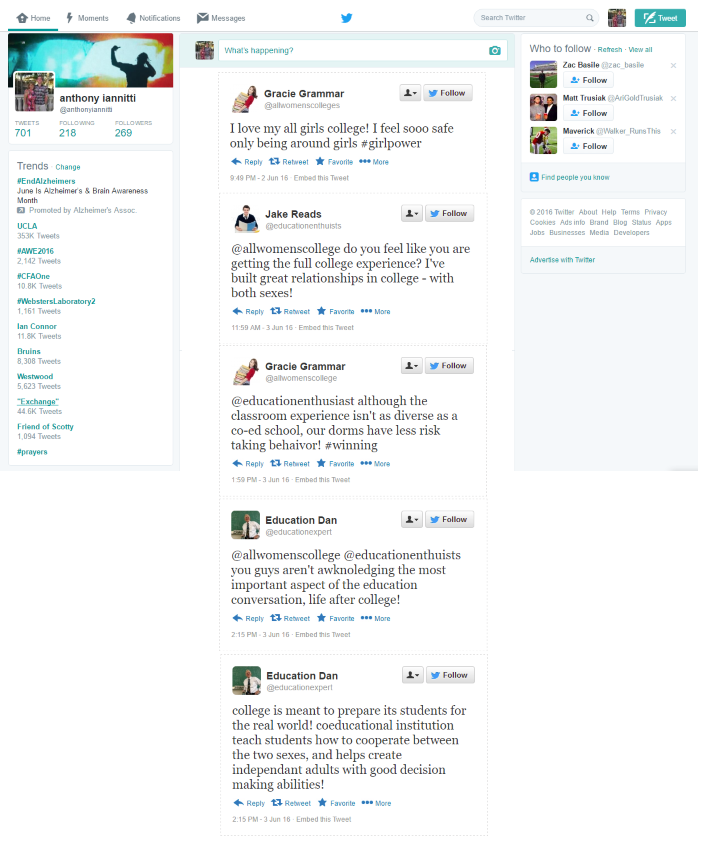
After creating a final paper, we then translated our final essay into a multimodal composition. A multimodal composition is using words, images, audio, and video to further an idea through a visual creation of the ideas communicated through a more serious piece of writing, such as an essay. For my multimodal composition, I created a fake twitter feed in which various twitter users were having a conversation about coeducation and its benefits. My multimodal composition is linked here. I enjoyed creating a multimodal composition of the beliefs I formulated in my final paper. I believe multimodal compositions are a strong way to depict ideas and arguments in a creative and easily relatable way. Multimodal compositions resonate with the viewer of the piece and help express the ideology of the composition in terms the viewer clearly understands. Multimodal compositions serve a useful and engaging purpose in the writing classroom. They serve a strong purpose in helping display content and ideas that would normally just be put in a standard, mundane essay. Multimodal compositions are beneficial and informative in the writing classroom and help to add variety to the types of ways writing is done and ideas are argued.

Reflecting on My Final Essay

While preparing to write my final essay, I worked through multiple ideas and eventually formulated what I wanted to argue in my essay and how I would prove my ideas. At first, I thought I would argue in favor of same-sex education. Eventually I realized I did not believe the arguments my sources were portraying and realized I sided more with coeducation. In addition, my conference with Professor Lueck helped me recognize what I wanted to talk about in my essay. Professor Lueck helped me realize that there was a huge gap in the conversation of coeducation verse same-sex education. I realized that those arguing in favor of same-sex education were ignoring talking about life after college.

graduation2

Coeducation is much more beneficial because it prepares students for life after college. In a coeducational learning environment, students of both sexes must learn to cooperate together in order to achieve their goals. While researching education, most of my sources did not comment on life after college. That is the research gap I planned to comment on and explore. Locating a research gap was beneficial in formulating my thesis and understanding fully what I wanted to write about in my essay. In addition, my survey results corresponded with the research gap I located which I used as real world evidence to back the conclusion I was arguing in my final essay. Overall, I believe I created a successful thesis and built an essay around a strong idea that I formulated based on research done over the quarter.

Response to Matt Haworth’s Blog – Why Santa Clara University?

In CTW class, we have been doing a large amount of our writing and researching about Santa Clara University so when I read Matt Haworth’s blog entry “Why Santa Clara University?” I thought it would be an interesting blog to respond to. While reading Matt’s blog entry, it made me reflect on my own college decision process, and why I ultimately decided to come to Santa Clara University.

broncos

Just like Matt, I got into my two dream schools: Santa Clara University and University of California Santa Barbara. This made my decision extremely difficult. I loved both the schools, but for different reasons. UCSB’s campus is right on the beach and is extremely beautiful, not to mention their lacrosse team is outstanding as well. SCU’s campus is in the middle of the epicenter of the hi-tech industry and is extremely beautiful, and has one of the best business schools in the country. My decision seemed impossible to make, until I started researching what I would study in school.

question

As it turned out, UCSB does not have a business school. It offered marketing and economics majors, but through the college of arts and sciences. I knew I wanted to study business and valued this highly when considering what school I would attend. In addition, I loved the fact that Santa Clara University was a Jesuit institution. I went to a Jesuit high school and absolutely loved the Jesuit programs and environment my high school provided. While choosing what university I would attend, I ended up choosing Santa Clara University and could not be any happier with my decision. Many factors went into me choosing SCU, such as its beautiful campus, its awesome extracurricular clubs and activities, and Jesuit campus life, but what ultimately made me chose Santa Clara University was its academics. Santa Clara University’s academics were unparalleled by any of the other universities I was accepted by. The Leavey School of Business is top tier and was the best option for me since I want to enter the business field after college. I am glad I chose Santa Clara University and am excited to spend the next four years learning and growing at this amazing university.

Week 3: Artifacts from the Archives

As I walked up the stairs to the third floor of the library, I had no idea what I was I getting myself into. I knew our CTW class was meeting in the back corner of the library, in some room called  “the archives”.  An archive is a “a collection of historical documents or records providing information about a place, institution, or group of people”. We had learned about archival research and all the amazing artifacts we might be able to find in the archives in the weeks leading up to our journey into the unknown . As I rounded the last flight of stairs to the third floor, I was full of anticipation. I could not wait to see what an actual archive was like.

As I entered the archive, I instantly noticed the large amount of books and magazines and objects scattered about the room. There seemed to be an abundance of resources filling the entire room. There were books shelves covering every wall filled with books of all ages.  The archive was truly unlike anywhere else I had ever been.

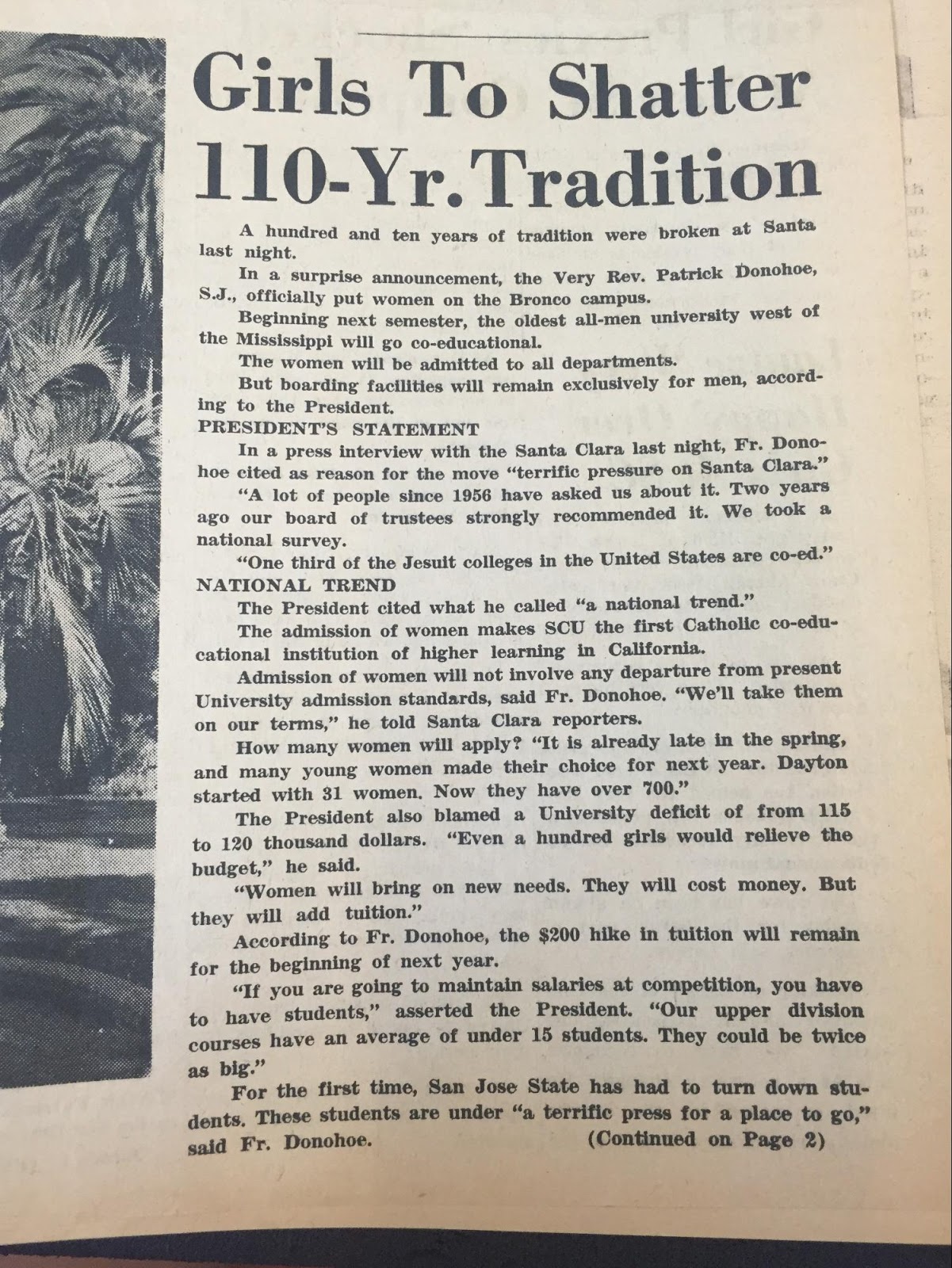
Not only was the archive filled with artifacts, but the artifacts it contained were extremely interesting. The archive curator laid out all sorts of artifacts pertaining to Santa Clara University and its interesting history. For example, I found this great article about the addition of female students to the university:

nice

This artifact, an article from The Santa Clara dating back to the 1960’s, was extremely interesting to me and became the main focus of my archival research paper. I found the old student newspaper articles to be fascinating because they were first hand accounts of campus life from this time period. No other source could truly captivate the feeling and atmosphere of the campus the same way a student written piece from the time period could. The archive was an interesting and engaging way to do research that ended up yielding some intriguing and significant sources.

Week 2: Research Question

As CTW class has gone on this quarter, I have been immersing myself in the research process. I have spent the past two class periods in the archives doing actual archival research. After examining many sources and finding some solid evidence, I have finally figured out what I want my research question to be.

How did the addition of females change the culture at Santa Clara University?

When our class first went to the archives on the third floor of the library, I had no idea what to expect. I did not really know what topic I wanted to write about, I did not know what type of materials we would be looking at, and I had no clue what an archive was going to be like. The first day of class in the archives was interesting. The professor who looked over the research explained in detail what the materials were that were sprawled all over the desks in this library room. The bookcases lining the walls were stuffed with books and there seemed to be an overwhelming amount of research in just one place. Apparently, that is only part of the research the archive has collected. I did in-depth examination of each tables’ materials. The materials I found most interesting were the older articles, in particular the ones pertaining to the culture of Santa Clara University. One of the tables had multiple books all flipped to articles and documents about the addition of women into Santa Clara University and how that affected the University. These resources caught my attention. I was interested to see how changing from an all male school to a coed institution affect the students, teachers, and the school itself. For example, the Graham dormitory was at one time a residence hall for only girls. This topic interests me because I have a personal connection to this topic. I went to an all guys high school. In my mind, it would be crazy to imagine girls being added to my old high school. The changes my high school would undergo would be immense. It is interesting for me to see the changes Santa Clara underwent after the addition of females to the University.

The research I found pertaining to Santa Clara University and its addition of female students was varied in opinion. On one hand, many articles wrote about the joy and excitement there was over the addition of girls to the university. On the other hand, some articles argued adding females was breaking tradition and changing the true meaning of Santa Clara. Through my researching I hope to gain a better insight on the general opinion of students about the transition to a coed university. I am excited about the research I gathered from the archives. I have a different variation of types of sources and I have sources from different arguments of the topic. My research is all relative to my topic and highlights insightful points about the time period, the culture, and the changes that were all happening at Santa Clara University.


Week 1: The Research Process

This week we have begun to dive into the topic of the research process. Thinking of the research process brings back memories of reading through books for quotes and staring at my computer screen for hours reading online sources. The research process, one of the most crucial aspects of writing an intellectual piece of writing, is also one of the most tedious. This is where an author chooses what they are going to base their arguments off of. The research process determines how strong of an argument one can build because it is the proof behind what the author is saying. If a piece of writing is published making a claim with nothing backing up the argument, than no one will believe that claim because the writing has no credibility behind it. In my experiences with researching, I have found that there it is extremely important to use research in my writing only if the quality of the source is high. The quality of one’s source is important because having a high quality source can build up the credibility of the author.

When I am researching I often follow a few strategies. I look for information that is focused and descriptive. There is no reason to quote something if it is a summary of a bunch of different information. I could easily look up facts and synthesize them into a large paragraph. It is important to use quotes to better your writing, by adding detail or description that is better provided by someone else’s words. Adding quotes just to add bulk to an essay often distracts the reader from the point the author is trying to argue. While researching, I often use the internet to find sources. Although this is often looked down upon as not “traditional” researching, I find the internet to be extremely helpful. There is an extremely immense amount of content on the internet. No matter what topic you have to research, there is something on the internet about it. And in addition, the internet makes it super easy to verify and check sources. If an article sources something online, you can look up that source as well and verify the information. The internet, if used right, is an extremely useful tool for conducting research. For example, Google Scholar is a extremely efficient way to conduct online research. It searches online for only scholarly articles on whatever topic you search. It is a great way to make sure you are using research that is from a verified source but is also about your topic.

Third Post: Looking Back on the Blogging Process

Reflecting on the Blogging Process 

When assigned our final writing project, which was to post online blogs, I found the assignment to be extremely relevant to the topic in which I had been writing on all quarter. This quarter in CTW class I have been writing and focusing on the topic of technology in education. The assignment almost became proof for what I had been writing about. Our class has been using blogs, a fairly new way to write and publish content using the internet, to publish academic writing. This assignment, in a way, is an example of technology being used to advance the spread of academia. In my last post, I turned an essay I wrote into a blog entry. As I turned my essay into a blog post, I encountered challenges I did not think I would have and I learned the actual influence technology has on education through using technology to post an academic blog entry.

Challenges 

As I transformed my formal educational essay into a blog post, which has to not only inform the reader, but capture their attention and care while they read, I ran into unforeseen challenges. One challenge I faced was being able to pick and chose which ideas would make it from my essay into my blog post. I had such a long and intricate synthesis essay it was difficult for me to chose which facts and arguments I wanted to present in my blog post. In addition, I struggled to portray my own voice in my writing while still maintaining enough formality in my tone so the reader takes my academic arguments seriously.  I would write one version of a paragraph and it would sound like a robot; the writing would be static and monotone, droning on in a way that no one would want to read. Then my next draft of the same paragraph would sound totally insincere. My writing would become clouded with colloquial terms and I would push the limits of slang and voice, ultimately leading to my writing being extremely unsuccessful. I had to draft multiple versions of all of my paragraphs and each attempt taught me something knew about combining voice and character, with seriousness and academia.

Before attempting to write my blog post, I had no idea how difficult it would to combine my voice with my arguments in a way that would captivate the reader but also allow me to prove my points. I now have a new found appreciation and respect for the ability to be able to argue ones ideas but also relate to the reader of the writing piece. I now understand the importance of being able to write in different categories of voice. There is importance in both being able to write scholarly essays and be able to write relatable blog posts.  I used to be of the mindset that an author’s skill came from how well they could write a formal essay and get a good grade on it, but now I understand it is much more about what the author says and not only the arguments they present, but how they present them.

Technology Improving the Quality of MY Blog

While writing about technology improving education, technology was also improving the quality of my blog. I used hyperlinks, embedded images, and real world examples. A “blog”, which is how I posted my writing, is a technological advancement. Without technology and the internet, I would not be able to even post a blog. It is interesting to think about the way I posted my writing influence the argument I wrote about. As the reader perused my blog post, the technological examples I used to make my writing better also added to the credibility of my arguments. If technology is able to make my educational blog post better, than technology can also make other educational facets better as well.

Another extremely important facet of my blog is that because of technology my blog is linked online with thousands of other people having the same conversation. Through hyperlinks, related articles, and even my blog url, my blog is accessible to anyone online. Articles and blogs on the internet are extremely easy to find and they are all linked to each other only because they are all posted online. This opens so many threads of conversation which then expands the current conversation on the topic. Education and technology are both paramount in our current society which means they must be talked about widely online. This sort of open conversation linking thousands of ideas and view points could be beneficial in education. If educators can share their techniques and best practices online, than the exchange of better ideas and techniques will spread like wildfire.

Concluding Thoughts 

To conclude this post I would like to state that blogging has taught me important skills and the rewriting of my own essay was a beneficial learning experience. Being able to reconstruct and re-stylize ones own writing is important to being an successful author. The point of publishing a piece of writing is to add to an ongoing conversation and to put your arguments about the conversation out there. As an author, communicating your arguments successfully is a key to having your audience believe the points you present as an author.

While writing my blog posts, I learned the importance of being able to write to your audience and changing your writing so the reader finds it interesting. In conclusion, I want to state that the exercise of blogging has taught me a lot about writing and how to write in a new way. Before this assignment, I had never written a blog before. This was a new experience which taught me writing techniques of how to persuade an audience through a specific writing medium. Overall, I enjoyed the process of blogging and learning how to use a (relatively) new technology to publish academic writing.

Second Post: Technology Increasing Educational Efficiency

Technology Revolutionizing Education

In recent discussions of the way technology affects education and its efficacy and efficiency, a controversial issue has been whether technology helps us educate more efficiently and increases the power we have to educate, or if technology is a hindrance and distraction when it comes to education. Some argue that technology is a powerful tool that could be used to revolutionize the way we educate and change the norms of educational practices.

One example of technology protecting the individual and their academic integrity is “digital tools” like Turn It In. Turn It In is an online software used to check for plagiarism in student essays or homework. This software uses technology to cross reference the paper to not only the internet, but also across all other essays submitted into Turn It In. This is a strong example of how technology can be used in education to benefit students and improve the quality of their education. In addition, technology can help to educate in alternative ways than traditional schooling.

https://blogs.scu.edu/anthonyiannitti/files/2016/03/turnitin-logo-2x.png

http://turnitin.com/

Another example of how technology is improving education is online education. If there is someone that cannot physically attend a university or have issues that prohibit them from receiving a traditional education they can still enroll in an online college. Someone who would not be able to receive an education can now get a full education because of technology. In addition, they can get any type of education they want. For example, University of Phoenix  has a program that is a popular way to earn a degree online. University of Phoenix’s Online College is known for its low cost and its high quality of education.

http://www.onlinedegreepost.com/images/phoenix.gif

http://www.onlinedegreepost.com/images/phoenix.gif

In addition to education being online now, books and magazines are widely published online too. There are such things as “e-books” and “online magazines”. For example, Amazon has a whole entire online store for their e-books that they sell for customers to read on their Kindle (Amazon’s popular e-reader).  Authors adapted to the changes and technology helped them to become more successful. They could now publish books in print and online, reaching a higher number of people and hopefully generating more sales. Also, technology helped them streamline the writing process. “Digital tools” like spell check and Microsoft Word helped to bring about ease while writing. Being able to save multiple drafts and quickly edit papers changed the way people wrote and ultimately changed how we go about creating literature. Technological advances such as this then carried over to education by the creation of online text books and web-accessible programs that give students homework problems. Teachers have even begun to video tape lectures and make students watch lectures online. The influence of technology in education has made classroom materials easier accessible and the quality of these resources better.

Last quarter, in my Business 70 class we used an online textbook and online homework tool. It was published by the company McGraw-Hill, a reputable textbook publishing company. We had to purchase a book, and then use the code inside the book to register online. At that point you could pretty much throw away the book. The only useful thing was the code. That code lets the textbook company know you purchased their book and that allows you to use their online tool.
https://www.g2crowd.com/products/mcgraw-hill-connect/reviews

https://www.g2crowd.com/products/mcgraw-hill-connect/reviews

The online tool was called McGraw-Hill Connect. McGraw-Hill Connect contained our textbook and all the worksheets and exercises we had to complete for the class. Over the course of the quarter we had mastered the online textbook and worksheet tool. It became a breeze to access our readings and do our practice problems. I would say that technology helped make the access of my educational tools more efficient and effective. This ease of access then led to me being able to access my education swiftly and easily, then leading me to more proficient studying of this subject.


Acknowledging the Naysayers:

While the examples I presented above seem to be flawless (hold the applause), there are plenty of counter arguments that are used against having an increasing presence of technology in education. Some people share the belief that an increasing presence of technology in education will make us less intelligent and extremely reliant on technology. While researching technology and education, I came across many varying viewpoints. I came across an article in our textbook, They Say / I Say, that was written by Nicholas Carr, an author and researcher. In an article he published, Is Google Making Us Stupid?, he argues that an increasing presence in technology will put us at a disadvantage. Carr states in his article that “as we come to rely on [technology] to mediate our understanding of the world, it is our own intelligence that flattens into artificial intelligence” (328). What Carr is saying here is that technology is becoming a crutch for his intellectual abilities and he is losing the need to educate himself because technology is becoming a source he can look to instead of having to seek knowledge in an educational fashion. In sum, then, the issue is whether technology can be used to help educate people in a powerful and more efficient way or whether technology is a distraction and crutch that becomes a hindrance to the educational process.

According to this view, the usage of technology will make our brains rely on technology so much it decreases our own critical thinking skills and decreases our intellectual abilities. In response to this viewpoint I would state that technology is not becoming a crutch, it is becoming a tool. Technology is always advancing and growing at exponential rates. If we have such a powerful tool in our arsenal why not use it to its full potential. What I am saying is that if we are willing to let technology influence every aspect of our life, than we should not shy away from having it in our education. If we can become more open minded towards technology being integrated into education, we will see that it will make a great change in the quality of our education. I believe that most people would agree with me that technology has greatly improved their life. Technology has made significant improvements in many facets of human life. Since this is the case, we should allow technology to greatly improve our education as well.

In closing: 

I would like to state that, I believe an increase in the amount of technology used in education could increase the quality, condition, and power of education. As the fields of technology and education become more intertwined, I believe we will see an increase in the amount of our society that is educated. In addition, I believe those who have been educated have been through quality programs backed by a combination of technology and education leading to the most efficient and effective way to educate. Those who spend the time and money to get an education will be more satisfied with their education. With more technological presence in education, the education students receive will be more relevant to the real world they are entering soon after getting their education.

To conclude my blog post, I want to point out that there is no debate that our society is becoming filled with technology and that it is becoming an integral part of everyone’s life. Education must not only educate students, but it also must prepare them for the world they are about to enter. If our society is reliant and filled with technology why should our education be any different? I believe it should not be any different. Technology can be used in education to protect students, make their education more valuable and involving, and also increase the interest of students because their education will be relevant to the world they see around themselves. I believe technology should be an integral part of education and that the improvements that come with the transition of more technology in education will lead to educational quality and effectiveness that far surpass an education void of technology.


Works Cited

Carr, Nicholas. “Is Google Making Us Stupid?” They Say / I Say: The Moves That Matter in Academic Writing. By Gerald Graff. Ed. Cathy Birkenstein and Russel Durst. New York: W.W. Norton, 2006. 313-328. Print.

Image Sources:

http://turnitin.com/

http://www.onlinedegreepost.com/images/phoenix.gif

https://www.g2crowd.com/products/mcgraw-hill-connect/reviews