Monthly Archives: June 2016

Classmate’s Multimodal Composition

On the last day of class, my classmates presented their multimodal projects and I saw a variety of different mediums of expression. Graham Honig, although he was not present in class on Friday, shared with me his multimodal project privately and that is what I would like to discuss. Me and Graham peer edited each others multimodal compositions before the day they were due. Graham’s research paper was about alcohol policies on college campuses, and their inability to limit irresponsible drinking among students. His claim was that they could not limit the drinking problems because most of the drinking occurred off school grounds which means the school had no ability to enforce the rules they have for the school campus.

Graham’s picture was that of him standing outside Santa Clara’s main entrance. On one of the lamp posts was a sign reading, “No Alcohol Beyond This Point.” Graham appeared to be looking at this sign while drinking a beer. The idea Graham wanted to communicate to his audience was that students were just drinking outside of the school’s jurisdictional abilities. He used this over exaggeration as an example to communicate these thoughts. His multimodal project is:
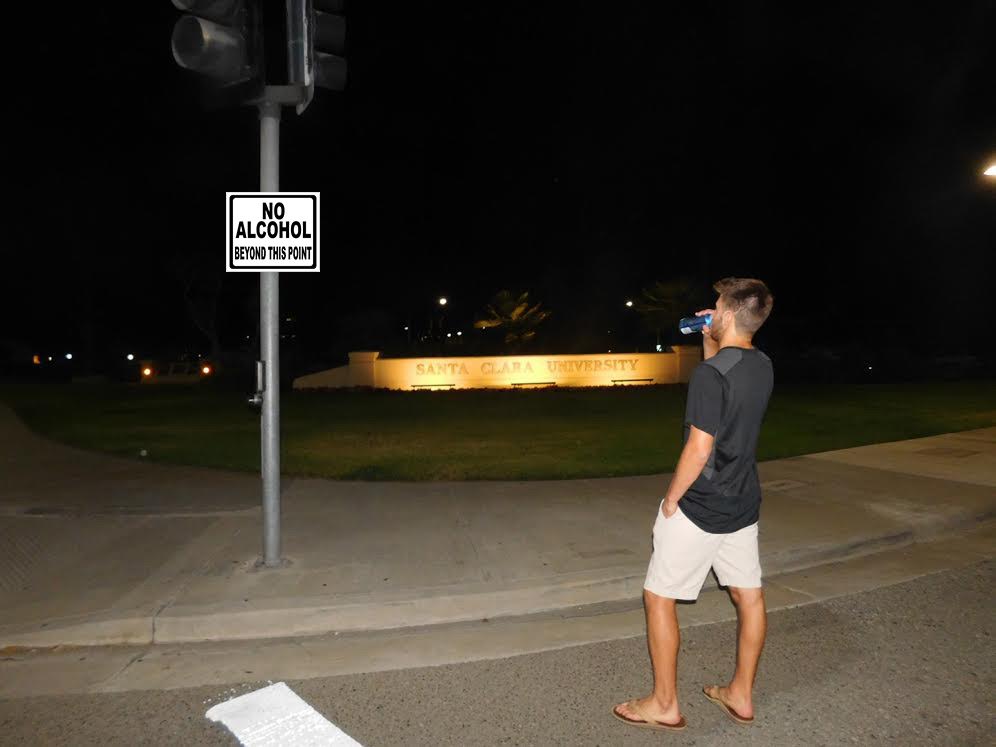
Displaying final ctw alcohol pic.jpgDisplaying final ctw alcohol pic.jpgfc628042-c39e-4f8b-8000-61c264a44cd3

His image is effective because the way he positioned himself to be looking at the “No Alcohol” sign really draws attention to the sign itself. The juxtaposition of the sign and himself really highlights the dilemma college campuses are facing. Overall, his message was clearly communicated to his audience through the image.


Multimodal Composition’s Role in the Writing Classroom

In the writing classroom, there is often a level of redundancy with the assignments assigned. Many English class are all about taking in information, and regurgitating it out in an essay format. What I have enjoyed about CTW at Santa Clara University is that we write a wide variety of pieces about varying topics, acquiring the information for each essay in a different fashion. For example, we wrote an essay about artifacts we gathered from the archives and we wrote an essay about information we gathered through surveying other students. What I enjoyed the most about writing varying pieces was how at the end of the quarter we synthesized and  combined all the information we gathered in to one culminating and concluding paper of our beliefs and what we have learned throughout the CTW process.

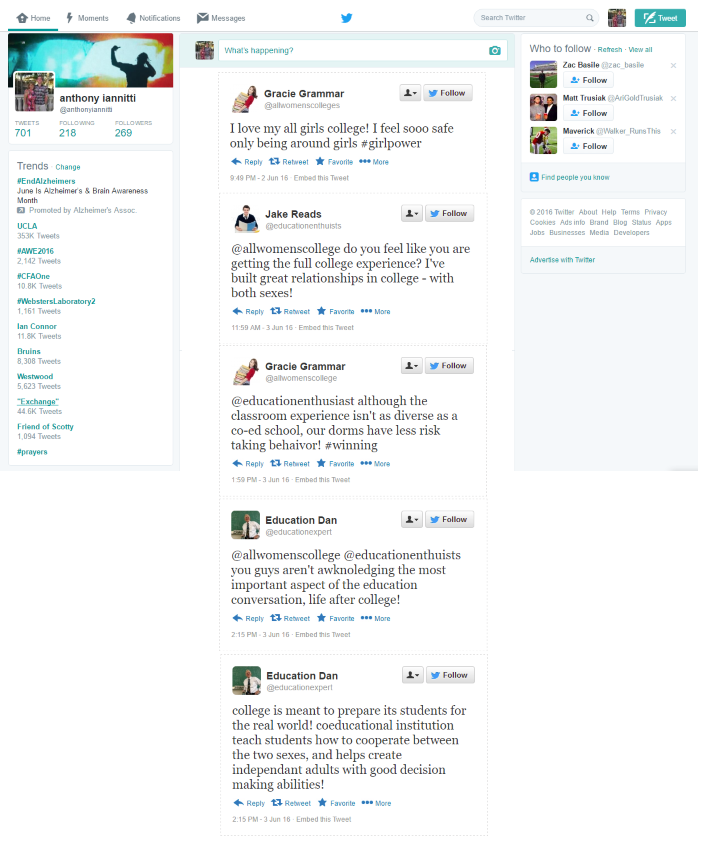
After creating a final paper, we then translated our final essay into a multimodal composition. A multimodal composition is using words, images, audio, and video to further an idea through a visual creation of the ideas communicated through a more serious piece of writing, such as an essay. For my multimodal composition, I created a fake twitter feed in which various twitter users were having a conversation about coeducation and its benefits. My multimodal composition is linked here. I enjoyed creating a multimodal composition of the beliefs I formulated in my final paper. I believe multimodal compositions are a strong way to depict ideas and arguments in a creative and easily relatable way. Multimodal compositions resonate with the viewer of the piece and help express the ideology of the composition in terms the viewer clearly understands. Multimodal compositions serve a useful and engaging purpose in the writing classroom. They serve a strong purpose in helping display content and ideas that would normally just be put in a standard, mundane essay. Multimodal compositions are beneficial and informative in the writing classroom and help to add variety to the types of ways writing is done and ideas are argued.

Reflecting on My Final Essay

While preparing to write my final essay, I worked through multiple ideas and eventually formulated what I wanted to argue in my essay and how I would prove my ideas. At first, I thought I would argue in favor of same-sex education. Eventually I realized I did not believe the arguments my sources were portraying and realized I sided more with coeducation. In addition, my conference with Professor Lueck helped me recognize what I wanted to talk about in my essay. Professor Lueck helped me realize that there was a huge gap in the conversation of coeducation verse same-sex education. I realized that those arguing in favor of same-sex education were ignoring talking about life after college.

graduation2

Coeducation is much more beneficial because it prepares students for life after college. In a coeducational learning environment, students of both sexes must learn to cooperate together in order to achieve their goals. While researching education, most of my sources did not comment on life after college. That is the research gap I planned to comment on and explore. Locating a research gap was beneficial in formulating my thesis and understanding fully what I wanted to write about in my essay. In addition, my survey results corresponded with the research gap I located which I used as real world evidence to back the conclusion I was arguing in my final essay. Overall, I believe I created a successful thesis and built an essay around a strong idea that I formulated based on research done over the quarter.