
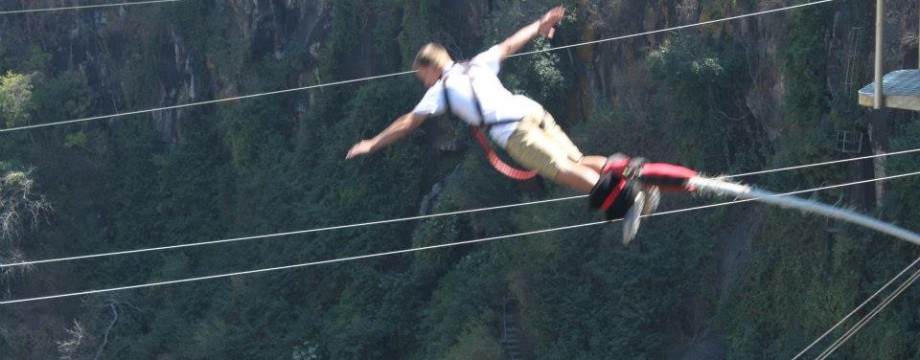
From the beginning, it was water. Water I grew up on, grew up around, grew up in. Wollochet Bay was the last thing I saw when I looked out my window before going to bed at night, and jumping in was the first thing I did upon waking up. Of course it wasn’t water that brought me here, to an inland school in a drought-filled region preparing for a project in the dry corridor of Central America. But it certainly played its part.
Gig Harbor, or The Gig as we call it, is a small, bedroom community across the Puget Sound from Tacoma. Families with young children and retired couples with grown children make up the whole town. The stereotype is that it is almost all white and upper middle class, and one of those is true. Time spent at our local food bank proved the latter to be false. Whatever the demographics, the tiny population combined with two months a year of idyllic summer weather on the water meant that several of my closest friendships were more than a decade old before I graduated high school. My dad read every Harry Potter book aloud to my brother and me, while my mom instilled in us a reluctant discipline through chores and strict rules on manners. The influence of mom, dad, and JK Rowling made up my entire worldview until our first big trip away from home.
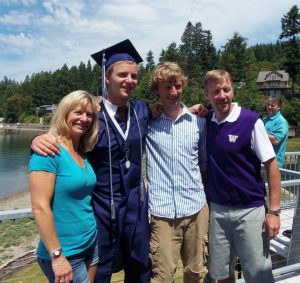
Views from The Gig, specifically my home.
The summer before I started middle school, we spent three weeks traveling Western Europe. It was probably the closest thing a family of four can get to a post-college backpacking trip. While the pace of travel, the barrage of new information, and the homesickness were enough to overwhelm me by the last week, it was my first true mental departure from my tiny corner of the map. The harbor’s bubble burst, and with it two key assumptions: a) everyone lives a similar lifestyle to me, and b) people outside the United States are intrinsically different, usually in a worse way. Almost everyone has this period of naïveté and almost everyone grows out of it, but the force with which it was snapped made me want to compensate for the time I spent in the dark.
This was an important starting point, but it was three events that happened four years later that truly set me on the course towards Santa Clara University and ultimately Nicaragua.
The first of these events took course over all four years. My Nana (what I called my maternal grandmother) passed away after a long battle with terminal, stage four lung cancer. My first experience with death at close range set in motion a certain restless, introspective energy that had been brewing since the trip to Europe. I had even tried my hand at several melodramatic, angsty poems in private, but this time my emotions were authentic and palpable. The result was the poem I read at my Nana’s funeral, which put firmly in my mind the impact writing could have.
The second event was my discovery of faith. My family’s influence on me was a mix of atheism and agnosticism, so surprisingly it was my friends that put the pressure on me to explore Christianity. I had always been doubtful of any organized system of belief, but over a week at a YoungLife summer camp I encountered the story and message of Jesus in a way I never had before. Although it changed little in regards to my morals, it certainly set a new framework for how I viewed the world and my place in it.
The final event, however, is what brought tangible evidence to this new framework. Sophomore year, I participated in a mission trip to Tijuana, Mexico to build homes for families living just outside the cartel-infested border town. Here, I had two more cliched realizations: a) humans living in extreme poverty could still have better attitudes and higher happiness levels than many of my classmates and friends, and b) I had won the genetic lottery in terms of wealth, family, and birthplace, which put me into a deep debt that, so far, nobody has asked me to repay. These are revelations I now call grace.
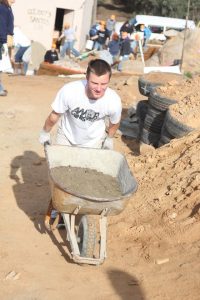
Day 1 of house building involved laying the foundation by mixing cement, which was downhill of our build site.
The mission trip was enough to motivate me to pursue fluency in Spanish and return to Tijuana the next three years. Though there was no moment of divine clarity or calling, I have consistently looked back on my time in Mexico as my defining vocational experience. I always imagined coming back years later, an educated young man with resources and influence, able to wield tools far more powerful than hammers and shovels.
Further traveling, from Turkey to Peru, Southern Africa to Belize, all reinforced this notion. Life spent wearing a suit at a desk in an office, even on the top floor of the most beautiful skyscraper, would not be satisfying if I was not working with the developing world. There was something so powerful, so raw about a place where people lived on the edge, on the margins rather than in comfort and complacency.
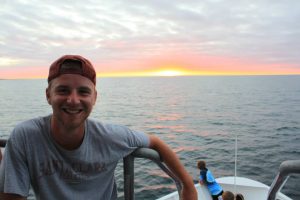
Fearlessly exploring the Galápagos Islands and still representing SCU (t-shirt and hat)
Many of these experiences have shown me that I am the beneficiary of an unjust world, but also that I can be part of the solution. Indeed, it is my responsibility, my calling, my light to shine. While in college, I have felt a burning excitement in my stomach when looking at data about economics and inequality or when writing a piece about something which interests me, but without the knowledge of where to direct this passion.
Of course, it goes back to water. Water is what I grew up on, grew up around, grew up in. Through the Global Social Benefit Institute, my focus will be to find the appropriate model to bring my lifeblood to the northern communities of Nicaragua. Maybe it was, after all, water that brought me here.