
In Management 80 we learned about something called the J curve, a concept concerning cultural adjustment. The first few days of an extended trip are full of excitement at embarking on the adventure – seeing a new place, meeting new people, and trying new things. A dip occurs a few weeks in when the novelty wears off and homesickness creeps in. Last, the traveler finds themselves adjusting, and the self-fulfillment this brings pushes them to a new high just before they leave. Up, down, all the way up. The shape of a J.
Surprisingly enough, I think Management 80 might have been on to something. Up close, this project has more closely resembled a heart rate monitor (a WW curve maybe?) than a smooth J. But zooming out, the natural arc is clear. At first, excitement drowned out most of the nervousness that came with large suitcases and long goodbyes. The first car ride through a new city or new country is always one of the highlights of a trip for me. This has been especially true in Latin American countries, where the eclectic architecture, the charming chaos of the traffic, and even the dirt roads and shanties never failed to excite me because deep down I already knew that someday, I’d be riding through a city like this on my way to work.
Now that this intuition had become a reality, I savored the trip up the Pan-American Highway from Managua to Estelí, watching passengers riding in the truck beds at sixty miles an hour, translating passing billboards in my head, and grinning guiltily at the sight of a Burger King. While the views were similar to other trips, my excitement was much more reserved. These weren’t passing spectacles – I was going to be here awhile.
The excitement bubble popped even sooner than the management textbook said it would. A mere one week in, thoughts of home and SCU dropped by uninvited when my mind was unoccupied, and the sheer number of days before I would touch American soil again finally sank in. This was partially due to the fast pace of the week-long cultural exchange trip we were on at the time. I found myself, for almost the first time, unable to stomach cultural foods such as vaho (pronounced “bow”), constantly dozing off as farmers spoke in rapid Spanish of their work with cooperatives, and lacking the energy to form cross-cultural friendships. My excuse came on day three of the exchange when David and Elia told me my voice sounded groggy. My throat had been feeling sore so David told me to check my tonsils for signs of white spots of bacteria in the mirror. When I did, my throat looked as though I had just choked on a powdered doughnut. I spent the rest of that week in bed losing fifteen pounds with a bad case of strep throat, but with the confidence that I had already reached the bottom of the J.
Since that point, we have learned a lot about our temporary hometown and country. While Nicaragua is often grouped in with dangerous countries such as El Salvador, Honduras, and even Colombia, in many ways it is safer even than Santa Clara. The most dangerous thing we do is not walking around without mace, nor is it carrying cash in a pocket instead of a fanny pack. It’s crossing the street on the way to the office in the morning, which would sound ridiculous were it not a major highway without controlled intersections.
Unlike many other countries, people here will assume you speak Spanish because that is truly the only option for communication. The local accent involves leaving out the “s” much of the time, so I’ve done my best to say things like “entonce’,” “e’tadounidense,” and even “A’DENIC,” our host organization. While my Spanish has certainly improved, and I notice myself thinking in or writing in it a veces, I have also realized how far away true fluency still is. Turning on the television, I can follow the plot of Hitch with its slightly comical voice overs, but when a Segovian man is reflecting on his youth gone by and dispensing marriage advice to me, sometimes I am at a loss for an appropriate reply because only the gist of his message crossed the language barrier. At that time and over the last few weeks, I have probably nodded and given an emphatic “Sí” of feigned understanding at some inappropriate moments.
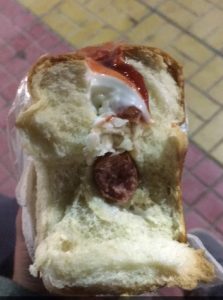
A desperate quest for American foods ends in a woefully disproportionate hot dog.
At first it was difficult to find a restaurant that served anything other than chicken, a tortilla, a thick slab of white cheese, and the cultural favorite, gallopinto (which is really just beans mixed with rice). For me, it did not take long for this to get old and I longingly opted for the most American item on the menu, which led to a string of several disappointing hamburgers. Every meal, several flies showed up uninvited, annoying us even more than the mosquitoes who nipped away sneakily at our elbows and ankles. Since then, we’ve found an abundance of charming, comfy cafés with cheap espresso drinks and an ideal mix of sweet and savory foods, any of which would be packed at all times were it near SCU. But I still almost cried tears of patriotic joy when we made it to the Burger King.
Despite our prior research into the social and economic context of the region, one factor we never accounted for was competition from NGOs. We expected bottled water and time honored rituals of fetching and boiling water for the family, but these have turned out to be non-issues compared to how many organizations have already been working on safe drinking water in the area. I remember distinctly the moment in which the thought crossed our minds all at once “Well, if all these guys haven’t solved it in this many years, what exactly are we gonna do?” If any of us still had our imaginary “We’re Saving the World” capes flapping behind us as we walked through Estelí and La Segovia, this is what took the wind out of them. And yet, a few simple emails turned these unforeseen rivals into partners, granting us interviews with several nonprofit employees who had worked on community water systems in rural Nicaragua.
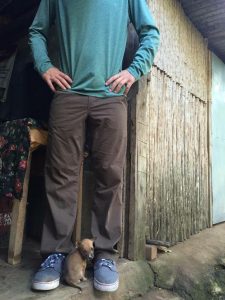
Fitting in has been a problem, even fitting into this picture. At least I’m not wearing shorts.
Another misconception I had when I arrived is that once I learned the dress and the rhythm of Estelí, I’d be able to fit in. I don’t know whether it’s the colors of my skin (the two you can find on a candy cane) or the three extra inches I have over the tallest passersby, but I still get a good amount of looks and outright stares even with my exceptionally normal dress and rhythm. Dress is easy, just don’t wear shorts. Or at least, it should be, but I love wearing shorts. Apparently in machismo culture, shorts connote femininity in men. It’s a good thing I’m so secure in my manhood.
Our lack of fitting in became extremely obvious one Saturday when we stopped at a street fair to watch two children perform a traditional dance to a questionably suggestive song. A guy about my age came up to me to see if he could ask me a few questions. After being assured that it wouldn’t take long, I agreed.
“Alright, and at the end, just say ‘Thank you to the great government.’” An alarm went off in my head as I remembered the travel warning of one day prior in which we were warned to avoid stating any opinion about the government, even a neutral one. I turned to Elia and David in desperation, hoping my eyes would communicate that we should leave. But at that moment the suggestive song ended and an amplified voice rang out through the central park of the city. Terrified, I realized it was my new friend’s voice. He introduced us as “some foreigners,” and held a microphone up to me with a few questions about how long we’d been there and what we liked about it. My blood pressure rose as I tried desperately to think of a way out, watching families look over with the mildest of curiosity at this tall chele wearing shorts. The guy asked me who I wanted to thank for the time I’ve enjoyed here. My thoughts flitted briefly to the Miller Center, my mom, anyone who could allow me to avoid giving away my forced political leanings.
“Gracias al…buen g-gobierno,” I said and inwardly flinched. But nothing happened, and we were able to escape the scene without getting followed or (as I looked behind me while walking briskly in my shorts) anyone really caring.
All blogs about travel in developing countries seem to contain a common thread: the humbling impact of being surrounded by poverty. It is for this reason that I have not yet mentioned the poverty we’ve witnessed, but it is also for this reason that I think the blog would be incomplete without addressing it. Yes, clearly, there is poverty, both the relative and the absolute kind, around us everywhere we go, whether to a rural community or an Italian restaurant. But a person can become desensitized to anything. This is obviously not ideal in terms of maintaining a sense of compassion, but it is important for the three of us to recognize that we are past the stage of being caught off guard by poverty and not stand on this pretense when talking to community members.
There are times when I look around me and can’t believe the luckiness that realized a childhood dream so soon after my childhood. And there are times when all I can think about this the time left on the clock before our plane takes off. At these times, I refocus by reminding myself of the exciting work yet to be done, the J curve yet to be climbed, and the Burger King just down the road.