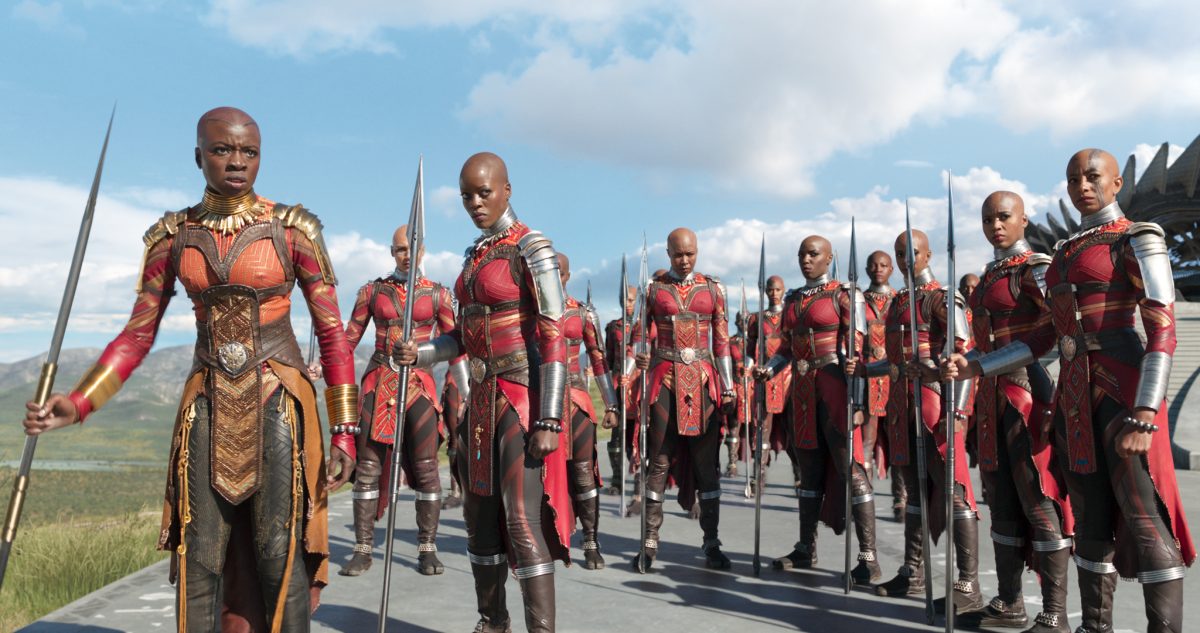
The Marvel movie “Black Panther” is an extraordinarily produced film that features brilliant actors and – even better – the destruction of countless stereotypes, one of them depicted in the image above: black women as warriors.
The Marvel universe has a tendency to star white actors in its movies; and, while embracing different cultures, say that of Americans or Russians, Black culture had not been strongly explored until the release of Black Panther. This is the first Marvel movie I can think of where a culture other than white or American is the star of the show and is appreciated in a new light. It gives its audience the ability to appreciate a culture which they may not have known a lot about, as African culture has been continually whitewashed since colonizers invaded the country many years ago.
Black Panther defeats not only the white or American stereotype of Marvel superheroes but also the stereotype that Africa may be less modern or technologically advanced than other continents. While Wakanda is not real, it allows the audience to view an Africa that does not give credit to colonists for its success and actually views white people as a bad addition to the continent than a good one.
For example, author Jelani Cobb explains the implications of the scene where Shuri, T’Challah’s younger sister, calls the white F.B.I. agent a colonizer: “When I saw the movie, the audience howled at the inversion, “colonizer” deployed as an epithet rather than a badge of cultural superiority,” Cobb says in his essay, “‘Black Panther’ and the Invention of ‘Africa'”. In this instance, Shuri is disgusted by this white man rather than afraid of him, showing a world that is Black-dominated and conquers the stereotypes of a white-dominated world that are widely accepted by society in current times.
Lastly, though there are countless more underlying meanings in Black Panther, I will explain one more stereotype: the powerful women in Black Panther defeat the societal standard of thinking that women should sit back and watch while men fight. In the film, the warriors of Wakanda are made up of exclusively women, while countless films have almost always made their warriors male. This depiction of women as powerful beings who are not discriminated against because of their sex. For example, in the final fight scene of the film, multiple of these female warriors are killed and it is not seen as any different than if it were a man dying; and instead of taking men with him to find the protagonist at the beginning of the film, T’Challah brings two women.
In conclusion, Black Panther makes many connections that take analysis and a rewatch before realization. Reading articles about the movie and watching videos that feature the directors, costume designers, or others involved in the creation of the film is a gratifying experience that educates the audience about Africa’s culture and traditions and makes the movie-watching experience just that much more rewarding.