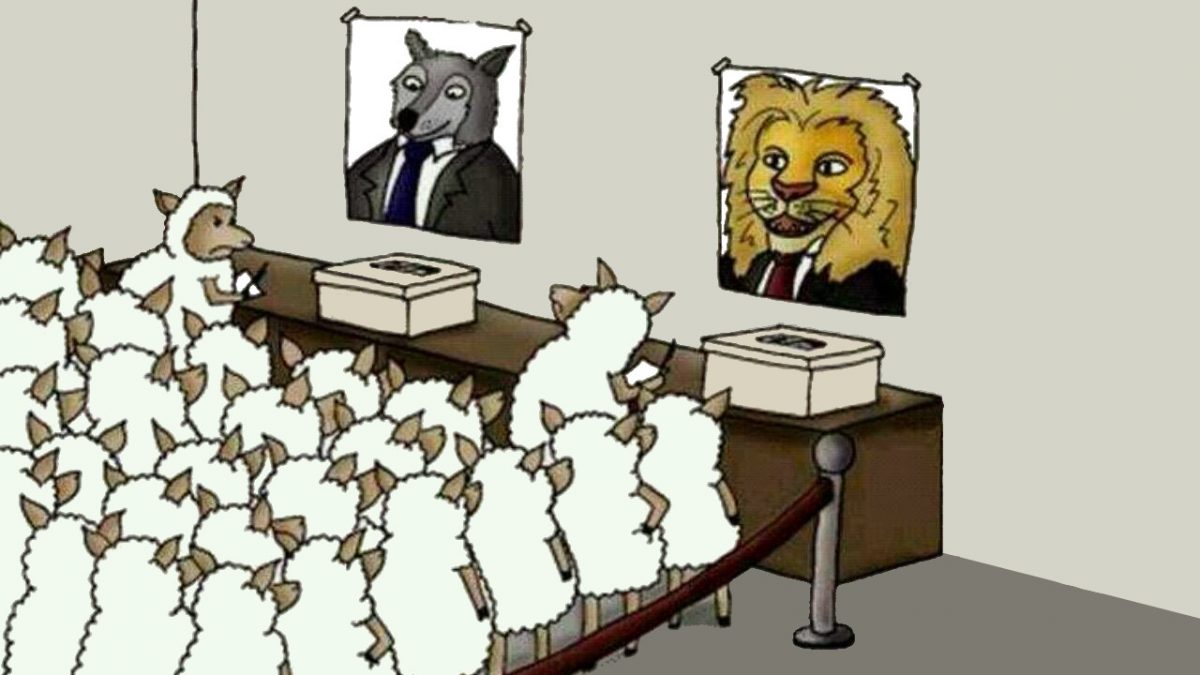
Having to choose the lesser of two evils: a conflict that nearly everyone must face on a daily basis. As you can see in the image above, many sheep are casting a ballot between a wolf and a lion. While there is no text on this image, the meaning is clear: none of the sheep want to die, but they have to choose who eats them – obviously, neither of these choices are good, but they have to choose.
I will relate this to the reading of the week: the dystopian novel The Marrow Thieves, illustrating the kidnapping and experimenting of indigenous people whose bone marrow will restore the ability of others to dream. This book is riveting in many ways; it illustrates a world that is nearly apocalyptic and not far from what Earth is fast approaching at the moment. Frenchie, the main character in the book, finds a group of indigenous people who are escaping the harvesters after his brother is taken by the marrow harvesters. Over several years, Frenchie is trained to hunt by the leaders of his camp; however, it is clear that Frenchie is more compassionate than his companions.
Now, the moose dilemma comes in. When on the hunt, Frenchie finds a moose quietly grazing before him. In this situation, Frenchie is forced to choose between two evils: whether to kill the innocent moose to feed his companions and risk wasting a large part of it, or leaving the moose alone and risking the starvation of his makeshift family.
Frenchie decides to spare the life of the moose in the end, but he faces intense debate within himself as he approaches the camp empty-handed: “Walking back to the meeting point, I swung between peace with my decision and wrenching regret,” (50). In the end, Frenchie accepts his decision when he sees that two of his peers brought back turkeys, so he didn’t have to worry about the starvation of his family. However, when faced with the Dilemma of The Moose (as I now call it), people often have to live with the regret of their choice, not knowing whether they made the right one. Frenchie got lucky this time.
When relating this conflict to the real-world, one realizes that humans must face the predicament of choosing the lesser evil nearly every single day. A less intense example would be having to choose between two restaurants that you don’t like that much for dinner or choosing whether to shower and be cold for the night, or not shower and stay dirty (beach volleyball life – and yes – I choose to shower every time).
Of course, these are modest situations when you relate them to problems that are illustrated in the novel and that are currently occurring in the real world: risking oil spills so we can have electricity, slaughtering animals so we can eat, polluting the air so our cars can have power, and draining lakes so we can have water, as well as countless more predicaments. In all, the dilemma of the moose very well characterizes the human trait of selfishness that conquers everyday life and decision-making, as well as the decisions that humans make which determine the future of Earth itself.