
Today’s blog post will be about Charlie Gillis’s controversial article, “Let’s Redefine Hero”. To summarize, Gillis uses this article to address the application of the word “hero” in a modern world. He argues that too many people are defined as heroes these days; that victims of terrorism and people doing their jobs being addressed as heroes takes away from the real heroic acts, such as the firefighters who died on 9/11 and people like Daniel Francis who crawled into a burning RV to save a young girl. Obviously, Gillis’s views are controversial, as everyone’s definition of “hero” is different; however, I will explain my stance on the topic.
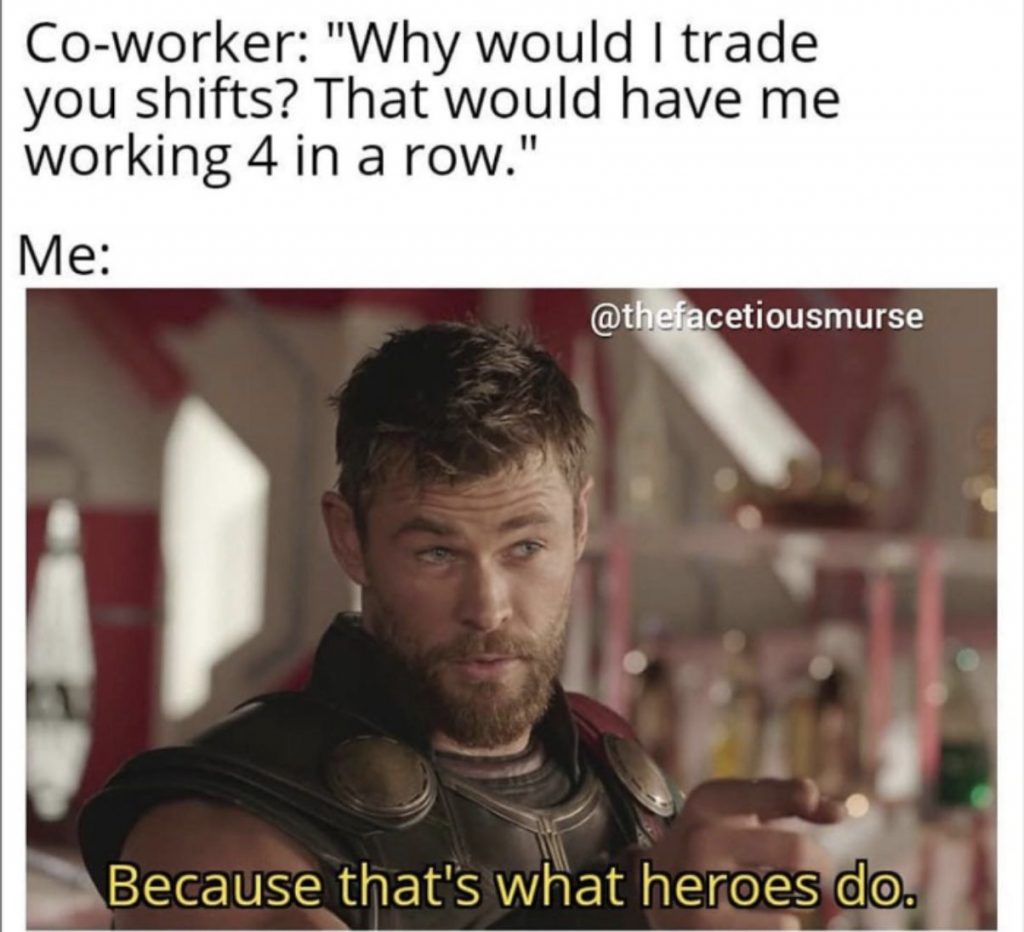
On one hand, I agree with Gillis. People are so decorated nowadays for committing simple acts of human decency. One topic I couldn’t stop thinking about when reading this article was boys. Social media has its way of honoring young men who are simply being decent. For example, parties: a boy who doesn’t spike a girl’s drink, or who takes away a drink that he knows is spiked, is not a hero. He is being a nice, decent human being. Likewise, if he didn’t take the drink away, he would be the opposite of a hero. The meme that I featured, recognizing a coworker as a hero for trading shifts, is another situation that supports Gillis’s view: trading shifts with someone is not heroic, it is nice.
While his subject is not that of boys or trading shifts, Gillis represents the same stance with his opinions on Toronto Transit Authority’s recognition of its employees for doing the bare minimum: “The acts, however, turned out to be little more than gestures of common decency — the kind we should be ashamed not to do,” Gillis noted. Of course, it’s nice of you to stop your car if a child wanders into the street, but what else would you do, run them over? I think there are actions that make people decent, and actions that make people heroic. For example, when that child wanders into the busy street, those stopping their cars to avoid striking the child aren’t heroic – they’re decent. However, the person who risks their own life to run after the child and rescue them is, plausibly, a hero.
On the other hand, Gillis made some statements that did not sit right with me. He mentioned members of the military and victims of terrorism, arguing that their recognition takes away from real heroic acts. I think most Americans agree that marines and people alike (firefighters, police, etc.) are heroes. These people risk their lives and often die to keep countless people safe, and that is undoubtedly heroic. Furthermore, there are many victims of terrorism who are heroes. Rick Rescorla was a veteran who rescued countless people from one of the Twin Towers on 9/11 before he succumbed in the collapse; Todd Beamer and other passengers on Flight 93 stormed the cockpit of their hijacked plane, crashing it into a field before it could reach the Capitol building. These are just a few examples of victims who are also heroes. Nevertheless, people can recognize others as heroes with varying degrees.

To conclude, Gillis’s article is certainly controversial and destined to arouse negative feelings in people. In my opinion, his general idea is reasonable, however, some of the examples he uses are downright wrong. While it is acceptable to not recognize certain people or groups as heroes, stating your dissent for their recognition is disrespectful. As I said in my Dead or Alive post, not everyone’s heroes have to be yours, too.