
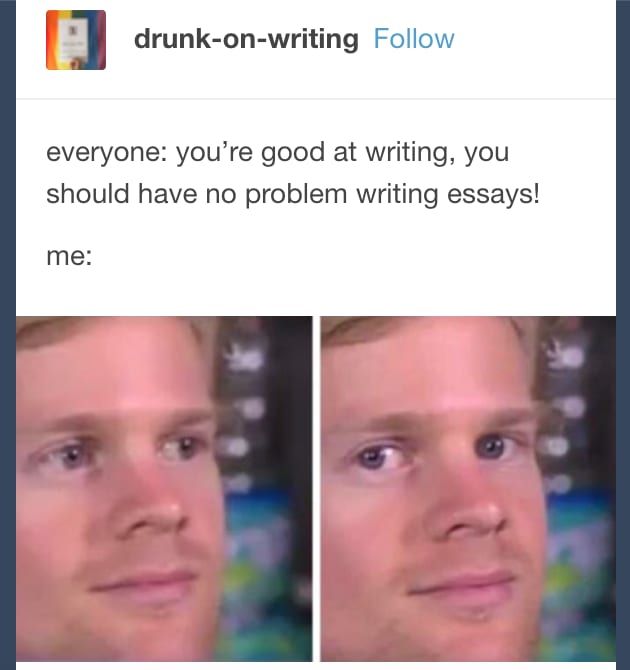
Chapter 9 of They Say/ I say led me to a great realization – I have been trying way too hard. I have loved writing since I was a child, even creating my own book in the first grade (I still have it on my bookshelf). However, academic writing has not always come so easily to me. I find essay writing to be incredibly difficult, especially when it is based on a rubric full of requirements that I’m not so sure how to fulfill. In AP history and English classes, I would peer-review essays of my classmates and bask in amazement at their writing skills; I was horrified at the same time because I believed my own work was nothing compared to theirs. After reading this chapter, I have come to understand this: perhaps it wasn’t a lack of skill that kept me from enjoying and flourishing through essay writing, but the pressure put on me from a young age by teachers saying that I had to alter my own voice in order to be a successful writer.
This chapter of TS/ IS informs us that successful essay writing, or writing in general, doesn’t have to be a different version of your own voice. Rather, it should be a combination of your everyday voice with a more academic, refined version: “It means creating a new voice that draws on the voice you already have,” (118, Graff and Birkenstein). Knowing the point that you are trying to make and communicating it effectively is reasonably the most important part of writing, but trying too hard to sound scholarly or intelligent often causes the intention to be lost in a sea of huge words that even the writer doesn’t understand; I admit, I am guilty of this.
“Translating academic-speak into everyday-speak can function as a thinking tool that enables you to discover what you are trying to say to begin with,” (125). As a writer and student myself, it’s all too true – people often don’t know the point they’re trying to make until they begin writing.
As the chapter states and as I personally believe, it shouldn’t be necessary to become a new person every time an academic essay needs to be written. Simply, it is important to first understand what you want to say, then take baby steps to alter (notice I said alter, not completely transform) the piece until it reaches its desired academic level without sounding fake – or like a sixteenth-century English playwright (sorry Shakespeare!) I know that the other students at my competitive high school were not the only ones struggling with this problem. Hopefully, in the future, teachers begin to advise their students that academic writing should have to silence your voice – it should strengthen it.