Women Leaders in Athletics

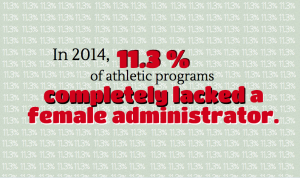
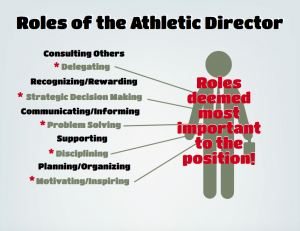
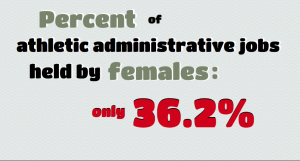
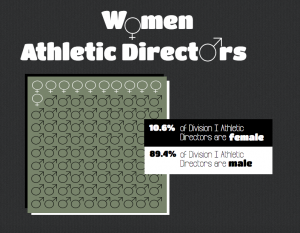
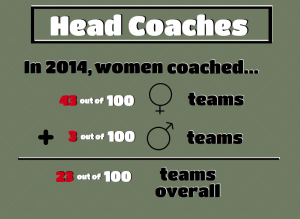
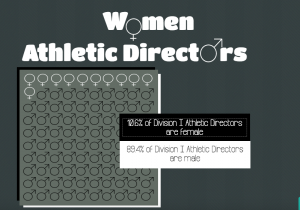
This is my last post. My goodbye. The following graphic is one I created in hopes of bringing awareness to an issue I researched in a recent paper for my CTW course.

Unfortunately I had to cut up the infographic to get it into a blog post. The best way to view it is through the below link. But without further ado I present to you my multimodal project.

HERE is the link to the infographic in it’s full glory.
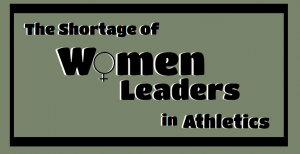
      

Is it everything you imagined? I know that I hyped this last blog post up but to be honest this took a lot longer than it looks. Getting everything to be natural to read while keeping in mind the message of the overall work is not as easy as it seems. The end product is supposed to look effortless, but I spent hours playing with hoe to arrange text, pick the colors of the text, format the shape of the text and choosing the best font.

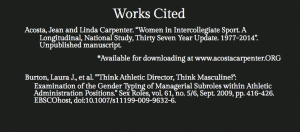
It may seem ridiculous but the font has so much to do with the tone of the piece. For example, just look at the difference between the whole piece and the works cited. I used a font that was ” all business” because it signals the audience that it is the works cited and that they don’t have a responsibility to read it.

All in all, this assignment was really entertaining and relaxing to create. As a photographer and art minor I love using visual techniques to create a message, so I used this assignment as stress relief when I was overwhelmed with schoolwork.

Hope you enjoyed my content on the blog overall!

Alaina

Posted in Uncategorized | Leave a comment

Research in CTW

We did a lot of researching this quarter…

and along with that came some reading about researching.

For example: Bizup’s article on B.E.A.M.and Klien’s article on hunting vs. gathering mode of research

Here are the two blog posts I wrote about the articles:

B.E.A.M.  and  hunting/gathering

Source: Megapixel.com

But did reading these articles help? Did I learn how to research? Yes, I would say I learned at least a little something about researching that I did not know before.

In fact, I used my researching skills in other classes already. For example, in my Cultures and Ideas II two course I had to write a researched essay. As I was attempting to find sources for that essay I found myself switching from hunting to gathering mode and back again. I also found myself identifying sources as background or exhibit sources as I found them. This was a new feeling for me because usually my researching does not have any  vocabulary attached to it.

With the articles that explained BEAM and hunting/gathering I was able to put words to what I was doing as a researched and wrote.

Now that I look back on it, the most valuable skill going forward will probably be using Boolean phrases to search databases. I had little knowledge of databases before my first-year at SCU and now I am confident in my ability to peruse them.

In addition, during the class as a whole I learned some great writing strategies which I will undoubtedly use consciously and unconsciously in the future.

Keep your eyes peeled for that last post!  Source: Flickr

Note: You may have noticed this blog is a reflection and does not bring up a new topic. Well, that is because the year is concluding and that means this course is concluding as well. I have one more blog post and then I will be done with any assignments for this blog. Stay tuned for that one because it will be a good one.


Posted in Uncategorized | Leave a comment

Essay—>Infographic

The Project:

It started with a 2200-word essay on the barriers women athletic directors face.

It ended with an infographic designed to inform teens and young adults of how few women leaders there are in athletics.

The Transition:

The path to that end was easier than expected. I knew that the purpose of my essay and my infographic would not be the same. My essay thesis simply did not lend itself to a digital and multimodal format.

If you only see my infographic, you would not be able to guess specifically what my thesis was in my essay.  To those without the essay in front of them, it would seem to be a simple “call to awareness” as I like to call it. However, my essay actually argued that we need more research on the public effect on women as athletic directors. That is to say, it was a more specific and less publicly relevant topic. So, basically I cut all of the fat and some of the muscle off of the thesis in order to create a message that I felt was best for public consumption.

The first step to eliminating the shortage of women leaders is to draw attention to the issue. If people are not aware of it, the cycle will continue. This is why my infographic is designed to inform. I am taking that first step.

The next step is to inspire young women to pursue careers in sports management. That is the call to action.

I wanted my multimodal assignment to target my peers because we are the ones that can change this. We can inspire and uplift fellow students to be a part of athletic administration. That is how we get more women in leadership positions in athletics.

Considerations:

To address the specifics of the infographic I posit the following topics…

Source: Wikimedia Commons

color: In creating the infographic I felt that black and white did not provide me with enough variety in color. I added olive to the aesthetic as the background and accent color in order to give a calm undertone to the piece.

tone: I considered using backgrounds that mimicked gym floors but when applying them I recognized that it changed the entire tone of the piece. With the floor as a background each segment became playful and it took the attention away from the statistics and therefore the entire argument.

shape: The most difficult part of designing the infographic was getting the shape. It was hard to find the shape of the text that best communicated a specific statement.


Posted in Uncategorized | Leave a comment

Momentum

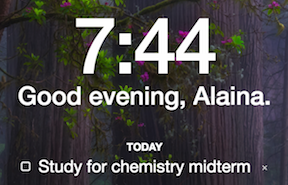
Screencapture of my Momentum page from 06/4/17

I recently discovered that many people use the Chrome application Momentum. It is basically a screensaver for your internet browser. I have been using for about a year, but I thought that it not at all popular. My sister forced me to download it, insisting it was useful and nice to have. However, I never really used it.

It was rather surprising when I saw that many of my friends used the application.

Momentum with a To Do List and a focus

What a focus looks like when one is set

Is suppose people enjoy the To Do List feature ( See image above). It seems super useful to be able to have a To Do List on the side of your screen as you are browsing the through other tabs. However, I literally never used it.  I prefer my To Do Lists on paper.

Or maybe the focus feature which allows you to set a goal for the day.

But neither of those uses were appealing to me, so it acted as a pretty image that greets me on the internet.

———

Oh yeah! I forget to mention that the images changes every day. Sometimes it is rolling hills and other days it is a dark forest. I see the image many times during the day, so I wonder if it affects my mood. For example, today’s image is drab and gives  haunted mood due to the purple tones and fog. Would my day have felt a little happier if it had been a sunny image of the cows out to pasture? Just a question for fellow Momentum users to ponder.

———

This all comes up because I am wondering why this product is popular. It has no appeal to me and I am not sure if my friends really use the functions either. I asked my roommate and she says she only uses the To Do List feature.

Whether or not we use it, it was still appealing to us at some point and we downloaded it so they have succeeded in selling their product to us. It is free but they still sold it to us in a way.

The Chrome Webstore ad for Momentum boasts that you can “Replace new tab page with a personal dashboard featuring to-do, weather, and inspiration”. It may seem useful and fun when phrased that way but it seemed useless once I downloaded it.

If you want to try for yourself here is the link to their ad. Will you be persuaded by it?

Posted in Uncategorized | Leave a comment

Multimodal Assignment

Source: Wikimedia Commons

For my Critical Thinking and Writing class we wrote a 2000-2500 word research paper on a topic of our choice. I chose to research women athletic directors. Now we are transitioning to a new project . The main stipulation is that the project is multimodal. So it could be a video, an infographic, a screencast, or an image with text overlaid. Essentially the message in your paper, or a blogpost. We must carefully design our project to target our specific audience and convey our specific message.

I immediately started to research infographics. I knew that the research I had compiled on the shortage of women athletic directors would lend itself to graphs and statistics. Through infographics I hope to be able to bring light to the subject. It is rarely discussed in the media how few women are in leadership, so I feel that it is important to draw attention to it.

This is the first panel of my infographic. I have only just started so I will be adding at least a handful more panels. When I have finished the entire thing, I hope to post it as a blog and discuss the process of creating it. But, for now I just wanted to give you a sneak-peek of what is to come.

Sidenote: I highly recommend Piktochart ( the software the above graphic was created on). Not only is it free, but the interface is very user-friendly. You can easily just go on their website to play around, even when you don’t have a specific project in mind.


Posted in Uncategorized | Leave a comment

Our Class Took a Field Trip!

That is, a field trip to the library on campus. It was pretty adventurous.

The librarian Gail, had a lesson prepared on integrating sources into our research paper. Specifically, how to introduce our sources to our audience.

Source: Pexels

The Quote Hamburger

Our professor had already introduced us to the “quote hamburger”  method which is  related to the topic Gail was discussing in the class that day.

Source: Wikimedia Commons

 The Top Bun- introduces the audience to the author

The Meat- the quote from the source

The Bottom Bun- interprets the quote in the context of the paper’s thesis

So, we had worked on introducing articles/authors before. However, the quote hamburger is a more general concept.

Getting Specific with Gail

Gail focused in on the first section of the quote hamburger. We were analyzing which information was pertinent, and important to tell the audience. Going over several examples we got a sense of what information should be included like an authors name ( if you are going to refer to the author later) and what information can be excluded (a description of a journal like Foundations of Psychology which the reader does not need explained to them).

Of course, how much you tell the audience depends on how you are using the source. If I am using Bob Smith’s article on rocket science to write a research paper on rockets, I should include his PhD in rocket science, but I don’t necessarily need to include his name.

And, if I am using a tweet on how amazing Ritz crackers are, to prove my point that celebrities love Ritz crackers then I must remember to tell my audience who the tweet is from. If I don’t tell them it is from a famous celebrity then the tweet seems irrelevant to my point.

Additionally, Gail mentioned open access journals. I had not really heard of this movement that makes articles open to anyone, without having to pay for a subscription to the journal. The researcher instead is the one who has to pay to get their work published. This is an interesting idea but in relation to quoting a source, if it is open access is important to note. It may seem arbitrary but knowing how a journal is funded influences what it will publish.

Posted in Uncategorized | Leave a comment

Source Map

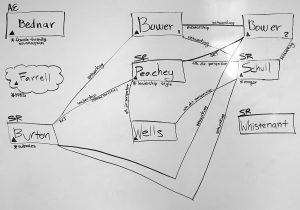
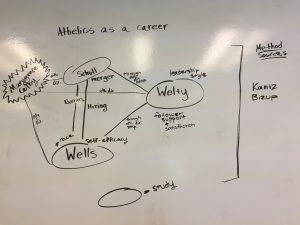
Here it is as promised! The comprehensive view of how my sources relate to one another. 

I initially thought my research paper would be something about the lack of women in leadership. It did end up that way, but as I was researching I found way more than I expected on the barriers to women becoming athletic directors. I figured there would be limited information on the such a specific subject so I was prepared to broaden my research question. In fact, though I did not need to. I ended up with enough information to address the barriers women encounter which result in a lack of women athletic directors.

The Triangles

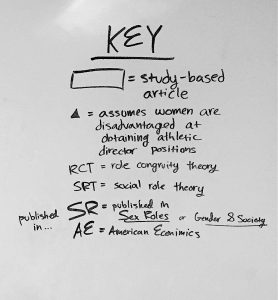
Though often dissimilar in the barriers they explore, these sources use the assumption that women are disadvantaged from achieving athletic director positions, with the exception of Whistenant (in 2003) who actually aims to prove this assumption in addition to discussing Title VII (which none of the other authors mention). I noted this with a black triangles in the bottom left corner by the author’s names.

Networking

The barriers explored within the conversation range from leadership style to lack of networking to lack of good mentorship. My sources came to no consensus on which factors are most important and some even failed to find a significant effect of their factor on athletic directors. However, there was some agreement that the lack of networking opportunities for women is a significant barrier.Namely, Burton, Bower (in both of his articles) and Schull identified this as a barrier to women in the sports management field. Schull’s case study revealed an extensive amount of gendered-politics behind one merger of women and men’s athletic departments. Though she never explicitly states that networking is a factor, the existence of the two competing groups in the study, referred to as “the posse” and “the brotherhood”, are evidence in themselves that networking has an impact on whether women are hired as athletic directors.

Posted in Uncategorized | Leave a comment

Research on the Lack of Women Athletic Directors

Source: Wikimedia

For an essay the going to write my Critical Thinking and Writing course, we were asked report in blog form on the conversation that is already happening around our essay topic.

Basically, how has academia, the public or others interpreted this topic? And what are they missing? Or where do they not connect the dots?

The Territory

My topic is, broadly, the lack of women leaders, specifically, athletic directors, including how and why this problems exists. As I read the scholarly articles on the topic, the sources made connections I had not necessarily considered previously.

For Example…

Source: Wikimedia

One case study supported the idea that there gendered politics  play a role in the process of hiring an athletic director.

Another source performed a study that the leadership style of an athletic director has an impact on perceived effectiveness of an athletic director regardless of gender.

One study provided evidence that some subroles (roles of an athletic director like networking, delegating, or evaluating employees) are gendered and those subroles perceived as male strengths are be the most important roles within the occupation.

Theoretical Framework

Though I did not have a ton of insight or knowledge on this specific topic to begin, reading these articles critically quickly brought me up to speed. As I read I made connections between these sources. And not just that they were they mostly studies or surveys. But important theoretical frameworks that they had in common like social dominance theory (SDT), social cognitive career theory (SCCT), and social role theory (SRT). These are theories that come from other literature which serve as shared assumptions of the authors. Without these theories to support the evidence, the studies would be practically useless.

The Gap

But, of the many  articles I read there was no discussion of the public view of the topic. I understand that the public has little knowledge of sports management as an occupation, but that does not void their impact on the issue.

Perhaps, the media or the sporting audience plays a role in supporting male athletic directors who tend to place more male coaches in their staff. In addition, there is certainly a conversation in the public eye about women leadership via form of women empowerment. Either of those aspects could have a significant effect (in the future or currently) on increasing or decreasing the number of women athletic directors.

Posted in Uncategorized | Leave a comment

Visual Source Relationships

In class today I created this depiction of source interactions (pictured below). I had just done a similar thing with my words as I wrote the first first sentences literature review on these sources. However, the image was a much better way of seeing the interactions between the sources, without having to stumbling over wording. As I was writing the literature review I would get stuck on trying to articulate what I meant.  Essentially, making a diagram is a more natural way for me to connect sources because I don’t get sidetracked trying to find how to say what I am trying to say. For example, I loved how I could incorporate method sources (as defined in previous articles). With creating a visual depiction I can remind myself to incorporate different aspects of articles without.
You might be thinking: “It looks a little messy”

Obviously, this map is scattered and a first draft of  the connections. So when I have more sources I hope to create a more organized, clear diagram (I will make a blog post to that when I create it). The link will appear here when I have posted it.

You might be thinking: “That’s so much work though”

Now it may seem like a lot of work to create a visual representation in addition to actually writing and researching for the essay, but this process is more comfortable for me. Rather than jumping into writing the literature view and just winging it, then having to go back and edit extensively, I can go into my writing with an idea of where I am headed.

You might be thinking: “This diagram is overwhelming” 

The only drawback that I see is there is that this web style of connections creates a complexity which does not allow for easy reading. I hope that when I create my second diagram I will have a better understanding of which connections are most important to my approach to the subject so that I can simplify the diagram and make it easier for the casual observer to understand. Yes, this diagram is for me, but I will also benefit from the simplification because it will force me to identify which parts of the sources to focus in on.

Stay tuned for the bigger, better version two!

Posted in Uncategorized | Leave a comment

Kantz Even Find the Words

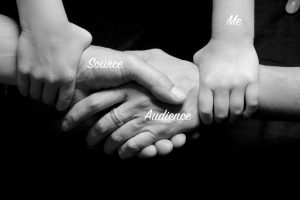
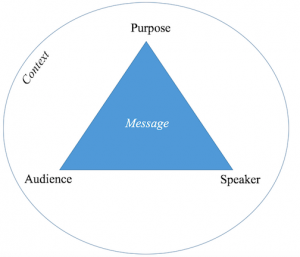
A diagram I created to show the basics of the rhetorical triangle

In “Helping Students Use Textual Sources Persuasively”  Margaret Kantz uses a college student, Shirley, as an example to showcase difficulties faced by students in writing analytic research papers. Kantz points out concepts such as the rhetorical triangle which allows students to identify the rhetorical context surrounding a piece of writing. This concept is one addressed in many angles throughout pieces discussing how to write ( as we have seen in our course in quarter one). A concept that I had not heard diction for before was “rhetorical gaps“. Meaning that there is a miscommunication or misrepresentation stemming from a rhetorical disconnect between the speaker, audience, and subject.

Source: Maxpixel

Source: Maxpixel

As I have been researching for my final paper in this class I have found a rhetorical gap between speaker and subject to be prevalent. The gaps are not large but certainly exist. Part of this is due to the fact that I have been reading studies or surveys generally.

The complexity of the subject I am researching makes it difficult to design a study which does not have a disconnect between what the researcher hopes to ask and the question the data actually answers. As with any subject on a complex subjects, there are imperfections, overlooked factors, and unsolvable problems that arise. For the most part researchers of these peer-reviewed articles are able to identify these issues.

Before reading Kantz article I did not have the diction or the frame of mind to recognize I was asking similar questions in the margins of each source. Now, I can easily identify what the gap in the research is without struggling to understand my issue with the source. To use diction we explored in one of my previous articles Kantz will be a method source for my final paper.


Here is the Kantz piece in College English

Posted in Uncategorized | Leave a comment