
My original question when beginning this project was “How does one maintain online popularity?” What I didn’t realize was that the online presence across multiple forms of social media is the driving force behind the success of many popular YouTube channels. It is the ability to connect with fans over so many different platforms that propels certain individuals and groups to internet fame. The more they see a YouTube video, or hear people talk about it, the more willing they are to take part in supporting the channel’s popularity. From my research, I have shown that the wider the social media base for YouTube channels, the more likely they are to gain subscribers quickly, and for an extended period of time.
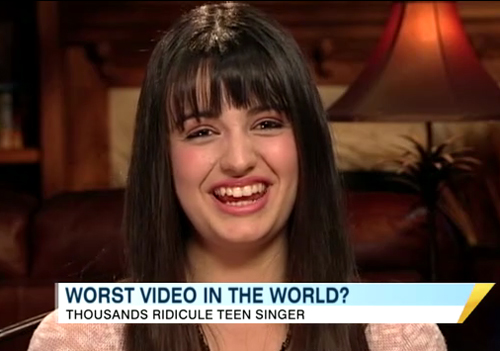
Screenshot from The Today Show regarding the negative response to Rebecca Black's video, "Friday"
My research also showed that although one may be able to quickly gain fame online, it may not be such a positive thing. For all of the fame that Rebecca Black has gained through YouTube subscribers and the general population that watches her videos, she endures ridicule and hate. Many of the comments I observed on the numerous videos that I watched from all nine channels that I observed were filled with hate speech and attacks that seemed to have little or no justification.
Is it worth the internet fame to be put under such ridicule? In David C. Giles and Donna Rockwell’s article, “Being A Celebrity: A Phenomenology Of Fame,” they argue that these negative attacks are outweighed by the psychological effects of fame. However, I think that because the internet has very few censors, internet celebrities are much more subject to attacks and harmful speech.
As a digital citizen, I think it is important to respect the boundaries and courtesies that the internet does not necessarily require. An internet celebrity may spread themselves across many social media platforms and reveal personal information in an attempt to connect with fans. However, I do not think this is an open invitation for social media users to be proponents of negativity and ridicule.
Through this research, I have learned mostly about the connection that social media platforms give to all kinds of people. They can make remarkable connections among bloggers with a strong message. For example, Tyler Oakley has used his online notoriety

Screenshot from one of Tyler Oakley's videos where he works with the Trevor Project at a gala for advocates of LGBT rights.
to work with organizations like The Trevor Project to help fight for LGBT issues. Musicians can reach fans across the world that might not ever be able to attend a show and viral videos can give everyday people a shot at celebrity. It is our responsibility as digital citizens to not only take advantage of the opportunities, but also to use them to spread acceptance rather than hate.