Vocational Imagination from GSBF

CR.weaving

Discovering myself more through the Global Social Benefit Fellowship (GSBF) at Santa Clara University (SCU), I have been asked three questions: What brings me joy, What am I good at, and Who needs me? I believe the answers to these questions can be found in my reflection about what I have taken away from this fellowship.

After nine months of involvement with the Global Social Benefit Fellowship, what will I take away from it? Well to start off, it has made me look at the world differently than a year ago. The people, places, and education I have learned did enlighten me to see and act in a new way. The fellowship has introduced me to new approaches on how one can promote greater social benefit in out world. The GSBF has definitely enhanced my education to delve into various social justice issues that I have been passionate about reducing or eradicating. From previous participation in SCU’s Casa de la Solidaridad study abroad program, I encountered terrible poverty and oppression for the first time. As president of my high school’s Mission Haiti club, I was indirectly affected by poverty through our deliveries of homemade friendship bracelets and school/medical supplies. From my involvement with Homeboy Industries in Los Angeles, CA, I learned about the importance of human dignity from the issue of gang violence. These social justice issues and many others continue to affect social structures and interactions. However, that just gives us more reason to fight these problems with creative and innovative strategies for greater change.

Through research, discussions, and fieldwork observations in a developing country, I have been inspired by the intellectual thought and wisdom learned. Two books that the fellows and I read are John Elkinton’s Power of Unreasonable People and Chris Lowney’s Heroic Leadership. Each one of these books has been insightful, expressing new and innovative ideas for passionate leaders in our world. From The Power of Unreasonable People, I learned that we all have the ability to promote change that may be askew from the norm. As George Bernard Shaw once stated, “The reasonable man adapts himself to the world, the unreasonable one persists in trying to adapt the world to himself. Therefore all progress depends on the unreasonable man.” Whether it is proposing a risky opportunity or an unconventional business strategy, we should have confidence in its success and to not let others trample over our different or crazy ideas. We are in the age of new thinking and new ways of solving social, economic, and environmental issues, so why not walk, or better yet, lead down that path of positive change for future markets. Now is the time to start learning from, partnering with, and investing in these people who are changing the way societies can better function and interact in the world.

From my fieldwork in the Philippines, the fellowship gave me the opportunity to view emerging global issues with a new eye. I was not only exposed to poverty with an unequal gap between the rich and the poor, but I also witnessed empowerment, self-sufficiency, and community building. Working with Rags2Riches, Inc., I learned to be touched by my experience. There, I met Filipinos who challenged my perspectives of the developing world and social issues that continue to be prevalent.

To reflect on a few points from Heroic Leadership, I have learned to never stop learning and asking questions as two fundamental practices of being a leader. When we question opinions about a certain topic, it can help us either solidify or change a little of what we first believed. There are many types of leadership strategies that can be developed, but it is the confidence and perseverance of a leader than will make it thrive and put into positive action. Also from Heroic Leadership, I learned to surround myself with Jesuit values that will compliment my personal and vocational goals. I must be humble in what I do, respectful of the people I may affect, and grateful for the opportunities I am given. I have learned that it is healthy to take risks that are out of my comfort zone. New and different opportunities may lead me down a path that I want to pursue in life, and it was a result of that risk taken. The Jesuits also embraced change, yet they remained rooted in Jesuit values of self-awareness, ingenuity, love, and heroism. Self-awareness can be linked to ingenuity in the corporate world. If one is seeking a corporate ingenuity through business strategies, it is important to be self aware in three aspects. First, one must know their personal and fundamental values that are nonnegotiable. Also, one should not be bias to a subject with unhealthy attachments and therefore have no room for compromise. A third nugget of wisdom is to have the confidence to seize new ideas, viewpoints, and approaches that can shine light on our world’s most pressing issues.

This fellowship has allowed me to investigate the interests and passions of my deepest self, to then be projected into my actions with others in the world.

As an advocate for greater social benefit, I want to energetically take on challenges with trust and mutual support. If I stick with my core values and social justice issues that really ignite my fire, then truth, joy, and love will continue to stay with me no matter what happens in life.

As a travel bug, I want to keep exploring new places and taking risks that will enhance my education and passion for new life adventures. I crave for new ways of living and engaging in our world, through different cultures and languages, and through new frontiers of natural beauty.
Posted in Uncategorized | Leave a comment

Finding Joy and Empowerment in the Philippines

Inspired by Fr. Greg Boyle, S.J.’s interpretation of Dorothy Day’s “Duty to Delight” from Tattoos on the Heart, we are “to be watchful for he hilarious and the heartwarming, the silly and the sublime. This way will not pass again, and so there is a duty to be mindful of that which delights and keeps joy at the center, distilled from all that happens to us in a day.”

Here in the Philippines, I have felt a “duty to delight” with the Filipinos I meet. I’ve been trying to reach out to new people and possibly make some genuine connections. Even though I barely know the Tagalog language, I’m glad most of them here speak English.

With Filipinos, it’s been fairly easy to talk to them and make some friends, both on the Ateneo de Manila University campus and in other communities around the country.

I’ve even learned to embrace some humorous moments with students, such as helping one another shoo a fuzzy caterpillar, gecko, or moth out of some rooms on campus. It’s definitely important to appreciate the little moments of laughter and positive energy that can help us bond with one another.

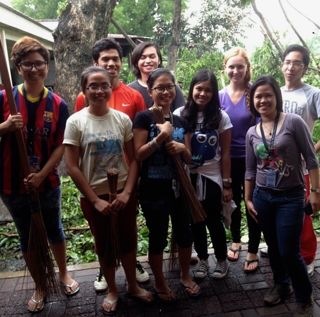
During about a week when I was housed at Ateneo, a major typhoon hit metro Manila. It definitely taught me how to bond with people I don’t know or just met, and also to cope with difficult situations with a hopeful spirit. The night before it really hit, the storm was starting to get really loud and it woke me up around 1am. I couldn’t fall back to sleep and was starting to get scared. The doors and windows were starting to shake from the strong wind. I usually shared a room with another fellow but she was gone at the time. I didn’t know how to prepare for the typhoon or really what to expect of it because the Filipinos whom I talked to were pretty vague and didn’t feel that alarmed by it (probably because they expect these every year).. So what I did was try to move my bed toward the thick wall to protect me from the four windows I had, in case water would come through or even shatter. I sat behind that wall (leaving room to open my bedroom door to the hallway) and had my flashlight, a book, and emergency phone to pass the time. At around 6am, the storm was getting stronger and rain was pouring down like crazy. Fortunately, the girls down the hall (whom I didn’t really know that well yet) knocked on my door to check on me. I saw many people in the hallway and then the floor with lots of water. About 30 min later, water rushed through my room from the balcony door and the screens of the windows. I, with the wonderful help of the other girls, had a mini panic attack and then quickly realized to grab all my stuff (electronics first of course). The four girls who lived next door to me were super sweet and let me put my stuff in their room. Both in the hallway and in my bedroom, we all helped sweep, mop, and fill buckets of water all over the floors. My room was in the worse condition because I was housed on a corner with windows on both sides and a balcony. The winds from the typhoon aimed right in the direction of my bedroom…oh how lovely. But from that frightening experience, I bonded with those four girls in their room: sharing snacks, playing monopoly and having 3 sleepover nights. Even though they are Freshmen and I am a Senior, it didn’t matter and we ended up becoming great friends. We still spent time together after the typhoon and constantly asked each another how we are doing. I’ve learned that Filipinos are so friendly, approachable, hospitable and overall wonderful people. As a result, that experience was a blessing in disguise for me. Below is a picture of some Ateneo students and myself cleaning up the debris of the typhoon’s aftermath. Roads and walking paths were completely covered with fallen trees and branches, but were fortunately cleared out with the help of some caring hard workers.

typhoon cleanup

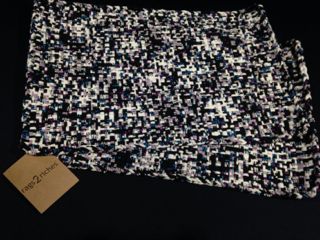
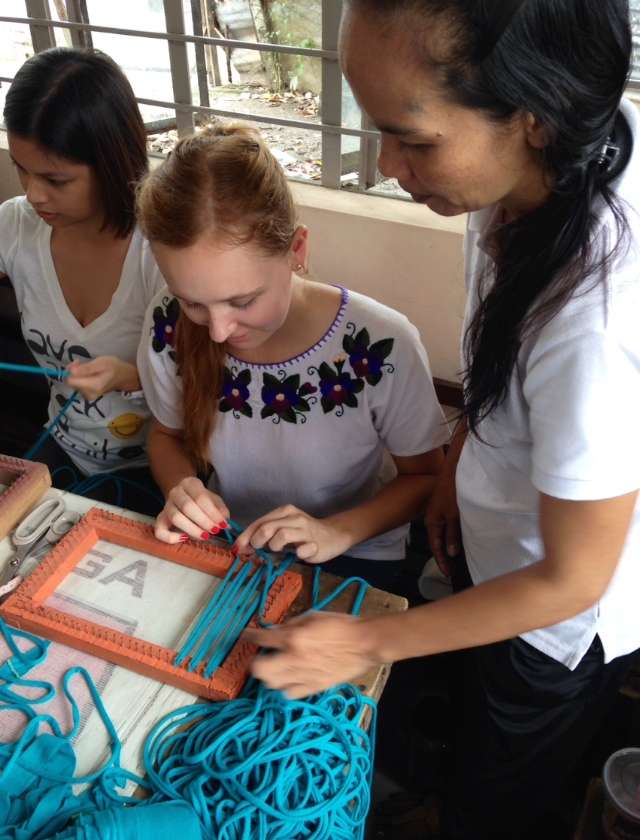
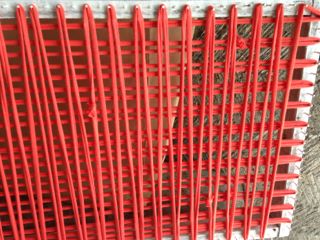
Through my internship with Rags2Riches, Inc. (R2R), I visited both the workshop and the impoverished communities of artisans that are connected to this social enterprise. There, I’ve been asking beautifully smiling artisans about their families and their involvement with R2R. It’s been amazing to listen to them share about themselves and how Rags2Riches is positively contributing to their livelihood development. In addition to our conversations, I also observed how the artisans hand-weave eco-friendly and fashionable products such as rugs, purses, and household accessories. They not only get paid by the product, but they are also connected to a variety of services and resources to improve their quality of life. Some examples that the artisans can receive are food security options, healthcare services, home loans, household items, savings accounts, and financial literacy. The two pictures below illustrate what a first stage and final stage of a production process looks like, from weaving specific patterns on a panel to passing quality control.

orange weavingr2r rug

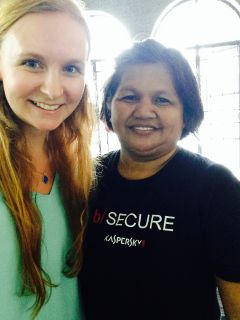
Whether it’s coping with the humidity, natural disasters, poverty, marginalization, injustice, it’s remarkable to see the Filipinos so resilient while smiling and singing in the streets. The woman in the picture with me below is named Ate Nhing, as the first Rags2Riches artisan from the community of Payatas. In what was once the largest waste site in the Philippines, she had gathered used scrap materials in Payatas to create useful products that could hopefully be sold. Luckily R2R founders met her and put her on board as an artisan leader for the social enterprise. I was honored to meet Ate Nhing with her constant spirit of joy and hope.

ate nhing

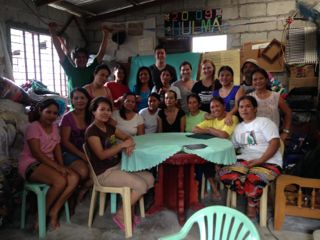
Some of my observations in the field had artisans expressing an inspiring attitude to focus their energy on a positive outcome, rather than a downward spiral of hopelessness on daily life struggles. It was evident that, through their work with Rags2Riches, they want to improve their current lifestyle to better support their family members. The picture below is of our last visit to the community of Hulma. Right when I walked into their home, I was overwhelmed by their bundles of energy through conversations and sharing of meals.

hulma

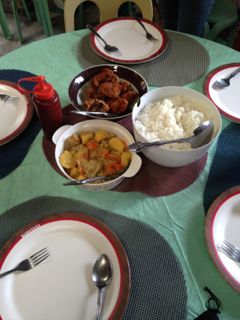
Below is a picture of fried chicken, vegetable curry, and rice from the Hulma community, as our first of two lunches that day. By the end of the visit, I was happily stuffed by these authentic Filipino meals.

r2r hulma food

I have come to realize during my time in the Philippines that there is much delight to be found. The Filipinos are very hospitable and absolutely love food. I often hear them ask, “Have you eaten?” It’s great; they really seem to care about each other and even foreigners of fare skin and strawberry blonde hair like me. One weekend after the typhoon, I was invited to Mass and a family dinner at a friend’s home. It was such a nice surprise to join them and learn about their family.

My experience in the Filipino culture and my work with Rags2Riches has indeed contributed to my vocational discernment.  It has further enhanced my passion to tackle social justice issues with enterprises that can hopefully benefit society in a more sustainable way. Lessons I have learned are to be in the present moment with where I am and who I am with, to be aware of my talents and weaknesses, to integrate both humility and compassion for others, to build a community where all members can flourish and empower one another, and also to continue to improve my local and global perspectives.

Posted in Uncategorized | Leave a comment

Being More Positive, Even When It’s Difficult

I grow
from falling,
from failing,
from struggling,
from learning the hard way.

I know that it will
make me stronger,
make me appreciate life more, make me see beauty more, make me love more.

I’m glad to be pushing myself to have more experiences that may be more difficult for me, such as my time in the Philippines.
But what keeps me going is my faith in God, my family, my friends, and the people whom I journey with. It’s important to have a support system and to know that you are never alone in whatever you do.

Remembering what Fr. Pedro Arrupe, S.J. (Former Superior General of the Society of Jesus) once said,
“Nothing is more practical
than finding God,
that is, falling in love
in a quite absolute and finite way.
What you are in love with,
what seizes your imagination,
it will affect everything.
It will decide what will
get you out of bed in the morning,
what you will do with your evenings,
how you will spend your weekends,
what you will read,
who you know,
what breaks your heart,
and what amazes you with joy and gratitude.
Fall in love. Stay in love.
And it will decide everything.”

Life is about finding your truest, most genuine, most sincere, most honest, most caring, most loving self. I definitely have ways to go before achieving that best self, but I hope to be on that path.

Posted in Uncategorized | Leave a comment

Vocational Discernment

Opening Doors to Happiness

Ever since I was a young girl, I’ve always had an ignited spirit to seek a greater sense of happiness in my life. As my curious mind developed over time, I came to realize that I love learning from people of different backgrounds than me, such as race, ethnicity, culture, religion, language, and socio-economic status. I believe that a possible explanation for this curiosity is having the privilege of growing up with many special opportunities that have valued diversity and human dignity. As His Holiness the Dalai Lama once said, “We cannot be happy ourselves without thinking about the happiness of others.” I support this statement because I tend to be happier when I experience the happiness of someone else, sharing in that happiness together. With a major in sociology, I naturally think about others in terms of their role in society through a cultural and structural context, as well as their connection to me. Also, with a minor in religious studies, I try to incorporate my Catholic and Jesuit values as a foundation to my sociological interest.

From family relationships, I have been exposed to Hispanic realities at Dolores Mission Parish and School in the Boyle Heights community of Los Angeles. There, I have been welcomed by their friendship and to attend their Christmas morning Mass with homemade tamales. This community continues to inspire me to fight for injustice, especially about the limited opportunities offered to them as a result of their ethnicity and their high presence of gang violence. As former pastor of Dolores Mission, founder and director of Homeboy Industries, and dear family friend, Fr. Greg Boyle has been an inspiring role model for me to value the dignity of each human being, regardless of past mistakes or even crime records.

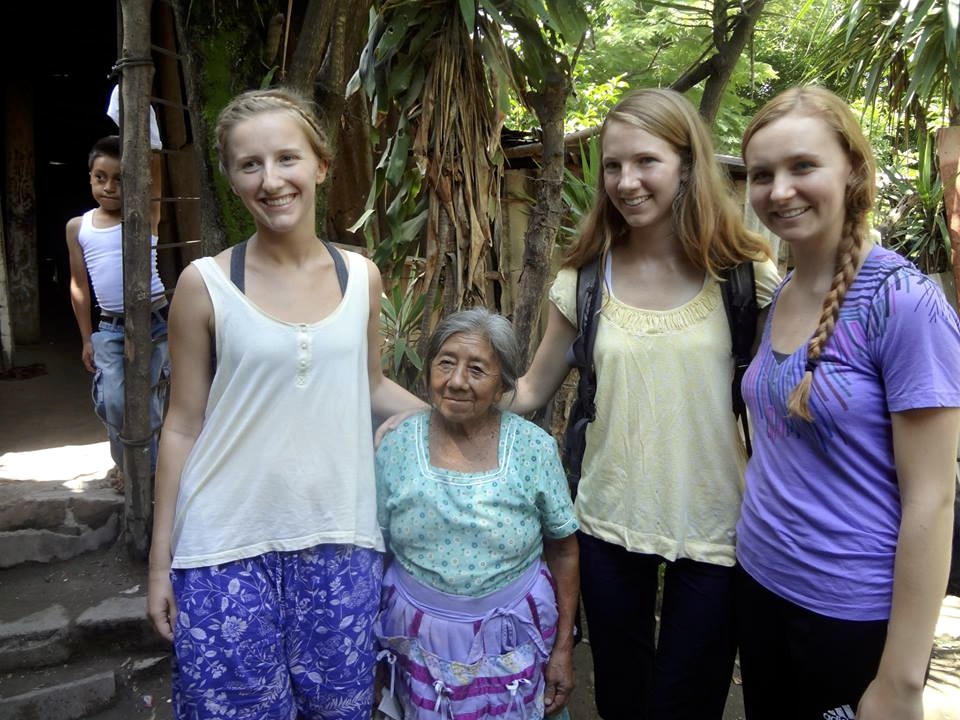
Another opportunity that exposed me to a different culture was my study abroad experience in El Salvador this past fall. There, I was given an opportunity to detach my comfortable, middle-class, American lifestyle and engage with families in various rural communities. Living without electricity, running water, and sewage system in shack homes on a volcano, I stepped into the Salvadoran reality of extreme poverty. There, I witnessed many people in the community of Las Nubes, even strong women in their 80s, who carry firewood, water jugs on their heads, and baskets of corn and coffee beans from local fields. Receiving ridiculously low wages, they work so hard to pay for their needs. Yet in the midst of these physical struggles, it is absolutely incredible when all of the families support one another as one big community by sharing food, supplies, and confianza (both trust and genuine love). In addition to my observations as an foreigner, I have enjoyed physically accompanying the families such as listening to their testimonies, sharing smiles and laughs, taking trips to local water tanks, washing dishes with them, shucking corn off the cobs, and making pupusas (thick corn tortillas with beans and cheese inside). Spending four months in this community has given me a more thorough experience of what life is like in such poor conditions.

C4

But how am I suppose to feel after that experience? Guilty for my privileged, American lifestyle? A desire to fix all of their problems? How does this relate to my future goals? I definitely have more questions than answers about the world of the poor and its connection to me. However, these healthy feelings of curiosity or frustration help me to reflect and then to develop a broader perspective on past and current situations. As of now, one lesson I have learned is having genuine and authentic relationships. These relationships incorporate a Salvadoran “confianza” with actions of honesty, openness, and vulnerability toward family and friends. It may not be the easiest, but it is one of the most important actions for me to express in daily life and future endeavors.

It humbled me with immense gratitude to be in the presence of the families of Las Nubes, and to also be a witness to their incomprehensive struggles to survive. These families have generously taken me into their homes as one of their children. Before going, I was a bit nervous about how they would react toward a white, blond-haired American girl with a different culture. Yet, I was shockingly welcomed with warm hugs of friendship. Their infectious love fills me with joy and inspires me to live in ways that are life giving.

Also in El Salvador, I tried to practice the themes of Catholic Social Teaching, such as respecting the life and dignity of each person, participating in various communities, creating an option for the poor and vulnerable, and living in solidarity with others regardless of race, ethnicity, religion, or socioeconomic status. I also tried to live out the Jesuit Tradition that is one of SCU’s educational components. As Santa Clara University’s 1983 Commencement speaker, Ignacio Ellacuria, S.J. as former rector at the University of Central America, where I studied in Fall 2013, stressed the need to “communicate…a consciousness that inspires.” 1 That transformational opportunity has inspired me to have an international perspective to fight for greater social benefit in our world. It also has allowed me to bear witness to testimonies of oppression, as well as stories of extraordinary joy.

However, shifting a bit from service learning to action research, I am extremely excited for a new kind of opportunity, that of which I know will emulate happiness for me and for others. Through Santa Clara University’s Global Social Benefit Fellowship, I am confident that it will provide me with greater awareness and knowledge of life struggles in marginalized communities of the world. In connection to my social justice passion, I have fallen in love with the Fellowship’s mission that strives to give students an incredible opportunity to learn and teach social entrepreneurship skills through Jesuit values and social justice practices in a developing country. As a “woman for others” in this Fellowship, I am interested in an action research that demands affordable resources by analyzing components on the development of social and economic operations. With the goal of lifting Filipino artisans out of poverty in the Philippines, this action research will strongly empower me to achieve my career goals of promoting sustainable development and self-sufficiency through compassionate reason.

Over the course of my journey with the Global Social Benefit Fellowship, I hope to make more sense of my difficult questions of injustice and different experiences as pieces of my life puzzle.


Endnotes:

  1. “The Jesuit Tradition at Santa Clara University.” The Jesuit Tradition at Santa Clara University. http://www.scu.edu/Jesuits/main.html. Web.
Posted in Uncategorized | Leave a comment

Hello world!

Welcome to Blogs@SCU Sites. This is your first post. Edit or delete it, then start blogging!

Posted in Uncategorized | 1 Comment